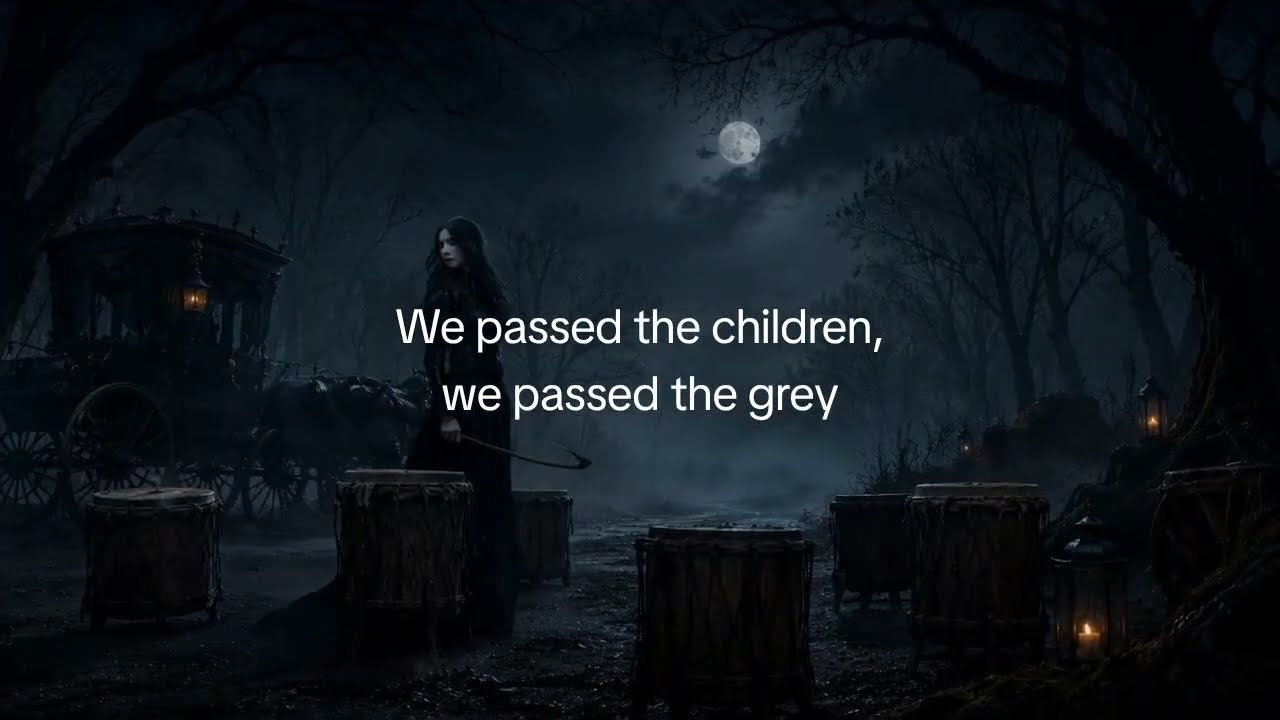
How Emily Dickinson’s famously courteous carriage ride with Death became gothic darkwave — preserving the poem’s calm surface while making the unsettling idea underneath it impossible to ignore.
WRITING THE SONG
The remarkable thing about Emily Dickinson’s “Because I could not stop for Death” is that Death does not arrive like a monster.
He is polite.
Patient.
Almost considerate.
The speaker is too occupied to stop for him.
So he stops for her.
That reversal was the natural starting point for Because I Couldn’t Stop.
A conventional death song might begin with fear.
Running.
Resistance.
A final struggle.
Dickinson begins with something closer to an appointment.
A carriage arrives.
The speaker gets in.
And the journey begins.
That quietness is what makes the poem disturbing.
Death does not need to chase anyone.
He already knows the passenger is coming.
The Rhialto version therefore works better when Death is not treated as a violent intruder.
He should feel inevitable.
Calm.
Almost courteous enough to make the listener forget what is happening.
That gives the song its central tension:
the most frightening person in the scene is the one behaving most politely.
The title Because I Couldn’t Stop deliberately shortens Dickinson’s opening idea.
The missing words matter.
Because I couldn’t stop—
for what?
For whom?
The listener already knows.
Leaving Death out of the title makes him feel even more present.
He does not need to be announced.
The carriage is already waiting.
Dickinson also places Immortality inside the carriage.
That strange detail expands the scene beyond a simple personification of dying.
There are effectively three travellers:
the speaker,
Death,
and the possibility of what comes afterward.
That makes the journey less like an execution and more like a transition whose destination is not fully understood.
The carriage moves slowly.
That is essential.
There is no urgency because Death has none.
Time belongs to him.
The speaker passes scenes associated with ordinary life:
childhood,
work,
the landscape,
the setting sun.
Everything continues outside the carriage.
The world does not stop simply because one person is leaving it.
That is one of the poem’s coldest ideas.
Death is enormous to the person experiencing it.
To everyone else, afternoon continues.
Children play.
Fields remain.
The sun moves.
The carriage passes through all of it.
For a gothic darkwave interpretation, that suggests motion without escape.
A steady pulse.
Repetition.
Something almost hypnotic.
The rhythm can keep moving forward while the emotional temperature gradually drops.
The listener should feel the carriage advancing even when very little appears to happen.
Because that is exactly the point:
nothing has to happen anymore.
The decision has already been made.
The passenger simply has not fully understood it yet.
The poem’s treatment of time becomes increasingly strange.
What begins like an afternoon journey eventually expands beyond ordinary measurement.
Hours and centuries become difficult to distinguish.
The speaker looks backward from a point far beyond the moment of death.
That perspective is one of the reasons the poem remains so unsettling.
The narrator is telling us about her own death as though it were something she remembers.
Not something happening now.
Not something she fears might happen.
Something that happened long ago.
That gives Because I Couldn’t Stop an unusual vocal position.
The singer does not need to sound terrified.
She can sound as though she already knows the ending.
That works particularly well for Vesper Mourdant.
Her darker material is often strongest when the supernatural is treated as familiar rather than sensational.
The disturbing thing is not a scream.
It is recognition.
Death arrives.
She knows who he is.
He has been expecting her.
And apparently he has excellent manners.
The poem also avoids giving the reader a reassuring explanation.
The carriage is moving toward eternity.
But eternity is not described.
Dickinson leaves the destination outside the frame.
That restraint is useful musically as well.
A song based on this poem does not need to resolve into heaven, hell or oblivion.
The power lies in remaining inside the carriage.
The listener gets the journey.
Not the answer.
That is why the central emotional idea of Because I Couldn’t Stop is not really:
I am afraid of death.
It is closer to:
I finally understand who has been riding beside me.
And by the time that realization arrives,
the carriage has already gone too far to turn around.
SOURCES & REFERENCES
Source status applies to the referenced material, not to the original Rhialto song.
Public-domain literary source
Rhialto reinterpretation
Because I Couldn’t Stop is a gothic-darkwave reinterpretation rather than a direct musical recitation of Dickinson’s poem.
The shortened title, Vesper Mourdant performance, darkwave treatment and emphasis on the disturbing politeness and inevitability of Death are Rhialto creative choices.
The central approach is to preserve one of the poem’s strongest contradictions: Death behaves gently while doing something absolute.