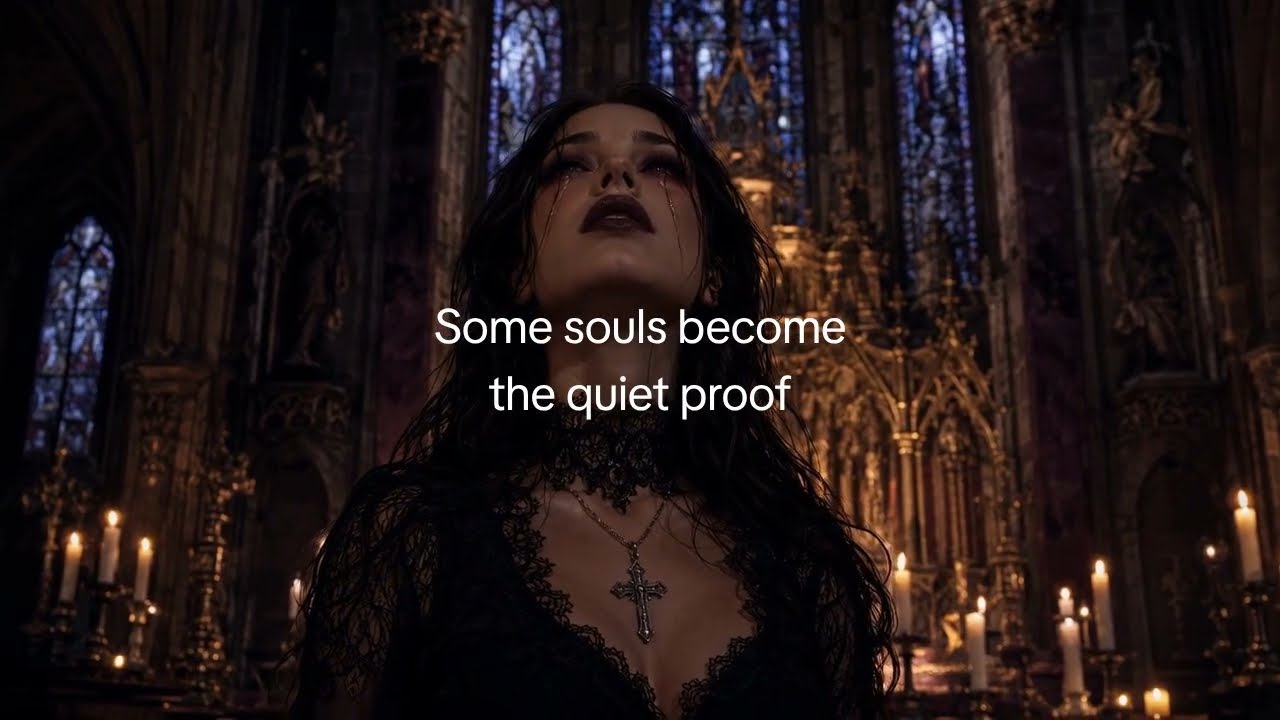
How a familiar blessings-versus-lessons saying became Vesper Mourdant’s cinematic darkwave reflection on faith, betrayal, boundaries and release.
WRITING THE SONG
Some people arrive gently.
Others arrive like storms.
At the beginning, both can look like love.
That uncertainty became the centre of Blessings and Lessons.
The song is not interested in the comforting idea that every painful experience was secretly good for us.
Some things hurt because they were harmful.
Some people betray us because they chose to.
Some wounds teach us something without becoming blessings simply because we survived them.
Vesper’s answer is more complicated:
“Some blessings only look like blessings afterward.”
And some lessons should never be mistaken for blessings at all.
The original concept grew from the widely circulated saying that some people enter our lives as blessings while others arrive as lessons.
It is often credited online to Mother Teresa, but that attribution is uncertain and should not be treated as established.
What interested me was not the authorship of the saying.
It was the neatness of it.
The phrase divides people into two categories.
Blessing.
Lesson.
Real relationships rarely make the distinction that easy.
A person can feel like a blessing and become a lesson.
A painful relationship can teach you something important without making the pain necessary.
And someone who hurt you does not automatically deserve gratitude because you eventually became stronger.
That tension became the song.
There is a particular kind of reassurance people sometimes offer after something painful:
Everything happens for a reason.
You were meant to learn from it.
It made you who you are.
Those ideas can be comforting.
They can also become ways of explaining away harm.
Blessings and Lessons pushes against that.
Vesper wants meaning.
She believes there may be meaning.
But she does not want meaning badly enough to pretend cruelty was kindness.
That distinction mattered from the beginning.
The song can recognize what suffering taught her without thanking the person who caused it.
Growth belongs to the survivor.
It does not retroactively justify the wound.
There is also a quiet faith running underneath the track.
Vesper is not singing from a position of simple certainty.
She can believe in God while still resisting explanations that turn every terrible event into part of an obvious plan.
That makes the spiritual element more interesting.
The question is not:
Do I believe?
It is:
What do I do with belief when the explanation does not satisfy me?
The cross imagery in the visual world works within that tension.
It represents faith.
It does not provide an answer.
The song leaves room for God without pretending that understanding automatically follows belief.
Sometimes faith exists beside the unanswered question.
One of the central emotional problems in the song is timing.
We usually do not know what a relationship means while we are inside it.
Someone arrives.
We trust them.
We make room.
Only later do we understand what the relationship actually changed.
That is why the line:
“Some blessings only look like blessings afterward”
became so important.
Recognition can be delayed.
Something quiet and ordinary may turn out to have saved us.
Something dazzling may reveal itself as damage.
The label comes afterward.
That gives the title another meaning.
Blessings and Lessons is not a list of two kinds of people.
It is the process of learning the difference.
The writing also became increasingly concerned with boundaries.
A weaker version of the concept could have ended with universal forgiveness:
You hurt me.
I learned something.
Therefore I forgive everything.
That was not the direction I wanted.
Vesper can release someone without reopening the door.
She can stop carrying anger without restoring access.
She can understand why someone behaved badly without allowing them to behave badly again.
That is a much more useful kind of growth.
The lesson is not always:
Forgive them and welcome them back.
Sometimes the lesson is:
I finally know where the door belongs.
This is why Blessings and Lessons sits slightly differently from a conventional empowerment anthem.
Vesper does become stronger.
But the song does not argue that she needed to be hurt in order to become strong.
Those are different claims.
She built something from what happened.
That achievement belongs to her.
The person who caused the damage does not receive authorship credit for the person she became afterward.
That is an important distinction in the song's emotional logic.
You can value what you learned without valuing what someone did to you.
The idea of release became another major part of the lyric direction.
Holding onto anger can allow someone who is gone to keep occupying space.
But releasing anger does not require rewriting history.
Vesper does not need to say:
It was fine.
She does not need to say:
You meant well.
She does not even need to say:
I forgive you.
She can simply decide:
You do not get any more of me.
That is release without absolution.
It gives the song a quieter strength than revenge would have provided.
The production was designed as a slow, cinematic darkwave piece at roughly 70–74 BPM.
That tempo gives the words room.
This was never meant to become a large electronic dance track or an aggressive industrial song.
The centre is Vesper’s voice.
A smoky contralto.
Close.
Controlled.
Almost conversational through the verses.
Around it:
Dark synth pads.
Deep bass.
Sparse piano.
Cold electronic drums.
Subtle strings and choral textures.
Restrained guitar.
The arrangement has gothic scale without drowning the lyric in gothic decoration.
One production choice was unusually specific:
No whispered opening.
Vesper already works comfortably in intimate gothic territory, and whispering would have been the predictable move.
The song needed to begin with greater emotional clarity.
Not theatrical secrecy.
Not someone hiding in the dark.
Someone who has already spent enough time thinking about what happened.
The vocal enters as reflection rather than performance.
That difference helps establish the character immediately.
She is not frightened to say this anymore.
The early sections remain relatively restrained.
That allows the track to accumulate emotional weight rather than presenting all of it immediately.
Piano and synth atmosphere establish the space.
Bass and cold drums provide movement.
Strings and choral textures arrive gradually.
The arrangement grows as Vesper's perspective becomes clearer.
Not because the past is becoming more dramatic.
Because she is becoming more certain about what it means.
The final chorus therefore needs to feel larger than the first without sounding like a completely different song.
The meaning has expanded.
The musical space should expand with it.
The vocal climax was designed around one sustained high note.
Not a series of showy runs.
Not constant belting.
One moment.
That restraint makes the note matter.
For most of the track, Vesper stays inside her lower register.
The performance feels controlled because control is part of the character.
Then the arrangement opens.
The final chorus arrives.
And the voice goes somewhere it has deliberately avoided.
The high note becomes less about vocal display than release.
The song has spent several minutes containing the emotion.
For one moment, it stops containing it.
The visual treatment places Vesper in a world of moonlight, ruined stone, mist and religious imagery.
A woman in black lace.
A cross pendant.
A black rose.
Red petals.
Candlelight.
A gravestone.
Old architecture disappearing into fog.
Those images create a gothic vocabulary for memory.
The grave does not necessarily represent literal death.
It can represent something finished.
The black rose can carry both beauty and grief.
The red petals introduce something warmer and more alive into the colder environment.
The lantern matters because the story is not entirely about darkness.
Vesper is looking for enough light to understand what happened.
Not enough light to pretend it never happened.
That idea eventually became the emotional centre of the piece.
At first it sounds optimistic.
It is.
But cautiously.
Time can reveal value we could not recognize earlier.
A person who challenged us may have helped us grow.
An ending may eventually become an opening.
A loss may redirect a life.
But the sentence also protects the song from becoming sentimental.
The recognition happens afterward.
Meaning is discovered.
It is not imposed in advance.
Vesper is allowed to experience pain as pain while she is inside it.
She does not owe the future an immediate explanation.
By the end, Blessings and Lessons is not really about classifying the people who passed through Vesper’s life.
It is about deciding what she will keep from them.
From some people:
Love.
Trust.
Memory.
Gratitude.
From others:
A warning.
A boundary.
A clearer understanding of herself.
She does not have to carry the person in order to carry the lesson.
That is the release.
Some people remain blessings.
Some become lessons.
Some were both.
And some do not deserve either title.
The final judgment belongs to the person who lived through it.
SOURCES & REFERENCES
Source status applies to the referenced material, not to the original Rhialto song.
Widely circulated “blessings and lessons” saying
The concept began from the familiar contemporary saying that some people enter our lives as blessings while others arrive as lessons.
The saying is frequently attributed online to Mother Teresa, but that attribution is not reliably established. This Song Note therefore treats the phrase as a reference saying rather than a verified Mother Teresa quotation.
Original Rhialto adaptation
The Rhialto version develops the saying into an original meditation on faith, betrayal, boundaries, survival, release and the difference between finding meaning in suffering and using meaning to excuse the person who caused it.
The source status is Reference Sources Only; no public-domain literary source is claimed.