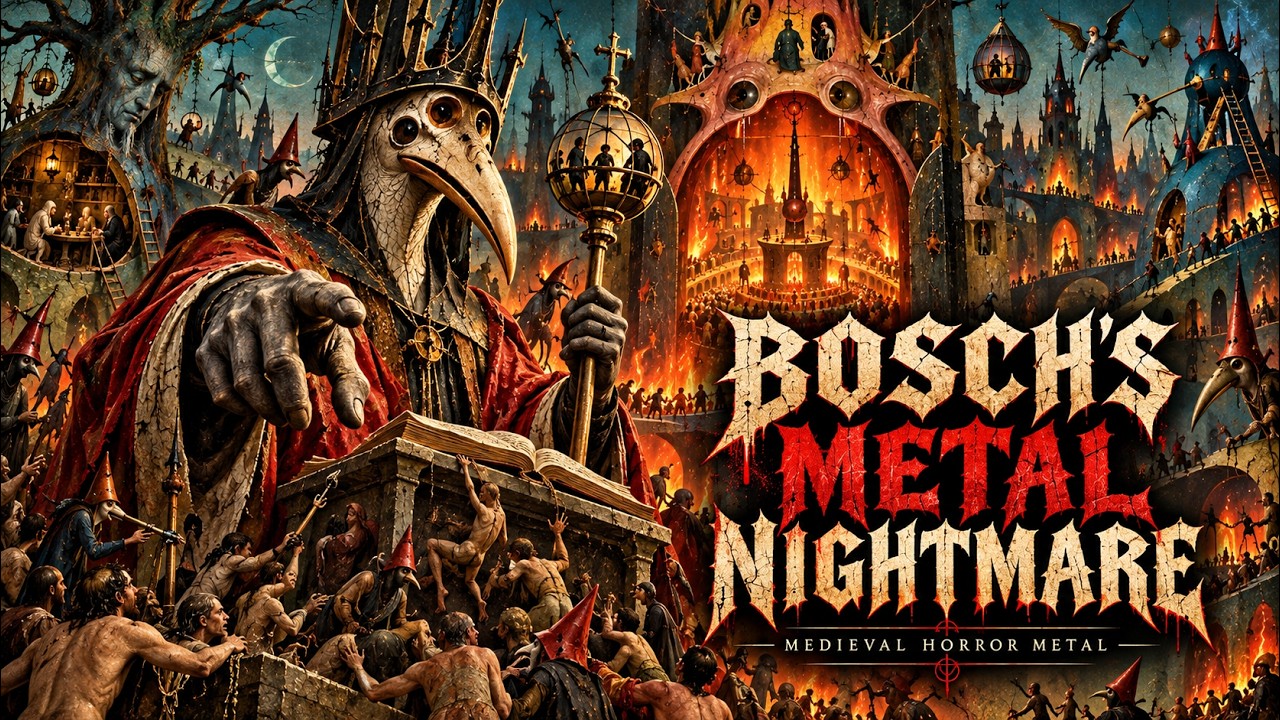
How the grotesque creatures, impossible architecture and musical instruments of Hieronymus Bosch became a horror-metal track built around one unsettling idea: what if Bosch was not inventing these nightmares, but recording what he saw?
WRITING THE SONG
The starting point for Bosch’s Metal Nightmare was not simply that Hieronymus Bosch painted strange monsters. It was the feeling that his images can look less like fantasy than eyewitness testimony from somewhere that should not exist.
That led to the song’s central question: What if Bosch didn’t imagine Hell — what if he simply painted what he saw?
The strongest visual influence is the hellish right-hand panel of The Garden of Earthly Delights. Its enormous instruments, hybrid creatures, distorted bodies, impossible structures and famous tree-man already feel almost like frames from a modern horror film. The music takes those images and treats them as something alive rather than historical.
Instead of retelling Bosch’s life or attempting to explain what the painting “means,” the lyrics build a fictional premise around the artwork. Bosch becomes someone who has witnessed something on the other side of a door and survived long enough to paint it.
That idea produced the central hook: “Bosch didn’t make the nightmare / He painted what came through.”
The song then pushes the concept forward five centuries. The monsters have not disappeared; they have simply become harder to recognize. That lets the medieval imagery become something contemporary rather than turning the track into a period piece.
Musically, Bosch’s Metal Nightmare was designed as medieval horror metal: heavy distorted guitars, screamed vocals, dark choral textures, bells, distorted strings and hurdy-gurdy-like sounds. The medieval elements provide the world of Bosch, while the metal arrangement gives the paintings their violence and scale.
The goal was to make the music feel the way a Bosch painting looks: crowded, disorienting, grotesque and full of details that become worse the longer you stare at them.
SOURCES & REFERENCES
Source status applies to the referenced material, not to the original Rhialto song.
Public-domain artwork
Museum reference
The Rhialto music, lyrics and fictional premise that Bosch was documenting something he actually witnessed are original creative elements. The page does not present that premise as an historical claim.