How a beautiful midnight carousel became a Vesper Mourdant dark-carnival horror story where every revolution costs years and the smiling riders eventually become bones.
WRITING THE SONG
Carousel of Bones began with the idea of taking something beautiful and nostalgic and changing only one rule.
The carousel itself is not evil-looking.
There are no broken horses waiting at the entrance.
No obvious monster.
No warning painted in blood.
Instead, it is almost impossibly inviting.
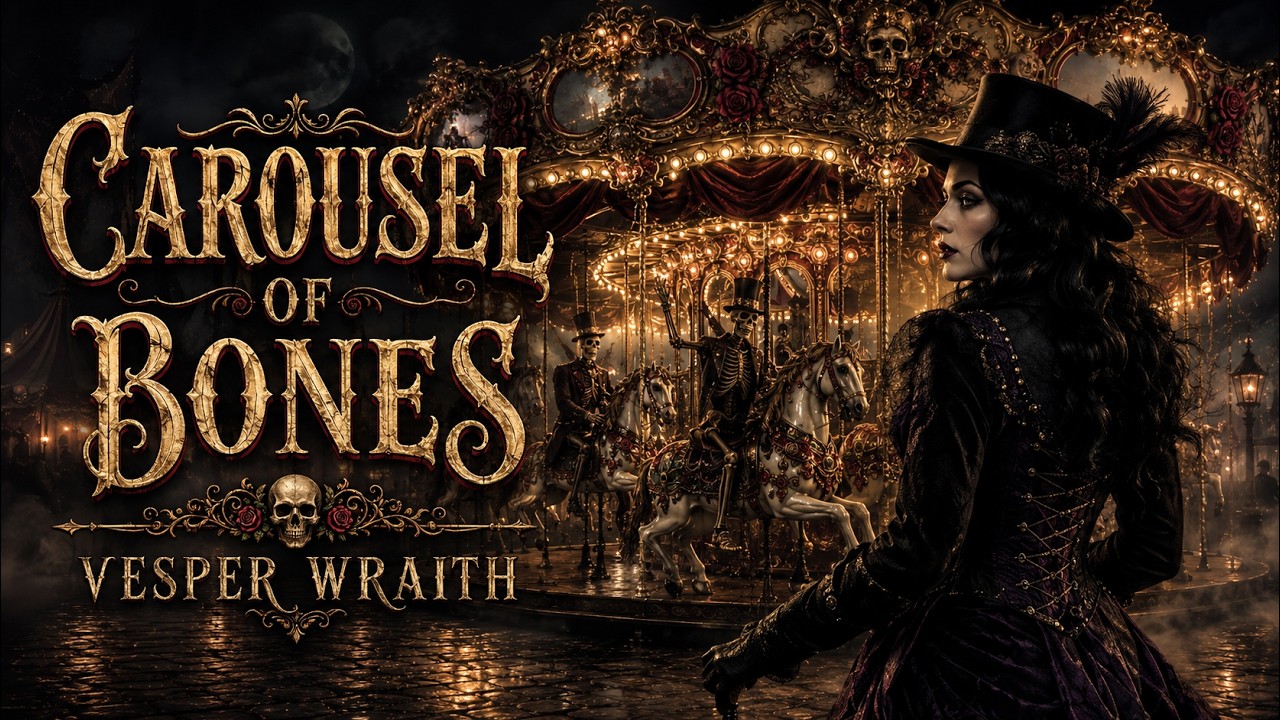
Amber bulbs.
Mirrored glass.
Gold leaf.
Wooden roses.
Painted horses.
Music floating through the cold night.
That beauty matters because the horror would be much weaker if the carousel announced what it was.
The riders have to want to get on.
And once they are riding, they have to want:
one more ride.
The supernatural rule is simple:
Every revolution costs time.
A child passes the observer.
When the carousel circles back, the child is older.
Another turn.
Older again.
A father lifts his young daughter onto a horse.
When he comes around again, silver has appeared in his hair.
Another rider ages from boyhood to adulthood.
Then middle age.
Then old age.
But nobody on the carousel reacts as though anything unusual is happening.
That became the most unsettling part of the idea.
The riders are not screaming.
They are not begging to get off.
They continue smiling.
They continue waving.
They seem to experience each revolution as though only a few moments have passed.
That creates two different versions of time.
For the people standing beside the carousel, entire lives are disappearing.
For the riders:
the ride has only just begun.
The recurring line:
Round and round we go
therefore starts as ordinary carousel language.
It sounds playful.
Almost nostalgic.
But each repetition changes its meaning.
“Round and round” gradually stops describing motion and starts describing mortality.
Every circle is another piece of a life.
The other important line is:
Nobody asks the time.
That became the heart of the horror.
The problem is not simply that the carousel steals time.
The deeper problem is that nobody riding it seems interested in knowing how much time has passed.
There is always another revolution available.
Always another moment.
Always another:
one more ride.
That phrase becomes increasingly important as the song progresses.
One more ride seems harmless.
It is only minutes.
That is what everyone waiting at the gate tells themselves.
But the carousel operates on exactly that assumption.
The riders never choose to lose their entire lives.
They choose one additional turn.
Then another.
Then another.
That made the concept feel larger than a haunted-carnival story.
The carousel becomes a metaphor for the way time can disappear while we are occupied with ordinary life.
Nobody normally experiences aging as a dramatic supernatural transformation.
You do not wake up and suddenly discover that thirty years vanished overnight.
It happens incrementally.
One more day.
One more week.
One more year.
One more ride.
The carnival exaggerates that process until it becomes visible.
The observers can see what the riders cannot.
That difference between perception and reality drives the entire piece.
At one point, the music itself begins to behave as though two clocks are running at once.
The old carousel waltz continues, but another pulse grows beneath it.
Three beats seem to turn against four.
The rhythms no longer agree about where time belongs.
That musical instability is not simply decoration.
The carousel has begun to distort time structurally as well as narratively.
The organ leans out of tune.
The familiar waltz starts to warp.
The beautiful antique machinery remains recognizable, but something underneath it no longer obeys the same clock.
Meanwhile, the visual transformation becomes harder to ignore.
Hair turns white.
Clothes hang differently on aging bodies.
Wedding rings become loose.
Shoulders bow.
But the riders still behave as though the evening has barely begun.
And that is why the final transformation does not need a dramatic attack.
Nobody is murdered.
Nothing leaps from the darkness.
The carousel simply keeps turning.
Eventually one rider comes past with a white hand still wrapped around the brass pole.
Then another.
Then rows of silent riders.
The same painted horses.
The same roses.
The same golden light.
But now the carousel carries bones.
That image became the title:
Carousel of Bones.
The gold still matters.
The lights still matter.
The beauty has to remain.
If the carousel collapsed into a rotten ruin at the end, the story would become a conventional haunted-ride transformation.
I wanted something colder.
The machine continues doing exactly what it was doing at the beginning.
It remains beautiful.
Only the riders change.
That makes the carousel almost indifferent rather than malicious.
It does not chase anyone.
It does not force anyone aboard.
It simply turns.
And people keep choosing another revolution.
That also places Carousel of Bones naturally inside The Carnival After Midnight.
The album’s carnival becomes frightening because its attractions obey rules that initially look almost normal.
The danger is discovered gradually.
A carousel is supposed to go round and round.
That is precisely why this attraction works.
Its supernatural rule is hidden inside the ordinary rule of the ride.
Musically, the track begins with the elegance of an antique carousel waltz.
The early sound should feel beautiful enough that the audience understands why someone would step onto the platform.
As the riders age, the arrangement begins to destabilize.
The carnival instrumentation warps.
Electronic elements become darker.
The rhythm underneath the waltz stops agreeing with it.
Harmony becomes increasingly unstable.
But the recognizable carousel remains underneath everything.
That contrast is central to Vesper Mourdant’s darker carnival material:
beauty does not disappear when the horror begins.
Sometimes the beauty is what keeps you there.
The four ideas underneath the piece are:
Beauty. Repetition. Mortality. Denial.
And the entire story can ultimately be reduced to one very ordinary request:
Just one more ride.
SOURCES & REFERENCES
Source status applies to the referenced material, not to the original Rhialto song.
Original Rhialto concept
Carousel of Bones is an original Rhialto / Vesper Mourdant supernatural-horror concept developed for The Carnival After Midnight.
The time-consuming carousel, rapidly aging riders, repeated revolutions and final transformation into skeletal passengers are original narrative elements rather than an adaptation of a particular literary work, legend, historical event or existing carnival story.
The piece uses traditional carousel and dark-carnival imagery — painted horses, mirrors, organ music, brass poles, lights and decorative gold leaf — as visual and musical genre vocabulary.