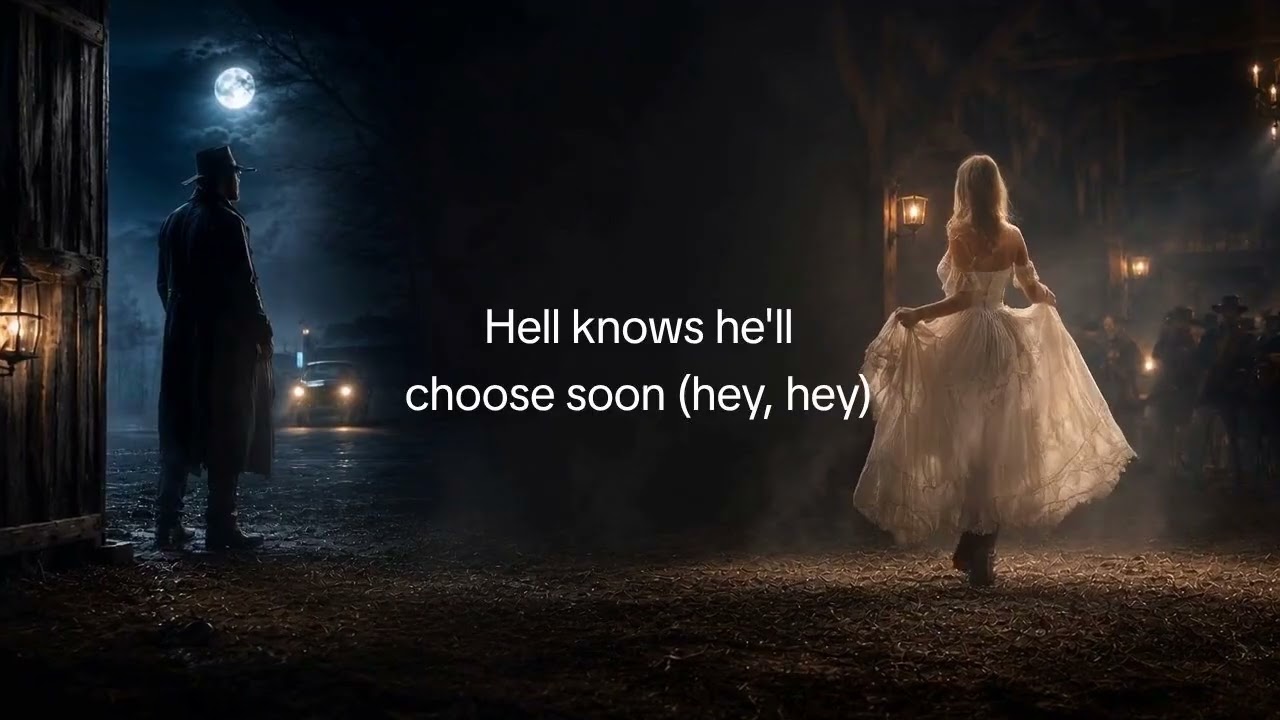
How the unanswered question at the centre of the traditional Cotton-Eyed Joe became a dark-country ghost story about a stranger who keeps returning to the dance long after he should be dead.
WRITING THE SONG
The traditional Cotton-Eyed Joe has one of those folk-song hooks that almost begs for a supernatural explanation.
Someone arrives.
Something changes.
Then he disappears.
And everyone is left asking where he came from and where he went.
Cotton-Eyed Ghost takes that unanswered question literally.
What if nobody ever found out where Joe went because he was no longer entirely alive?
That turns the familiar dance-song figure into something much darker.
The Rhialto version begins with the atmosphere of an old country dance: fiddle, boots, movement, people gathering after dark.
But there is someone else at the edge of the room.
A stranger who seems familiar.
A man who perhaps should not be there at all.
The public description reduces the idea to three images: a midnight country dance, a fiddle that knows too much, and a dead stranger waiting by the door.
That became the world of the song.
The important part was not simply turning Cotton-Eyed Joe into horror. The older song already contains the right mystery.
Its central character is defined largely by arrival and disappearance.
The reimagining simply asks what kind of person could keep doing that for generations.
The answer became a ghost.
That shift also changes the emotional meaning of the dance. A lively gathering can continue around him, but underneath it sits the suspicion that this has happened before.
People know the tune.
They know the steps.
Perhaps they even know not to look too closely at the man beside the door.
That fits naturally with Lux Arden’s darker country world. The arrangement keeps the fiddle-and-dance ancestry of the source idea but moves it toward gothic Americana and folk horror rather than novelty country.
The contrast is the point:
the rhythm says dance;
the story says leave before he notices you.
Cotton-Eyed Ghost therefore works less as a parody of Cotton-Eyed Joe than as an answer to its oldest unanswered question.
Where did he go?
Maybe nowhere.
Maybe he has been coming back all along.
SOURCES & REFERENCES
Source status applies to the referenced material, not to the original Rhialto song.
Traditional song — Cotton-Eyed Joe
The precise origin of Cotton-Eyed Joe is uncertain, and the song exists in many lyrical and melodic variants rather than one definitive original version. Historical documentation connects it with Black American folk tradition in the American South, long before its later circulation through old-time, fiddle, country and popular-music traditions.
Dorothy Scarborough — On the Trail of Negro Folk-Songs (1925)
Library of Congress — Cotton Eyed Joe
Cotton-Eyed Ghost, its ghost narrative, lyrics, production and Lux Arden interpretation are original Rhialto creative elements built from the traditional-song framework.