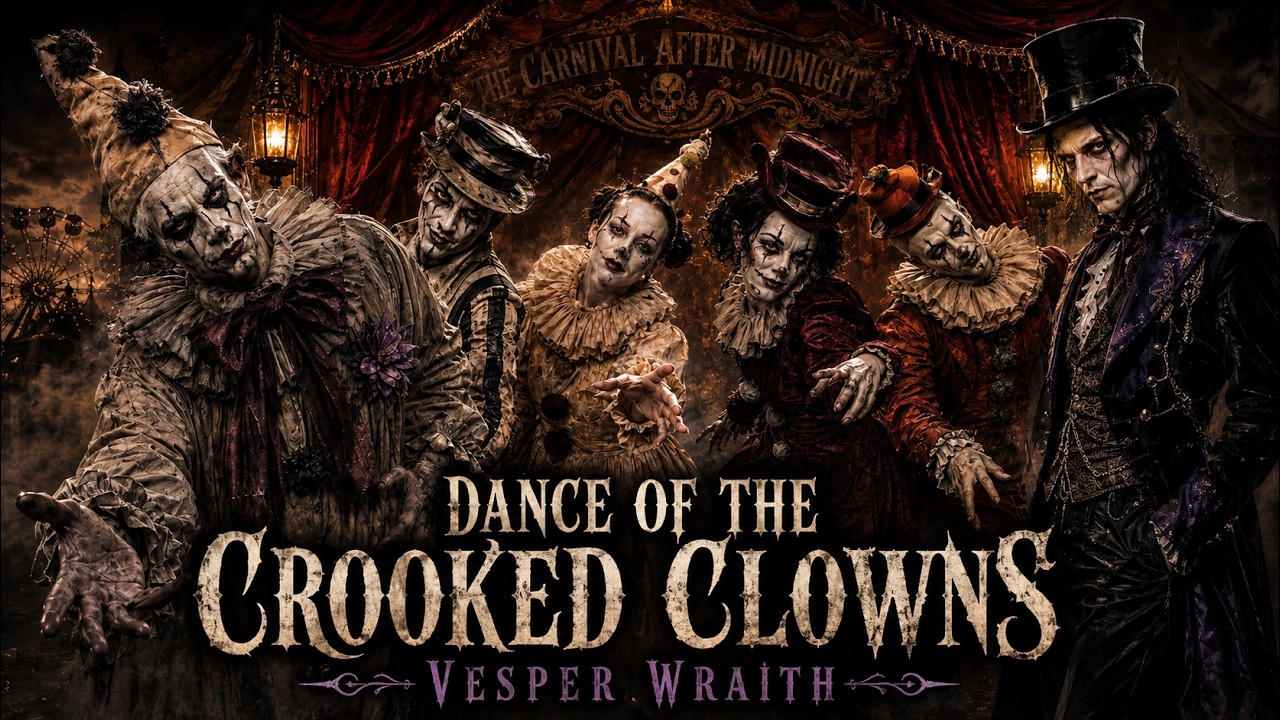
How five crooked carnival clowns became a Vesper Mourdant dark-circus horror story where every musical stop lets them move closer and silence becomes the real danger.
WRITING THE SONG
Dance of the Crooked Clowns was designed to be the point in The Carnival After Midnight where the carnival stops being merely strange and becomes physically dangerous.
Earlier attractions can still be explained away.
An odd performer.
A strange ride.
A trick of the lights.
A carnival that feels older than it should.
The clowns change that.
There are five of them.
Their costumes belong to another era.
Not exaggerated modern killer-clown costumes.
Faded formal circus clothes.
Melancholy makeup.
Old fabric.
Smiles that seem to have been painted in place far too long ago.
At first, they are simply dancing.
Badly.
Or perhaps not badly.
Just incorrectly.
Their knees bend at uncomfortable angles.
Elbows seem to turn slightly too far.
One clown spins half a beat late.
Another moves before the music tells him to.
Their choreography almost forms a pattern.
Almost.
That uncertainty mattered.
I did not want monsters charging toward the audience.
The first reaction should be:
That’s odd.
Then:
Did that one move?
Then:
Why are they closer?
The central mechanism came from the relationship between movement and silence.
While the carnival music plays, the clowns dance.
When the music stops, they freeze.
Completely.
No breathing.
No blinking.
No adjustment of posture.
Nothing.
That initially seems reassuring.
If they stop moving when the music stops, perhaps the music is the dangerous part.
Then the music starts again.
And the clowns are standing several feet closer.
Nobody saw them move.
Nobody can explain how they crossed the space.
But they did.
That became the horror engine of the track.
Every musical stop creates the same question:
Where will they be when the sound comes back?
The first time, the difference is small enough to doubt.
Maybe you remembered the distance incorrectly.
Maybe one clown had always been standing there.
Maybe the circle shifted.
Then it happens again.
And again.
The clowns keep appearing closer.
The crowd begins noticing.
People stop laughing.
Someone steps backward.
The dance is no longer entertainment.
It is measurement.
That led to the first major hook:
Keep the music going.
Normally, silence offers relief from frightening music.
Here, silence is the danger.
The noise becomes protection.
As long as the damaged carnival tune continues, everyone knows where the clowns are.
The moment it stops, something changes.
The second hook explains why:
Don’t let them hear the silence.
That line makes the clowns feel less like performers and more like creatures responding to some rule nobody fully understands.
Perhaps silence releases them.
Perhaps silence feeds them.
Perhaps the music is keeping them under control.
Perhaps they are simply waiting for the music to fail.
The story never needs to solve that.
The only instruction that matters becomes:
KEEP THE MUSIC GOING.
That changes the musicians too.
They are no longer playing for the crowd.
They are playing for survival.
If the drummer drops a stick, somebody has to keep the rhythm.
If the organ fails, another instrument must fill the space.
If a cable breaks, the silence cannot be allowed to spread.
Music becomes a barrier.
The entire midway becomes increasingly desperate to maintain it.
That is where the arrangement shifts from creepy circus performance into industrial panic.
The foundation is industrial dark circus / electro-cabaret.
Detuned piano.
Distorted brass.
Damaged carnival fragments.
Heavy mechanical percussion.
A melody that still resembles carnival music but sounds as though the machinery producing it is beginning to fail.
The important element is interruption.
Every stop should feel dangerous.
The first silence can be short.
Almost playful.
Then the music resumes.
The next stop lasts slightly longer.
Another restart.
The clowns are closer.
As the track progresses, the performers begin playing harder because everyone now understands what another silence could mean.
The percussion becomes more violent.
The carnival melody glitches.
The brass sounds damaged.
The piano feels increasingly unstable.
The music itself seems frightened of stopping.
Visually, I wanted to avoid the familiar screaming evil-clown cliché.
The clowns are more disturbing if they remain controlled.
They do not need blood-covered faces.
They do not need exaggerated monster teeth.
They should look like performers from an old travelling circus whose photographs somehow learned to move.
Their expressions remain composed.
Their smiles remain fixed.
What makes them frightening is their posture.
Crooked joints.
Impossible angles.
Bodies slightly misaligned with ordinary anatomy.
And most importantly:
coordination.
They are not wandering independently.
They know where the audience is.
They know where the exits are.
They know how much distance remains.
Their crooked circular dance gradually becomes an enclosure.
Each restart tightens the circle.
That gives the title another meaning.
They are not simply crooked because their bodies look wrong.
Their dance itself is crooked.
A circle that should entertain becomes a trap.
This also made the track an important turning point in The Carnival After Midnight.
Before Dance of the Crooked Clowns, the carnival can still seduce you.
There is beauty.
Mystery.
Curiosity.
Something impossible might even feel exciting.
The clowns change the emotional progression:
amusement → curiosity → discomfort → urgency.
For the first time, the listener is not merely exploring the carnival.
They are obeying a survival rule.
That is why the final silence needed to be different.
Throughout the song, the listener learns the pattern:
Music.
Stop.
Fear.
Restart.
Clowns closer.
Music.
Stop.
Fear.
Restart.
Clowns closer.
So eventually the audience expects another restart.
Then comes the last stop.
And it lasts too long.
No percussion.
No piano.
No damaged brass.
Nothing.
The listener waits.
The crowd waits.
Everyone knows what the rule says.
Keep the music going.
But the music does not return.
And somewhere inside that silence—
a quiet laugh.
That ending matters because the song has spent its entire runtime teaching the listener to fear exactly one thing.
Not the clowns.
Not the carnival.
Not even the dark.
Silence.
SOURCES & REFERENCES
Source status applies to the referenced material, not to the original Rhialto song.
Original Rhialto concept
Dance of the Crooked Clowns is an original Rhialto / Vesper Mourdant supernatural dark-carnival story developed for The Carnival After Midnight.
The five crooked clowns, their old-fashioned appearance, the music-and-silence movement rule, the shrinking distance after each musical stop, the survival instruction “Keep the music going,” the warning “Don’t let them hear the silence,” and the final extended silence are original Rhialto creative elements.
The track uses general historic circus and travelling-carnival imagery as setting and genre vocabulary. It is not an adaptation of a specific clown legend, literary work, film or historical event.