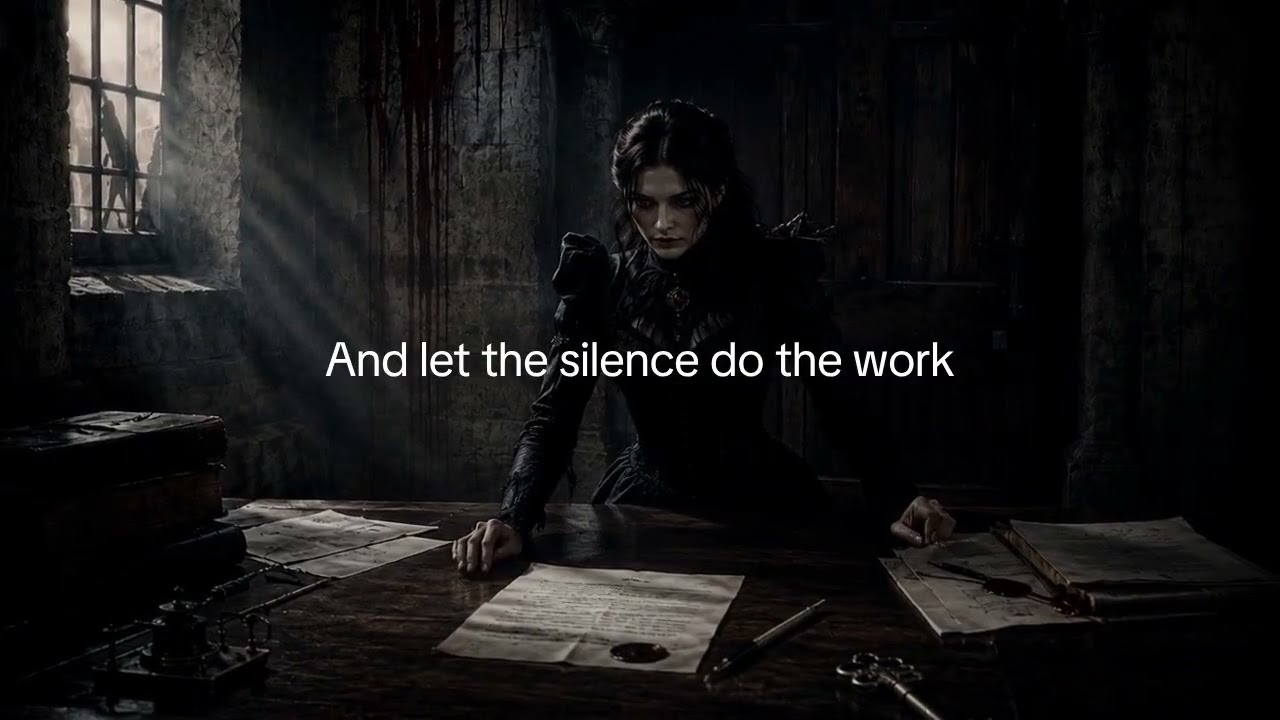
How Isabella and Angelo’s confrontation in Shakespeare’s Measure for Measure became gothic industrial music about coercion disguised as mercy, choice and consent.
WRITING THE SONG
Do Not Call It Mercy began with Isabella’s confrontation with Angelo in Shakespeare’s Measure for Measure.
It is one of Shakespeare’s most uncomfortable scenes because the threat does not initially look like violence.
It looks official.
Controlled.
Reasonable.
Angelo has authority.
He has the law.
He has Isabella’s brother under sentence of death.
And he knows she has come to him because she wants Claudio spared.
That imbalance became the entire foundation of the track.
The important idea was not simply:
a powerful man threatens a woman.
It was something more specific:
a powerful man constructs a situation in which coercion can be described as her decision.
Angelo does not need to physically force Isabella.
He controls the consequence.
If she refuses him, Claudio dies.
If she submits, Angelo can pretend that she agreed.
That distinction gave me the main hook:
Do not call it mercy
when I am the one who pays.
The word mercy matters because that is what Angelo is supposedly offering.
Claudio has been condemned under the law.
Angelo possesses the authority to spare him.
So the surface version of the story says Isabella is asking a powerful official for mercy.
But the moment Angelo attaches a price to that mercy, the word stops meaning what it is supposed to mean.
Mercy cannot be something extracted from the person begging for it.
That became the song’s argument.
The second key image was the door.
A door held shut
is not an open way.
That line became one of the strongest parts of the concept because it translates the entire moral problem into something physical.
Angelo can tell Isabella she has options.
But he controls the room.
He controls the key.
He controls the sentence.
He controls what happens if she walks away.
Technically, there is a door.
Technically, she may choose not to accept his bargain.
But if one path has been deliberately constructed to carry an unbearable punishment, calling the other path a free choice becomes dishonest.
That is the distinction the track keeps returning to:
permission is not the same thing as consent.
And neither is the absence of visible force.
That made the setting important.
I did not want a medieval or highly theatrical Shakespeare environment.
The track works better if the power feels institutional.
A closed office.
A desk.
Documents.
A seal.
A key.
Paperwork waiting for a signature.
A controlled room where everything belongs to the person making the demand.
Angelo’s authority should feel administrative before it feels monstrous.
That makes the scene colder.
Nothing has to look chaotic.
The horror comes from how orderly everything is.
He can sentence someone with paperwork.
He can delay an execution with paperwork.
He can offer Isabella the possibility of saving Claudio with a sentence delivered calmly across a desk.
And if she refuses, another document will move through the system.
That is why the song contains so many mechanical and bureaucratic sounds.
A key clicking.
Paper sliding.
A desk struck by a hand.
A seal pressed down.
A door closing.
Those sounds became percussion.
The production was built around dark contemporary gothic electronic music rather than conventional Shakespearean instrumentation.
Around 128 BPM.
A hard, controlled beat.
Low synth-bass pressure.
Dry piano.
Distorted organ or harmonium.
Industrial details that suggest both church and institution without fully belonging to either.
The church-like texture matters because Isabella is preparing for religious life.
The institutional textures matter because Angelo is using secular law.
She is trapped between two systems of authority.
One defines what she believes she cannot give.
The other tells her what will happen if she refuses.
Musically, neither system needed to be presented as purely comforting.
The distorted organ therefore never becomes sacred or triumphant.
It sounds damaged.
Compressed.
Almost trapped inside the room with her.
The vocal was designed to remain controlled for as long as possible.
A low female lead.
Close to the microphone.
Little wasted movement.
Isabella should not sound powerless.
She understands exactly what is happening.
That is crucial.
The track is not about a woman failing to recognize manipulation.
She recognizes it immediately.
Her problem is that recognition does not remove the consequence.
Angelo still holds Claudio’s life.
That is why the lyrics keep separating choice from ownership.
One of the later lines becomes:
Whatever order dawn obeys,
you do not get to call it mine.
That was the endpoint I wanted.
By morning, something will happen.
Claudio may live.
Claudio may die.
Isabella may be blamed.
Angelo may continue pretending the outcome resulted from her decision.
But she refuses one thing:
his right to define the story.
He can control the machinery.
He cannot make coercion become consent simply by naming it that way.
That connects back to another recurring production element:
whispered words around the lead vocal.
Consent.
Choice.
Sentence.
The words appear like institutional labels.
Almost clinical.
Each one sounds neutral until the context corrupts it.
Choice.
What choice?
Consent.
Under what pressure?
Sentence.
Whose authority?
Those whispers should become more intrusive as the track continues.
At first they belong to the room.
By the end, they are almost inside Isabella’s head.
That reflects the psychological violence of the bargain.
Angelo is not only threatening Claudio.
He is trying to transfer responsibility for the threat to Isabella.
If Claudio dies:
you chose this.
If she submits:
you chose that.
Either way, the powerful person who created the trap attempts to disappear from the moral equation.
That is why the song refuses to resolve neatly.
A conventional adaptation might give Isabella a triumphant anthem.
She rejects him.
The music explodes.
She walks out.
Victory.
But that would weaken the original problem.
Walking out does not save Claudio.
The price of refusing the bargain is still real.
So the bridge reaches the line:
He may believe I let him die.
For one breath,
I do too.
That moment mattered because Isabella’s certainty has a cost.
Even when she knows the choice is coercive, she can still feel responsible for the consequence.
That is exactly what makes the trap effective.
The person applying pressure does not need to convince the victim that the bargain is fair.
He only needs to make the alternative painful enough that guilt does the rest.
The arrangement narrows around that line.
The hard beat falls away.
The organ recedes.
The room becomes almost empty.
A dry piano.
Breath.
Paper.
Perhaps the faint mechanical hum of the building.
The singer sounds alone even though Angelo is still technically the person with power.
Then the rhythm returns.
Not triumphantly.
More like a system restarting.
Because the machinery is still there.
The law still exists.
The sentence still exists.
The door is still controlled by someone else.
That is why the final chorus needs to sound firmer rather than bigger.
Do not call it mercy
when I am the one who pays.
She is no longer arguing.
She is defining.
Then:
A door held shut
is not an open way.
And finally:
Whatever order dawn obeys,
you do not get to call it mine.
That final line refuses the language Angelo needs.
He may still impose an outcome.
But he cannot honestly attribute it to her.
Visually, I wanted the piece to remain controlled almost to the end.
No exaggerated villain performance.
Angelo should be frightening because he appears respectable.
Measured gestures.
Clean clothing.
Official objects.
A man accustomed to being obeyed.
Isabella sits or stands across from him with very little room around her.
The door remains visible.
So does the key.
The camera should repeatedly make the exit appear physically close.
Only a few steps away.
That reinforces the central contradiction.
She could walk to it.
She could open it—
if he allows the conditions attached to that decision to be ignored.
Which they cannot be.
The final image returns to the administrative world.
Papers remain on the desk.
The room is quiet.
No one receives a dramatic moral victory.
A key turns.
Then nothing.
That unresolved ending felt appropriate because Measure for Measure itself is deeply uncomfortable about power, law, sexuality and who gets to define justice.
Do Not Call It Mercy takes one part of that problem and makes it contemporary:
If the powerful person controls the punishment for saying no—
the word choice does not make the situation free.
And the word mercy does not make it merciful.
SOURCES & REFERENCES
Source status applies to the referenced material, not to the original Rhialto song.
William Shakespeare — Measure for Measure
The principal literary source for Do Not Call It Mercy is Shakespeare’s public-domain play Measure for Measure, especially Isabella and Angelo’s confrontation in Act 2, Scene 4.
Angelo has sentenced Isabella’s brother Claudio to death. He then makes increasingly explicit that he could use his authority to save Claudio if Isabella will submit sexually to him.
The scene gives the adaptation its central concern: the difference between a genuine choice and a decision made under coercive power.
Rhialto’s version moves the confrontation into a more contemporary institutional-gothic environment and focuses on how authority can disguise coercion with words such as mercy, choice, and consent.
The hooks “Do not call it mercy / when I am the one who pays,” “A door held shut / is not an open way,” and “Whatever order dawn obeys / you do not get to call it mine” are original Rhialto elements.