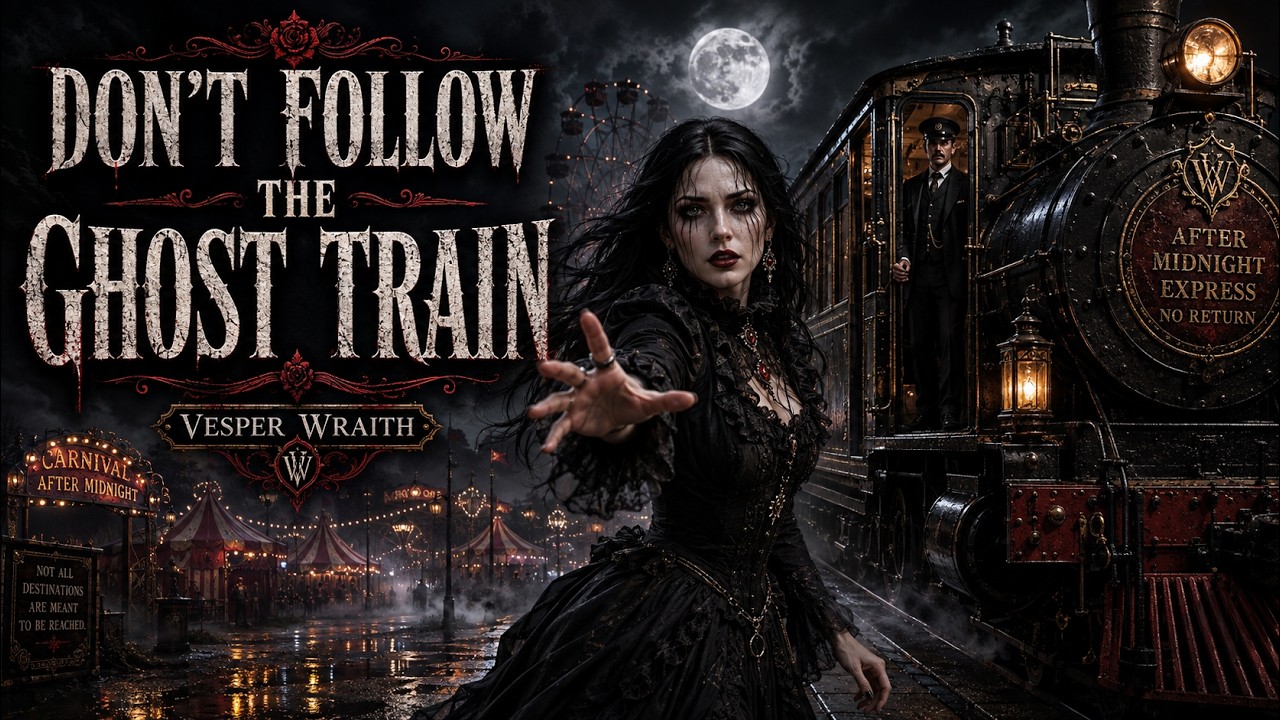
Vesper Mourdant’s ghost train promises a way out of the carnival, then carries its passengers through impossible memories back to the platform where they began.
WRITING THE SONG
The carnival has stopped being inviting.
The listener wants to leave.
Then a conductor announces exactly what everyone hopes to hear:
“Last train out.”
The crowd moves toward the platform. Vesper gives a warning.
They board anyway.
Don’t Follow the Ghost Train turns the promise of escape into the carnival’s next attraction.
This is Track 10 of The Carnival After Midnight, following The Magician’s Last Trick and leading into Everybody Leaves at Dawn.
The album has reached its panic stage.
Earlier attractions drew visitors through curiosity, pleasure and the promise of entertainment. Now the carnival offers something more urgent: a way out.
That timing makes the train persuasive.
The listener has reasons to distrust the place, but the platform appears to provide a solution. A conductor, a departure call and waiting carriages give escape a familiar shape.
There is something concrete to do.
Get aboard before it leaves.
The conductor’s announcement combines reassurance with pressure.
“Out” promises movement beyond the carnival.
“Last” makes hesitation feel dangerous.
The crowd does not have unlimited time to examine the offer. Other people are boarding, and missing the departure could mean being left behind.
That is how the attraction uses the listener’s fear.
The desire to escape becomes the reason to enter another part of the carnival.
The title is a direct instruction:
“Don’t follow the ghost train.”
It introduces a conflict between what the listener wants and what Vesper appears to know.
The train looks useful.
Her warning makes it suspect.
But by this point, the listener is desperate enough to choose the visible possibility of escape. Boarding becomes an understandable mistake.
The track needs that choice. The carnival does not simply force the listener into a carriage.
It gives them a destination they want to believe in.
At first, the journey appears to carry the passengers away.
Then the windows reveal impossible places: old homes, forgotten streets, graves, memories and lives that should be long gone.
The landscape becomes personal.
The train is travelling through things its passengers recognize, but those sights no longer belong to an ordinary route.
A window should help establish where a traveller is.
Here, each familiar image makes the location harder to explain.
The journey continues while confidence in its destination falls apart.
The train’s movement supplies a convincing sensation of progress.
The passengers have left the platform. The scenery changes. The machinery carries them forward.
None of those things guarantees that they are getting free.
That distinction is central to the track.
The carnival can provide speed, distance and a succession of places while keeping the journey entirely within its control.
The passengers experience departure.
They have not secured an exit.
The second central hook states the trap:
“Every track leads back.”
It turns the railway itself into part of the carnival’s enclosure.
Choosing a different line would not necessarily help. The problem is larger than one wrong turn.
The phrase also changes the meaning of everything seen through the windows. Those impossible places have been part of a journey whose destination was never truly open.
The passengers have travelled.
The carnival has kept them.
The published recording is described through heavy industrial percussion, warped carnival organ, distorted strings and dark electronic production.
Those textures give the journey weight and mechanical force.
The locked album blueprint called for a persistent railway rhythm and a gradual increase in tempo, building toward a final chorus with runaway momentum. It then proposed sudden brakes, silence and a bell.
Those are documented arrangement intentions.
Their purpose was to make the listener feel the journey accelerating beyond their control, then confront the place where it stops.
The machinery becomes part of the storytelling.
When the doors open, the passengers are back at the exact carnival platform where they began.
The return resolves the route while making the larger situation worse.
There is no distant station to explore and no unfamiliar town in which to seek help.
The apparent escape has delivered them to the starting point.
The familiar platform now means something different.
They know what it costs to mistake departure for freedom.
The published premise ends with Vesper waiting on the platform.
That detail redirects attention from the railway to her.
She gave the warning.
She is there when the listener returns.
Her presence suggests a familiarity with the carnival’s rules that the listener still lacks. The track deepens that suspicion without explaining her whole relationship to the place.
The journey has changed what the passengers know.
Vesper seems to have known where it would end.
The ghost train belongs to the same world as the fortune teller and the magician.
Each offers something a visitor wants, then reveals the danger within the offer.
Here, the desire is freedom.
That makes this attraction especially cruel. The listener’s recognition that the carnival is dangerous becomes the very thing that draws them aboard.
Don’t Follow the Ghost Train turns escape into a circular journey: the passengers follow the promise of a way out, only to discover that the carnival owns the tracks.
SOURCES & REFERENCES
Source status applies to the referenced material, not to the original Rhialto song.
This is an original Rhialto concept developed for Vesper Mourdant’s The Carnival After Midnight.
The note draws on the locked album blueprint and the published video description.
The departure call, warning, impossible landscapes, returning train and Vesper waiting on the platform appear in the published premise. The proposed acceleration and ending effects come from the musical-development blueprint.
No specific literary work or historical railway legend is claimed as its source.
Source status: Reference Sources Only.