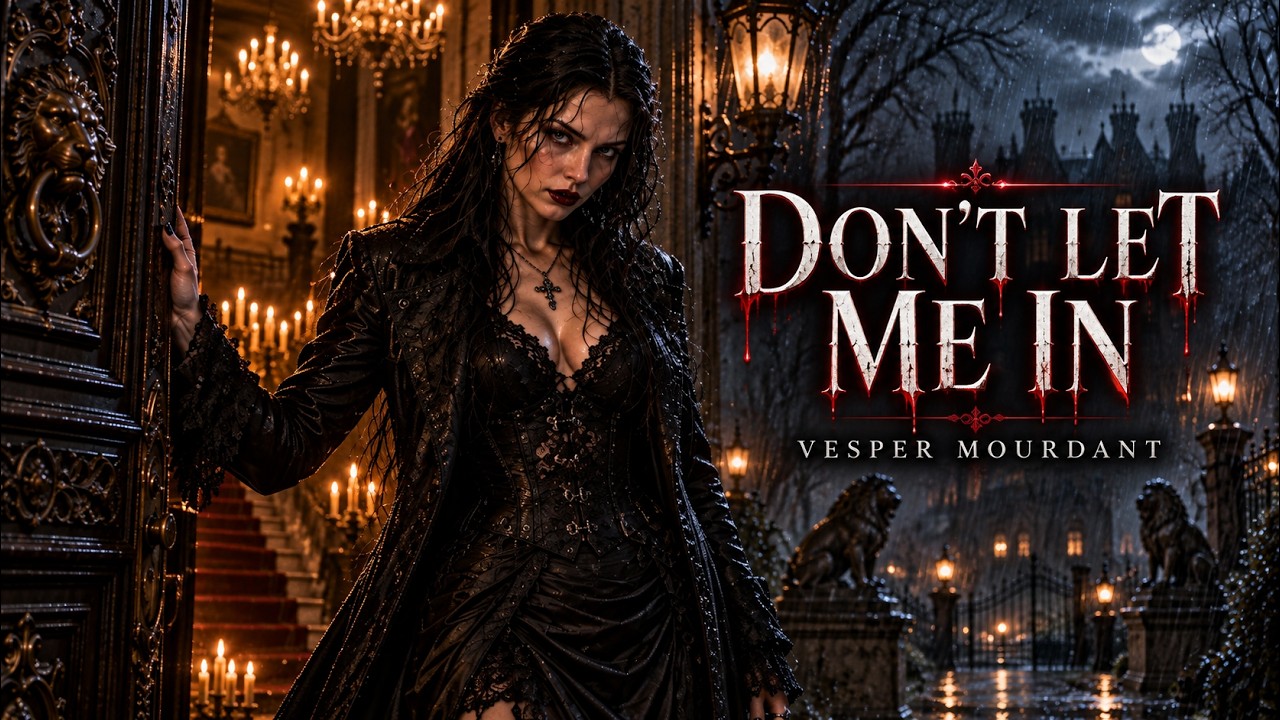
How a vampire warning became a Vesper Mourdant gothic-horror story about temptation, consent and the one irreversible invitation that changes the rules.
WRITING THE SONG
The central idea behind Don’t Let Me In came from one of the most recognizable rules in modern vampire fiction:
a vampire cannot cross the threshold unless someone invites it inside.
That creates an unusual kind of monster.
A creature can be immensely powerful and still be stopped by something as ordinary as a doorway.
So the interesting question became:
What if the vampire herself is the one warning you not to invite her in?
That changed the relationship immediately.
Instead of a predator pretending to be harmless, Vesper’s character knows exactly what she is capable of.
She is standing outside.
She wants to come in.
But some part of her is still saying:
Don’t let me.
That contradiction became the emotional core of the piece.
The title is therefore both a threat and a warning.
Don’t Let Me In does not mean:
I do not want to enter.
It means:
I want to enter badly enough that you should not trust me.
The person inside still has control at the beginning.
The door is locked.
The threshold holds.
The answer can simply be no.
That creates tension without requiring the vampire to attack immediately.
She can wait.
She can speak through the door.
She can say his name.
She can make it clear that she knows he is inside.
And perhaps most unsettlingly:
he never told her where he lived.
That detail turns the situation from strange to dangerous.
The visitor did not arrive accidentally.
She found him.
Still, the rule holds.
She cannot simply walk through the door.
So she warns him.
Lock it.
Do not listen.
Do not mistake desire for safety.
And above all:
do not invite me in.
The chorus needed to make that rule impossible to miss.
The strongest repeated phrase is simply:
DON’T LET ME IN.
But another line became equally important:
You don’t get to close it twice.
That is the real consequence.
Before the invitation, the door means protection.
After the invitation, the physical door may still be there—but the supernatural boundary is gone.
You can regret what you said.
You can slam the door.
You can lock it.
But you have already changed the rule.
That made the invitation more interesting than a simple jump scare.
It is irreversible.
The entire song becomes a countdown toward one spoken mistake.
And Vesper is almost arguing against herself.
She tells him what will happen.
She gives him the rule.
She gives him the warning.
She practically gives him the escape instructions.
All he has to do is refuse.
That also creates a darker question:
Why doesn't he?
Curiosity?
Attraction?
Loneliness?
The belief that she would not really hurt him?
The feeling that being wanted is worth the danger?
The song does not need to resolve that completely.
In vampire stories, temptation has always been as important as fear.
The creature outside the door is dangerous.
But she is also compelling enough that saying no becomes difficult.
That tension suits Vesper Mourdant particularly well.
Her darker work often works best when danger is not ugly.
The dangerous thing can be elegant.
Beautiful.
Persuasive.
Fully aware of what it is.
That is much more interesting than simply putting a snarling monster on the porch.
The song gradually builds toward the moment when warning becomes inevitability.
The arrangement moves through gothic rock, alternative metal and industrial atmosphere.
The guitars become heavier.
The tension becomes more physical.
The chorus keeps returning:
DON’T LET ME IN.
Each time, the warning feels less like advice and more like the last remaining rule holding the situation together.
Then the music strips down.
There is space.
The threshold is still intact.
And finally, after everything she has told him, after every warning—
he answers.
COME IN.
That is the real climax.
The vampire does not break the door.
She does not overpower him.
She does not cheat.
He changes the rule himself.
And once those words have been spoken:
you don’t get to close it twice.
That is why the song works better as a vampire story than as a generic home-invasion horror piece.
The door is not simply wood and a lock.
It represents consent.
Permission.
The final boundary between wanting something dangerous and actually allowing it into your life.
Before the words are spoken, Vesper's character is trapped outside.
Afterward, the person inside may be the one who is trapped.
Musically, the track leans into gothic rock, alternative metal and industrial horror rather than traditional theatrical vampire music.
Heavy guitars give the chorus weight.
Industrial textures make the house and doorway feel physical.
The breakdown near the end creates room around the final invitation so that two quiet words can carry more impact than another wall of guitars.
That contrast was important.
The biggest moment in Don’t Let Me In is not a scream.
It is not the creature attacking.
It is someone calmly saying:
Come in.
And realizing a fraction of a second later that the warning was sincere.
SOURCES & REFERENCES
Source status applies to the referenced material, not to the original Rhialto song.
Original Rhialto concept
Don’t Let Me In is an original Rhialto / Vesper Mourdant vampire-horror narrative.
The specific characters, situation, warnings, threshold confrontation, repeated “Don’t let me in” hook, irreversible invitation and final “Come in” reversal are original creative elements.
Vampire tradition and popular culture
The song uses the familiar modern vampire-fiction convention that a vampire must be invited across the threshold of a home.
That convention should not be presented as a universal rule from historical vampire folklore. Historical vampire beliefs varied considerably across cultures, and many of the rules now associated with vampires were developed or standardized through later literature, theatre, film and popular culture.
The invitation rule is therefore used here as recognizable vampire genre vocabulary, not as a claim about one authentic historical vampire tradition.