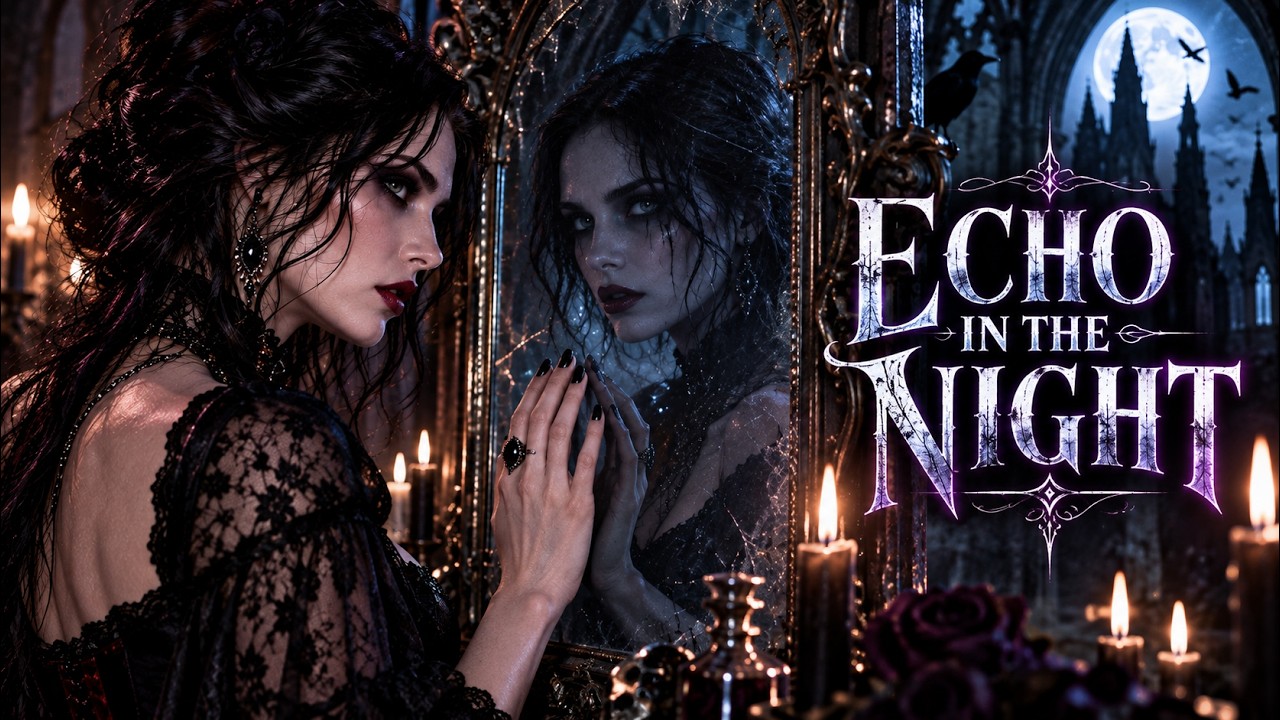
How Christina Rossetti’s “Echo” became nocturnal gothic darkwave about grief, dreams and a lost beloved who can return only before morning.
WRITING THE SONG
Echo in the Night began with Christina Rossetti’s “Echo.”
What attracted me was how little the poem needs in order to create its supernatural atmosphere.
There is no haunted house.
No monster.
No dramatic apparition.
Only someone who has lost the person they love and desperately wants that person to return through dreams.
That was enough.
Rossetti’s speaker does not seem satisfied with memory.
Memory is too distant.
She wants presence.
A face.
A voice.
Breath.
The physical sensation of somebody being close again.
But the only doorway left is sleep.
That became the emotional premise of the Rhialto adaptation:
What if dreams are the one place grief still allows the dead to visit?
The track does not try to decide whether the beloved is truly returning.
That ambiguity matters.
Perhaps this is supernatural.
Perhaps the narrator is dreaming.
Perhaps memory has become so vivid that the distinction no longer matters.
The emotional experience is the same.
At night, the person is there.
At dawn, they are gone.
That gave the song its first major hook:
Come back in the echo.
The word echo became much more than the title reference.
An echo resembles the original sound.
But it is not the original sound.
It arrives afterward.
Weaker.
Delayed.
Dependent on something that has already disappeared.
That made it a perfect metaphor for grief.
The narrator is not really asking for the past to repeat.
She knows that cannot happen.
She is asking for whatever remains of it to return strongly enough that she can feel it again.
That leads into the second hook:
Come back through the dark.
Darkness is not threatening in this song.
Darkness is useful.
The daytime world insists on reality.
Empty rooms look empty.
Photographs remain photographs.
Silence remains silence.
Night makes those boundaries less certain.
A shadow can resemble a person.
A reflection can move before you do.
A curtain can briefly look like somebody standing beside the window.
Moonlight can turn an ordinary room into the place where something impossible might happen.
So the song gradually makes darkness feel less like absence and more like access.
Then comes another important line:
Find me underneath my sleep.
That line pushes the idea deeper.
The narrator does not simply want to dream about the lost person.
She wants to meet them somewhere inside the dream.
As though sleep contains another location beneath ordinary consciousness.
A place where memory can become physical.
That is where the visual language expanded.
Empty rooms.
Moonlit windows.
Reflections.
Black water.
Long corridors.
Curtains moving with no visible wind.
A figure standing at the far end of a room and disappearing when the light changes.
Nothing should become overtly horrific.
This is not a ghost story in the conventional Halloween sense.
The supernatural possibility should remain beautiful.
Quiet.
Almost welcome.
Because the narrator wants the haunting.
That is what makes the song emotionally different from many gothic tracks.
Normally the central character wants the ghost to leave.
Here, the fear is that the ghost will leave.
That reversal led to the strongest emotional hook:
DON’T LET THE MORNING TAKE YOU.
Morning becomes the antagonist.
Not death.
Not darkness.
Not the ghost.
Daylight.
Every sunrise restores the separation.
The dream dissolves.
The beloved disappears.
The room becomes ordinary again.
The narrator wakes with the knowledge that she had them back—
and lost them again.
That makes each dream both comforting and cruel.
Rossetti captures that contradiction beautifully in the source poem.
The dream is sweet because the beloved returns.
It is painful because waking proves the reunion was temporary.
I wanted the music to live inside that same tension.
The production begins as slow nocturnal darkwave.
Analog bass.
Cold electronic drums.
Cathedral-like synths.
Sparse piano.
Long guitar swells.
Ghostly backing voices.
Nothing moves quickly.
The track should feel like entering sleep gradually.
The verses remain intimate.
The vocal stays close.
Almost whispered in places.
There is enough space around the voice to make every breath noticeable.
The choruses become much larger.
Not because the song becomes angry.
Because longing becomes too large to contain quietly.
The synths widen.
The guitars bloom.
Additional voices appear behind the lead.
The room suddenly feels enormous.
That scale gives the chorus the quality of somebody calling across a distance that cannot actually be crossed.
Then the arrangement falls inward again.
That contrast repeats throughout the track:
intimacy → expansion → disappearance.
Exactly like the dream.
The bridge strips almost everything away.
The song enters a suspended state.
Very little percussion.
Minimal harmony.
The vocal becomes close enough to feel almost uncomfortable.
And then:
Speak low.
Speak slow.
Those lines came directly from the emotional intimacy of Rossetti’s ending.
The beloved does not need to make a grand supernatural entrance.
The narrator would rather have something smaller.
A whisper.
A face near hers.
The simple sensation of closeness that existed before death separated them.
That restraint was important.
Grief often focuses on tiny things.
Not dramatic declarations.
The sound of somebody breathing.
The way they entered a room.
The exact distance between two faces during a conversation.
The small ordinary details become enormous after they are gone.
That gave the song another visual rule:
never show the lost beloved too clearly for too long.
A reflection is stronger than a full portrait.
A silhouette is stronger than a perfectly visible ghost.
A hand appearing briefly against glass is stronger than an elaborate supernatural effect.
The person should feel like something memory is struggling to hold together.
That also allows the imagery to blur the boundary between dream and remembrance.
Did the narrator actually see someone in the hallway?
Or did she remember seeing them there?
Did the reflection move?
Or did she expect it to?
Is the figure beside the lake real?
Or is moonlight simply creating the shape she most wants to see?
The song never resolves those questions.
The emotional truth matters more than the supernatural explanation.
One of the later hooks pushes the longing toward something almost desperate:
I would trade a thousand mornings
for one midnight in your bloom.
By this point, morning has become the price of reality.
The narrator would gladly surrender ordinary waking life for a single perfect night with the person she lost.
That is where the song becomes slightly more dangerous.
At first she wants the beloved to visit her dreams.
Now she is beginning to prefer the dream.
That distinction matters.
Grief can make memory into a refuge.
But a refuge can also become somewhere you stop wanting to leave.
The lyric continues with the desire to lose the world that took the beloved away and feel them breathe again.
That is the emotional peak.
The narrator is no longer asking memory to comfort her.
She is asking it to replace reality.
Musically, this is where the production reaches its largest point.
The gothic-rock elements expand.
The drums become heavier.
The guitars move forward.
The backing voices multiply.
The vocal finally loses some of its restraint.
There can be an anguished edge.
Even a scream.
Not horror.
Not rage.
A person trying to keep the dream from dissolving.
Then morning begins arriving anyway.
The production starts stripping itself down.
The huge chorus recedes.
The distorted layers disappear.
The rhythm weakens.
The room becomes quiet again.
And eventually the only thing left is the voice.
Distant.
Reverberant.
Almost no longer present.
The final words return to the intimate request:
Speak low.
Speak slow.
Then the echo carries the voice farther away.
That is how the track ends.
Not with proof that the ghost existed.
Not with proof that the narrator imagined everything.
With distance.
The same distance that existed at the beginning.
Except now the listener has briefly experienced what it feels like when that distance disappears.
That is what Echo in the Night ultimately took from Rossetti.
Not simply the image of a lost lover returning in dreams.
The cruel beauty of getting someone back only when you are unconscious—
and losing them again every time you wake.
SOURCES & REFERENCES
Source status applies to the referenced material, not to the original Rhialto song.
Christina Rossetti — “Echo”
The principal literary source for Echo in the Night is Christina Rossetti’s public-domain poem “Echo.”
Rossetti’s speaker calls for a lost beloved to return during the silence of night and through dreams, where memory, love and physical closeness can briefly be experienced again despite death and separation.
The poem was included in Rossetti’s Victorian-era body of work associated with Goblin Market and Other Poems.
Rhialto’s adaptation does not simply set Rossetti’s poem verbatim.
Instead, it expands the central dream-reunion into a modern gothic-darkwave narrative about grief, memory, shadows, reflections and the recurring moment when morning separates the lovers again.
The hooks “Come back in the echo,” “Come back through the dark,” “Find me underneath my sleep,” “Don’t let the morning take you,” and the expanded dream imagery are original Rhialto elements.
The closing “Speak low / Speak slow” treatment develops the intimate language and emotional atmosphere of Rossetti’s ending into the song’s whispered outro.