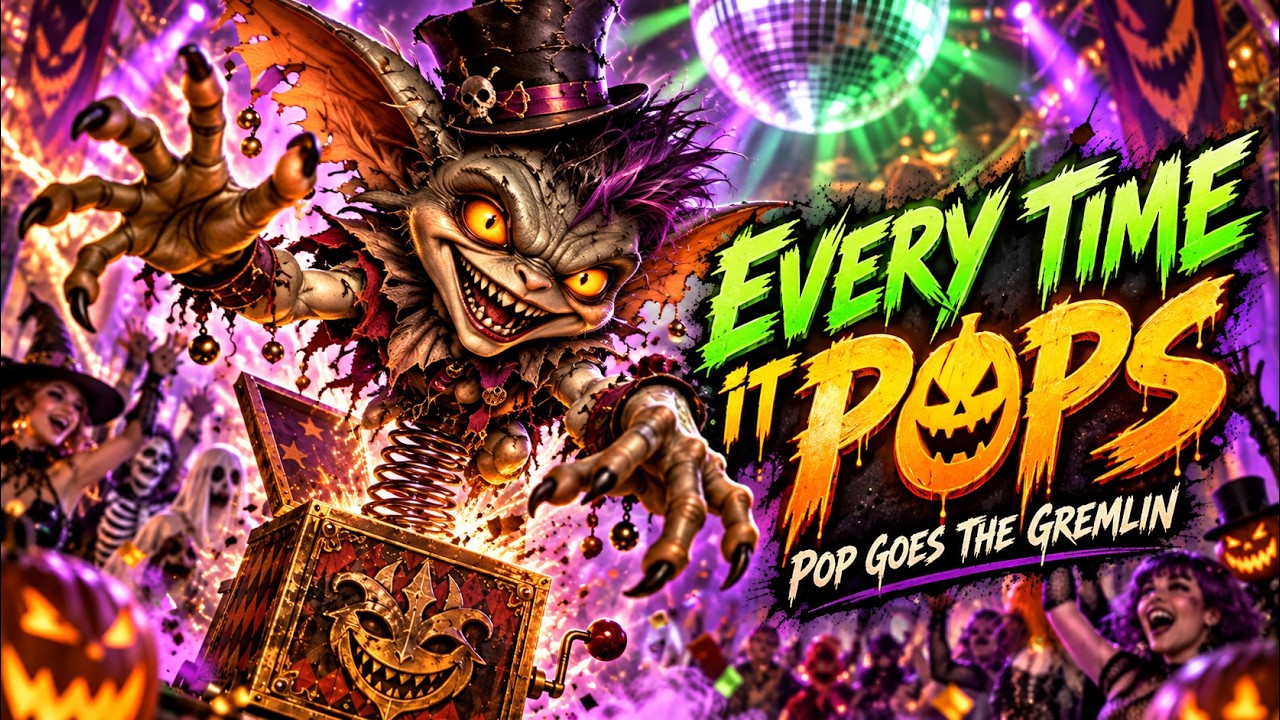
Rhialto turns Pop Goes the Weasel into Halloween dance music about a wind-up box, an escaped gremlin and a party with one increasingly dangerous rule.
WRITING THE SONG
Wind the handle.
Wait for the music.
Watch the lid.
Everyone knows something is going to happen.
That anticipation is what makes a jack-in-the-box work. You expect the surprise, but you still react when it arrives.
Every Time It Pops takes that familiar mechanism and gives it consequences:
“Every time it pops, somebody drops.”
The music keeps inviting everyone to dance.
The box keeps making that invitation more dangerous.
The transformation began with “Pop Goes the Weasel” and its instantly recognizable payoff.
The revision replaced the weasel with a gremlin.
That change gave the Halloween version a creature suited to the story: small, mischievous and capable of turning something ordinary into chaos.
A wind-up toy becomes a container for trouble.
The lyric introduces the escaped creature directly:
“Gremlin loose
Teeth and sparks
Little green trouble tearing through the dark.”
Those details establish its character quickly. Teeth provide the threat. Sparks connect it to malfunction and disruption. “Little green trouble” keeps a playful streak running through the horror.
The gremlin belongs at this party.
It is also the reason the party should stop.
The jack-in-the-box gives the story a simple structure.
The handle turns.
The tune plays.
The tension rises.
Then the lid opens.
That sequence can repeat without losing its purpose because everyone understands what the next pop might mean.
The familiar toy becomes a countdown that nobody can read precisely. People know the surprise is coming, but they cannot comfortably predict the moment.
The music uses the same uncertainty.
Every return to the box renews the expectation of another disruption.
The main hook has two jobs.
It tells the audience the rule of the story.
It also sounds like something a crowd could shout over a dance beat.
“Every time it pops, somebody drops.”
“Drops” carries a useful double meaning in this setting. It belongs to the language of dance music, while also suggesting someone falling—or disappearing from the party.
That overlap lets the chorus remain catchy without releasing the threat.
The audience can enjoy the payoff and still understand that something is going wrong.
Each repetition makes the same promise.
Each pop delivers it again.
The production direction was built around Halloween electro-pop and house, with a target tempo of 128 BPM.
A four-on-the-floor beat and heavy bass provide the party foundation. Carnival and toy textures bring the wind-up box into the arrangement.
The crucial instruction was to strip the music back before each “POP!”, then follow it with a large dance drop.
That makes the familiar nursery-rhyme payoff part of the production itself.
The pause creates anticipation.
The pop triggers the surprise.
The returning beat turns that surprise into movement.
The story and the arrangement follow the same mechanism.
The creative direction called for a slowed hint of the traditional melody before transforming that identity into a club-synth motif.
Recognition matters here.
The audience arrives with an expectation attached to “Pop Goes the Weasel.” The adaptation can then twist that expectation without explaining the whole setup.
Music-box and warped calliope textures preserve the toy-like quality.
The dance production makes the familiar material feel larger, louder and less safe.
The result aims for a Halloween party atmosphere with a recognizable childhood tune moving underneath it.
The vocal direction called for a playful, mischievous female lead, supported by crowd chants.
That attitude helps hold the two sides of the music together.
There is danger in the box.
There is also an invitation to keep turning the handle.
A performance that enjoys the chaos makes that invitation more convincing. The narrator can sound entertained by something the guests should find alarming.
The crowd responses make the party part of the mechanism.
Everyone knows the hook.
Everyone joins in.
And the music keeps going.
The published video description centres the story on the twisted jack-in-the-box, the gremlin and the repeated consequence of the pop.
Disappearances give that repetition an accumulating effect.
The room can begin as a party and gradually become a place where the remaining guests ought to notice who is missing.
That tension suits the music’s playful horror.
The beat offers a reason to stay distracted.
The box offers a reason to pay attention.
By the end, the question becomes unavoidable:
“Where’d everybody go?”
The outro returns to the smallest sound in the story.
A click.
Then:
“POP.”
After all the dance energy, that tiny mechanical sound is enough to restore the threat.
The audience already knows the rule.
There is no need to explain what happens next.
The box still works.
SOURCES & REFERENCES
Source status applies to the referenced material, not to the original Rhialto song.
“Pop Goes the Weasel” — traditional tune and nursery rhyme
The Library of Congress holds an 1853 arrangement of “Pop Goes the Weasel” by James W. Porter. Its historical discussion also documents the tune’s nineteenth-century life as a social dance with a sung payoff.
That dance history makes the modern party treatment especially fitting.
Every Time It Pops transforms the historical material through an original Halloween narrative: a gremlin escaping a wind-up box, party chaos and the recurring “somebody drops” hook.
Source status: Public Domain Sources