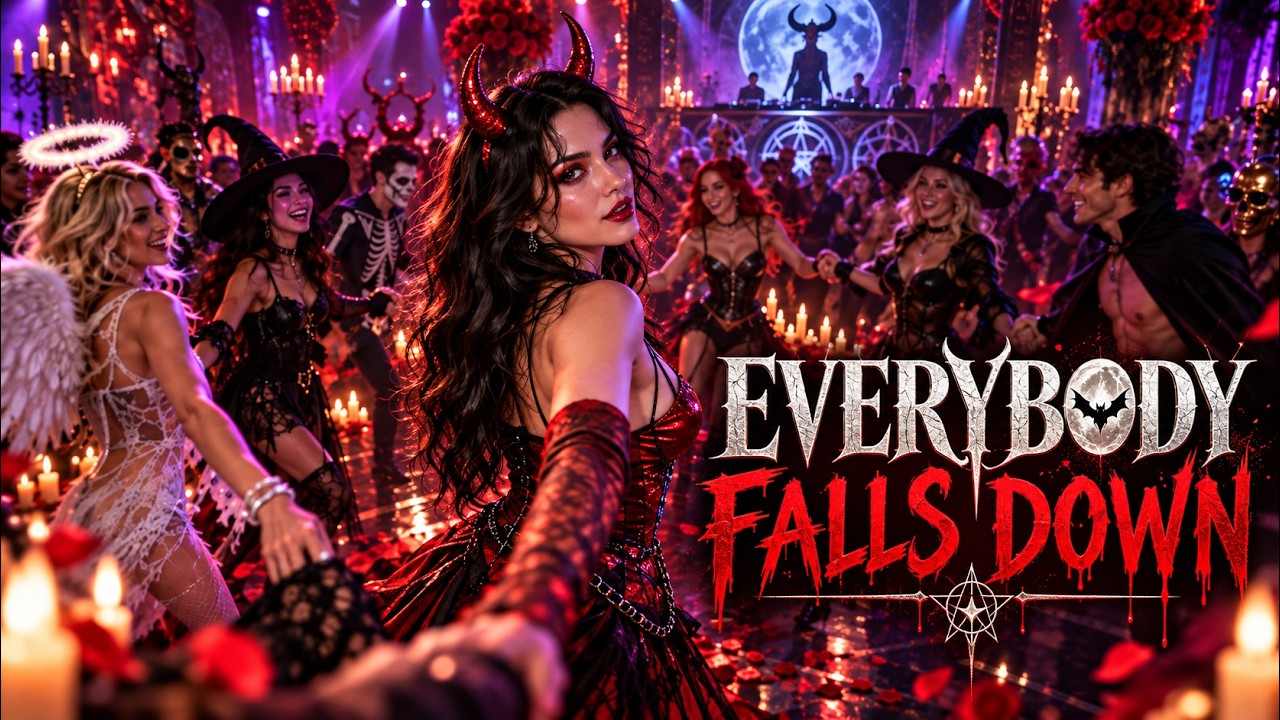
Rhialto transforms Ring Around the Rosie into a Halloween dance-floor ritual: everyone joins the circle, everyone falls—and the people who get back up have changed.
WRITING THE SONG
It starts as a game.
Hold hands.
Go round and round.
Wait for the familiar instruction.
“Everybody falls down.”
At a costume party, that could be harmless fun. Everyone knows the movement. Everyone understands the joke.
Then they get back up.
Different.
That extra step became the central twist of Everybody Falls Down.
The familiar game ends with everyone falling down.
Our version asks what happens immediately afterward.
Getting back up ought to restore the group to where it started. The next round should be another repetition of the same game.
Instead, the return becomes the disturbing part.
The guests have completed the movement correctly. Something has happened to them because they did.
That turns a familiar circle dance into a ritual disguised as party entertainment.
Nobody needs to learn complicated instructions.
They already know how to participate.
The main hook stays simple:
“Everybody falls down.”
It works as an instruction, a crowd chant and the title.
Its familiarity makes it easy to join in. The audience does not need a long explanation before understanding the action.
The horror develops around that recognition.
At first, falling belongs to the game.
As the music continues, the same words begin to sound like a rule the dancers cannot avoid.
The hook remains unchanged while its meaning grows darker.
The second hook changes what the first one promises:
“Get back up
But don’t come back the same.”
Getting back up usually signals recovery.
Here, it introduces transformation.
The dancers can return to their feet without returning to themselves. The game has moved them through something they did not understand when they joined the circle.
That is the unsettling idea beneath the party atmosphere.
The fall is shared.
So is whatever follows it.
A Halloween party is a useful setting because everyone has already agreed to look different.
Masks, makeup and costumes make unfamiliar appearances ordinary for the night.
That creates room for the supernatural turn.
When someone seems changed, the setting offers an easy explanation: it is part of the costume, part of the performance, part of the fun.
The concept gradually pushes beyond that reassurance.
The guests came dressed as something else.
The circle raises the possibility that they might leave as something else.
Another familiar fragment becomes part of the Halloween machinery:
“Ashes, ashes—lights go out.”
The line gives the dance a blackout.
It also marks a point where the room can change beyond the guests’ sight.
The darkness belongs naturally to a Halloween party, but within this story it becomes more than atmosphere. It interrupts everyone’s ability to see what the game is doing.
The circle continues to matter even when the dancers cannot clearly read the people beside them.
The creative direction was dark Halloween dance-pop and electro-house, with a target tempo of 128 BPM.
A four-on-the-floor beat, bass, claps and stomps give the music a physical foundation.
Spooky synths and music-box accents preserve the nursery-rhyme connection while adding Halloween unease.
The vocal direction called for a theatrical female lead with group chants.
That combination supports participation. The lead can guide the action while the crowd responses make it feel collective.
The aim was an infectious party track with something sinister developing underneath it.
The circle-dance concept also gives the music a natural structure.
Round and round.
A repeated chant.
A shared action.
A fall.
Then the return.
Repetition is part of both the game and the dance production. Each new cycle can bring the audience back to something recognizable while making the situation less comfortable.
The music does not need to abandon its party energy to develop the horror.
The repetition itself becomes suspicious.
Why are they still playing?
What has changed since the last round?
The development notes emphasized the break between the fall and the return of the beat.
That pause gives the transformation room to happen.
For a moment, the collective movement stops.
Then the music comes back, and the instruction changes to getting up.
The contrast makes the return feel like an event rather than the automatic end of a children’s game.
The dancers rise into the next section.
The story gives the listener a reason to wonder who—or what—has risen with them.
Everybody Falls Down does not need an elaborate supernatural explanation.
Its strongest idea is compact:
Everyone knows how to play.
Nobody knows what the game now does.
That allows the music to remain playful and accessible while carrying its darker implication.
The guests join because the ritual looks familiar.
By the time its consequence becomes clear, they have already completed it.
SOURCES & REFERENCES
Source status applies to the referenced material, not to the original Rhialto song.
“Ring Around the Rosie,” also known as “Ring a Ring o’ Roses” — traditional singing game
The adaptation draws on the familiar circle, repeated words and shared falling action of the historical children’s game.
The popular claim that the rhyme originated as a description of plague is not established history. Library of Congress folklore research examines that explanation as a later story told about the rhyme.
Our Halloween version creates its own supernatural premise.
The changed dancers and the instruction not to come back the same are fictional additions, rather than claims about the rhyme’s original meaning.
Source status: Public Domain + Reference Sources
The traditional rhyme supplies the historical source material; modern folklore research supplies context.