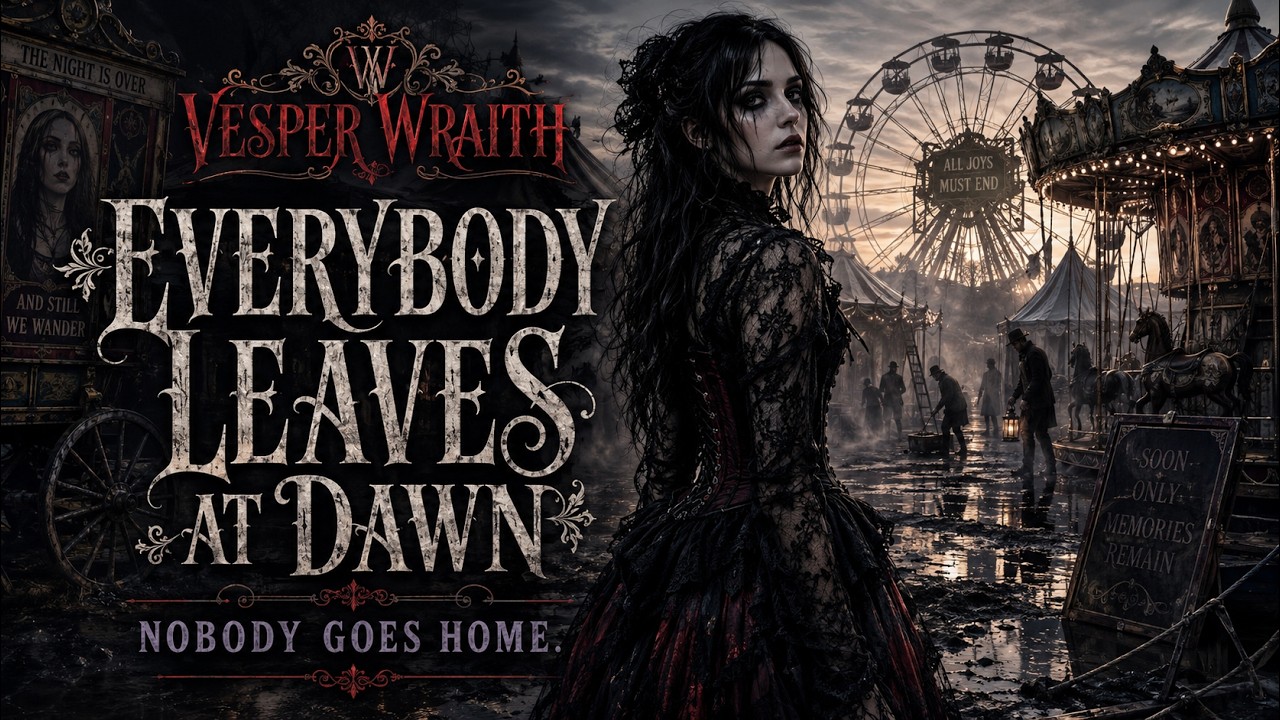
How dawn became the final trap in The Carnival After Midnight: the visitors survive the night only to discover they are becoming the carnival’s next workers.
WRITING THE SONG
Everybody Leaves at Dawn was designed as the emotional and narrative climax of The Carnival After Midnight.
By this point in the album, the listener has already moved through the midway.
The ticket seller.
The Ferris wheel.
The crooked clowns.
The haunted attractions.
The carousel.
The ghost train.
Everything has become progressively stranger.
So the obvious expectation is that dawn will finally end it.
That expectation became the trap.
The first important line is:
Everybody leaves at dawn.
At the beginning of the piece, that should sound almost comforting.
The worst night of your life has an ending.
The sky is getting lighter.
The music is stopping.
The machinery is slowing.
The carnival workers begin shutting everything down.
For the first time in hours, the world appears to be returning to normal.
That sense of relief was essential.
If the song began by announcing that nobody escapes, there would be nowhere for the story to go.
Instead, dawn has to feel like salvation.
The pale natural light replaces the coloured bulbs.
The tents stop looking impossible.
The rides become ordinary machinery again.
Workers move through familiar shutdown routines.
Lights click off.
Music boxes wind down.
Metal cools.
Canvas is folded.
Everything becomes calm.
And somehow that calm feels worse than the chaos that came before it.
Because the visitors begin noticing something.
The carnival workers look different.
The person selling tickets was not there yesterday.
Neither was the new ride operator.
The clown wiping away yesterday’s makeup looks familiar.
So does the conductor.
So does the fortune teller.
And slowly the truth becomes visible:
the carnival does not kill its visitors.
It keeps them.
That was the central revelation.
The people who seemed to belong to the carnival throughout the album were not necessarily born into it.
They were previous guests.
Someone once entered exactly as the listener did.
Someone followed the lights.
Someone bought a ticket.
Someone stayed too long.
And when morning came, the carnival gave them a job.
Ticket seller.
Barker.
Ride operator.
Musician.
Clown.
Fortune teller.
Magician.
Conductor.
Attendant.
Performer.
The roles continue because the carnival continues.
That turns the entire album backward.
Every strange figure encountered earlier becomes more tragic.
The ticket seller was once a visitor.
The conductor was once trying to escape.
Perhaps the clown was once frightened of the clowns.
The people who appeared to be part of the threat may also be prisoners.
That is where Vesper’s role changes too.
Until this point, she can appear to know too much.
She understands the carnival.
She knows which doors matter.
She knows when something is wrong.
She knows what the listener has not yet understood.
That can make her seem suspicious.
Perhaps she brought the listener here.
Perhaps she works for the carnival.
Perhaps she is part of whatever is controlling it.
Everybody Leaves at Dawn complicates that.
Vesper knew what would happen because:
it happened to her too.
She was once brought through the gates.
She once believed morning meant escape.
She once watched the carnival shut down.
And at some point, she became part of the show.
That makes her less of a villain and more of a tragic guide.
She knows the rules because she has already lost to them.
The song should not explain exactly how long she has been there.
It should not reveal who created the carnival.
It should not tell us whether the workers can ever truly leave.
Those mysteries belong to the carnival itself.
The important revelation is personal:
Vesper remembers being the visitor.
That is enough.
The central hook therefore changes meaning halfway through the song.
First:
Everybody leaves at dawn.
Relief.
Then:
Everybody leaves at dawn.
Nobody goes home.
The second line destroys the first.
Technically, the promise was true.
Everyone leaves.
They leave the midway.
They leave the rides.
They leave the night behind.
But they do not leave the carnival.
They simply move to the other side of it.
That semantic reversal became the emotional centre of the track.
It is why “Nobody goes home” needs space.
The arrangement should pull back before that line.
No huge wall of sound.
No scream.
Let the listener understand the sentence.
Then allow the music to widen around the realization.
Deep strings.
Low percussion.
Dark synth support.
Vocal layers slowly appearing behind Vesper.
Because by that point, the audience finally understands what the entire album has been showing them.
The workers are the missing people.
The performers are the survivors.
And survival may be worse than death.
Musically, Everybody Leaves at Dawn needed to feel different from the more frantic carnival tracks.
The panic is over.
This is what comes afterward.
The beginning is almost drumless.
Intimate piano.
Low synth.
Soft sub-bass.
Restrained strings.
Faint dawn ambience.
Vesper should sound tired.
Human.
Controlled.
Not theatrical.
Not demonic.
Not triumphant.
She is telling someone something she has had to explain before.
As the truth emerges, fragments from the rest of the album can return.
A ticket bell.
A distant carousel phrase.
A worn calliope melody.
A trace of the ghost train rhythm.
The sounds should not become a medley.
They should feel like memories.
The carnival remembering itself.
By dawn, those motifs are slower.
Older.
Almost mechanical.
The night’s attractions are being packed away.
But they are not gone.
They are waiting.
One of the most disturbing ideas in the piece is how calmly the transformation happens.
Nobody drags the visitors into cages.
Nobody announces:
You belong to us now.
Instead, someone finds themselves behind the ticket booth.
Someone is holding a uniform they do not remember putting on.
Someone knows how to operate machinery they have never seen before.
Someone reaches for a bell at exactly the right moment.
The carnival does not need to explain the job.
The role simply settles into them.
And eventually the listener realizes what role is waiting for them.
The ticket seller.
That creates a direct handoff between the end of this story and the beginning of the next night.
Tomorrow, someone else will arrive.
Someone else will see the lights.
Someone else will approach the gate.
And the person who survived tonight will be standing there to sell them the ticket.
That is the final cruelty.
The victims become part of the mechanism that catches the next victims.
Not necessarily because they want to.
Because the carnival needs them.
That is also why the album does not truly end at dawn.
The following reprise returns to the central idea:
The Carnival Comes at Sundown.
Morning is not victory.
It is intermission.
The carnival sleeps.
The workers prepare.
The sun crosses the sky.
And somewhere toward evening, the lights come back on.
The ending of Everybody Leaves at Dawn therefore needed to remain quiet.
The horror has already landed.
There is nothing left to chase.
Nothing left to fight.
Only recognition.
The carnival survived the night.
So did you.
And now you understand that those may be the same thing.
SOURCES & REFERENCES
Source status applies to the referenced material, not to the original Rhialto song.
Original Rhialto concept
Everybody Leaves at Dawn is an original Rhialto / Vesper Mourdant supernatural dark-carnival narrative developed as part of The Carnival After Midnight.
The dawn reveal, former visitors becoming carnival workers, transfer of roles between generations of guests, Vesper’s inherited captivity, the listener becoming part of the carnival, and the central reversal “Everybody leaves at dawn / Nobody goes home” are original Rhialto story elements.
The track uses general travelling-carnival imagery — ticket booths, ride operators, barkers, clowns, conductors, performers and midway machinery — as setting and genre vocabulary rather than adapting a specific literary work, legend or historical event.