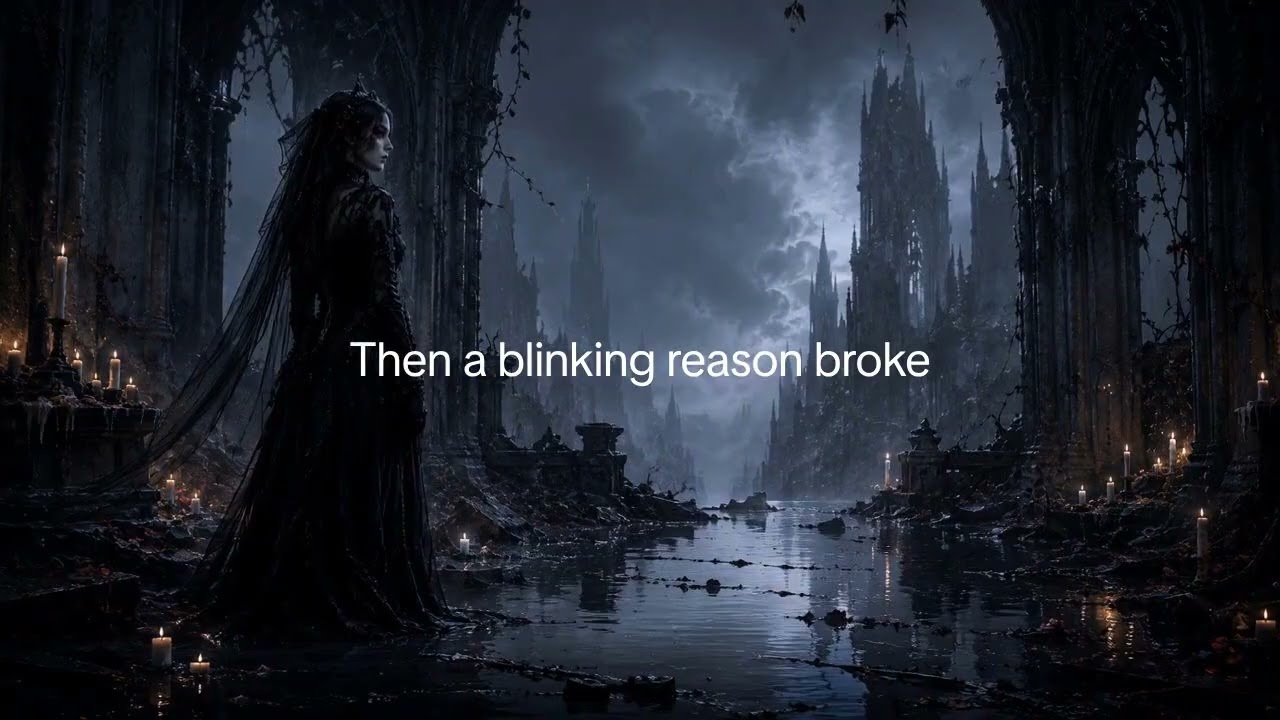
How Emily Dickinson’s “I felt a Funeral, in my Brain” became ritual darkwave built from footsteps, drums, bells and the collapse of reason.
WRITING THE SONG
Funeral in My Brain began with Emily Dickinson’s “I felt a Funeral, in my Brain.”
The poem feels almost musical before any music is added.
It moves through repeated physical sensations:
treading.
Then:
beating.
Then:
tolling.
Then:
falling.
That progression gave the adaptation its entire architecture.
Rather than treating Dickinson’s funeral as a literal burial, I wanted the music to remain inside the speaker’s head.
The funeral becomes the sound of a mind losing its ability to hold itself together.
That is why the first important element is not melody.
It is footsteps.
Treading—treading.
The repetition matters.
A single footstep can be ignored.
A procession cannot.
At first, the sound remains distant.
Something moving somewhere beyond the immediate foreground.
Then it repeats.
And repeats.
Until the rhythm begins taking over everything around it.
That became the first stage of the track:
pressure.
The narrator is still observing what is happening.
She knows something is wrong.
But she remains separate from it.
Then the funeral service begins.
Dickinson compares it to a drum.
That image made the musical direction almost unavoidable.
The percussion needed to become the psychological event.
Not accompaniment.
Not decoration.
The drum is what is happening to the narrator.
So the arrangement gradually shifts from footsteps into ritual percussion.
Frame drums.
Low electronic impacts.
Metallic strikes.
A pulsing bass that begins to feel less like music and more like an internal heartbeat.
The repeated motion creates the sense that thought itself is being worn down.
That led to the main Rhialto hook:
There’s a funeral in my brain.
It is deliberately simpler and more direct than Dickinson’s opening.
The source poem describes the sensation.
The adaptation turns it into a declaration.
By the time the chorus arrives, the narrator is no longer wondering what is happening.
She has named it.
The next image expanded naturally from the poem’s bells:
Black bells calling out my name.
The bells become personal.
They are not tolling for some distant funeral.
They are tolling for the person hearing them.
That changes the emotional direction.
The funeral is not something she is witnessing.
It belongs to her.
Or perhaps more precisely:
it belongs to some part of her.
That ambiguity was important.
The song is not about literal death.
It is about the feeling that something inside the mind is being buried while the body remains present to hear it happen.
That is why the production sits between gothic electronic music, ritual darkwave and psychological horror.
A conventional gothic-rock arrangement would have externalized the drama.
Big guitars.
A visible antagonist.
A physical setting.
But Dickinson’s poem is frightening because almost everything happens internally.
So the Rhialto version needed to feel enclosed.
The vocal stays relatively low and controlled through the early sections.
That restraint matters.
The singer is not immediately screaming.
She is trying to understand.
The track becomes more disturbing because the world around that calm voice is becoming less stable.
Synths distort.
Percussion becomes heavier.
Bowed-metal textures begin scraping through the arrangement.
Bells appear farther out in the stereo field.
The room seems to become larger even while the narrator feels increasingly trapped.
That contradiction reflects one of the strangest images in Dickinson’s poem:
the sense that the entire heavens have become a bell while the speaker is reduced almost entirely to hearing.
The world expands.
The self contracts.
Eventually there is nothing left except sound.
That became the tolling section of the adaptation.
The bells are no longer ordinary church bells.
They become enormous.
Almost architectural.
As though the whole environment is ringing.
The vocal begins to fracture around them.
Layers appear.
Whispers answer the lead.
Some lines arrive slightly late.
Some disappear before they finish.
The arrangement is still recognizably musical, but coherence is beginning to fail.
That leads to the bridge.
The bridge needed to feel different from a standard songwriting bridge.
It is the point where structure itself begins breaking.
Rhythm stutters.
The pulse drops away and returns incorrectly.
Synths distort.
The vocal becomes less linear.
Fragments begin replacing sentences.
The funeral procession has reached the part of the mind that was still trying to organize it.
And then comes the central collapse:
a plank in reason breaks.
That image is one of the reasons I wanted to adapt this poem in the first place.
It makes reason physical.
Something you can stand on.
Something carrying your weight.
And something capable of snapping.
The Rhialto version treats that moment almost literally in sound.
The groove drops out.
The harmonic floor disappears.
The listener loses the rhythmic reference point they have depended on.
Then the track falls.
Not metaphorically.
The production creates the sensation of descent.
Bass drops.
Pitch falls.
Voices move downward.
Percussion appears farther away.
Each musical layer seems to pass another invisible level.
That reflects the final movement of Dickinson’s poem:
falling through world after world after the structure of reason has failed.
The adaptation turns that into the most extreme musical section.
The controlled vocal finally gives way.
The ritual rhythm becomes more primal.
Fragments of the main hook return:
Funeral in my brain.
Treading—treading.
The language becomes simpler because language itself is failing.
There is no longer room for explanation.
Only repetition.
That was an important songwriting decision.
As the narrator becomes less able to think coherently, the lyrics should not become more elaborate.
They should become more elemental.
Footsteps.
Bell.
Drum.
Name.
Brain.
Down.
That reduction allows the music to carry the psychological collapse.
Visually, the same principle shaped the concept.
I did not want a normal funeral procession filmed in a cemetery.
The funeral should be impossible.
An interior Gothic architecture that behaves like a mind.
Veiled mourners walking through corridors that should not connect.
A cathedral appearing inside rooms.
Staircases descending into darkness.
Bells hanging where ceilings should be.
Black-clad figures passing repeatedly through the same doorway.
The same mourners appearing closer each time.
The setting begins almost coherent.
Then perspective fails.
Walls lengthen.
Floors tilt.
Doorways open onto impossible spaces.
The environment is not haunted by something outside it.
The environment itself is losing reason.
That is where the funeral imagery becomes psychological horror rather than conventional Gothic decoration.
The mourners are particularly important.
They do not need individual identities.
They function more like intrusive thoughts.
One passes.
Then another.
Then the same figure seems to pass again.
The repetition is what makes them disturbing.
Exactly like the treading in Dickinson’s poem.
The funeral continues because the mind cannot stop replaying it.
The strongest adaptation choices therefore came directly from Dickinson’s verbs.
Treading became rhythm.
Beating became percussion.
Tolling became sound design.
Breaking became structural collapse.
Falling became the ending.
The goal was not to explain the poem.
The goal was to let the production perform it.
That is also why the ending cannot resolve cleanly.
There should be no reassuring final chord.
No return to the opening key.
No indication that the narrator has climbed back out.
The descent simply reaches the edge of what can still be understood.
Then the music stops.
The funeral does not necessarily end.
The listener simply loses contact with it.
And that leaves the last unsettling possibility:
perhaps silence is not recovery.
Perhaps silence is what comes after the mind has finished falling.
SOURCES & REFERENCES
Source status applies to the referenced material, not to the original Rhialto song.
Emily Dickinson — “I felt a Funeral, in my Brain”
The principal literary source for Funeral in My Brain is Emily Dickinson’s public-domain poem “I felt a Funeral, in my Brain.”
Dickinson constructs the poem as an escalating internal experience: mourners repeatedly tread, the funeral service beats like a drum, the speaker experiences space and the heavens as tolling bells, and finally a “plank” of reason breaks and the consciousness falls downward.
Rhialto’s version does not simply set the poem verbatim.
Instead, it uses Dickinson’s rhythmic and psychological structure as the foundation for a new gothic-electronic adaptation.
The hooks “There’s a funeral in my brain,” “Black bells calling out my name,” and the expanded ritual-darkwave structure are original Rhialto elements.