How a woman trapped in a ruined cathedral became a Vesper Mourdant gothic-metal horror story about fear turning into resistance, defiance and a confrontation with something ancient beneath the altar.
WRITING THE SONG
The starting point for God Cannot Hear You Here was a simple horror question: What happens when the place that should be your sanctuary becomes the trap?
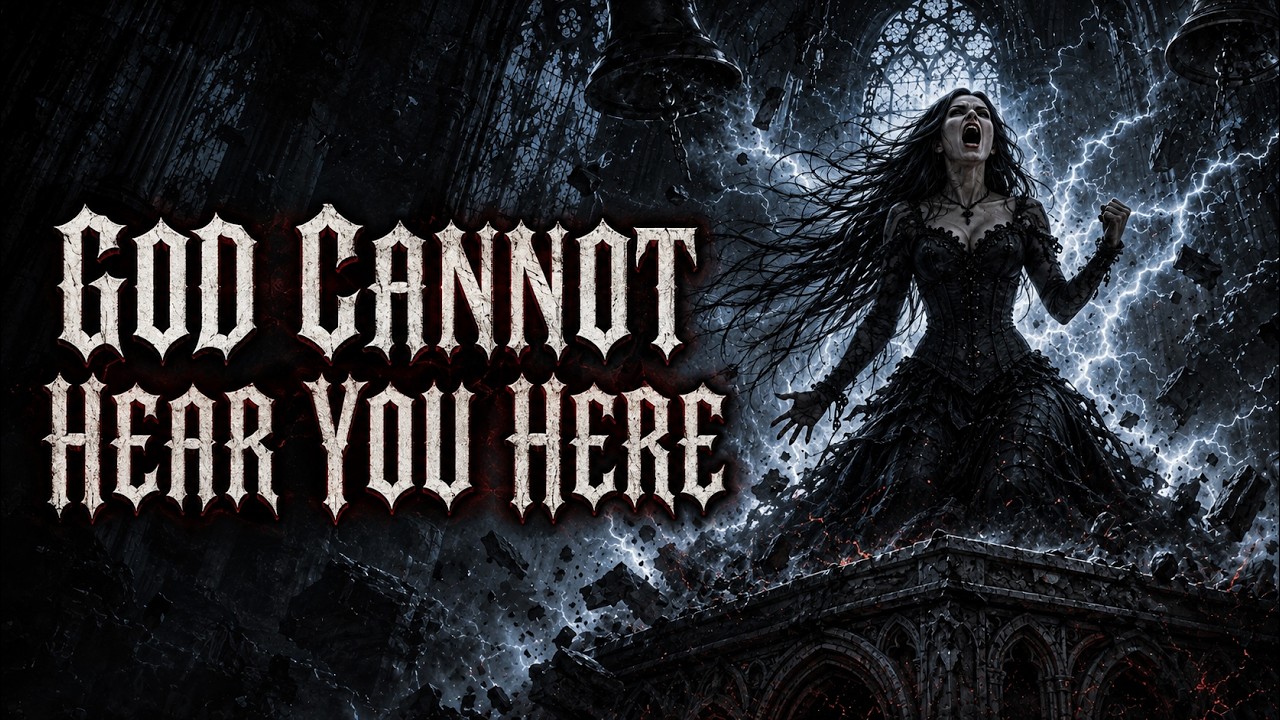
A woman is caught in a violent storm and finds refuge in an abandoned cathedral. At first it feels like safety. Then the doors will not open, the building changes around her, and something beneath the altar wakes.
The title became the central threat: GOD CANNOT HEAR YOU HERE. It works as a supernatural warning and as a boast from whatever controls the cathedral. Within the story it is the language of the monster, not a theological statement.
The emotional arc begins as conventional gothic horror, but the protagonist does not remain a victim. Fear turns into resistance, then defiance.
One of the pivotal moments is: “YOU WANTED ME AFRAID! YOU SHOULD HAVE LET ME PRAY!”
Later, the answer becomes more direct: “I CALLED FOR HANDS THAT NEVER CAME — NOW MINE WILL PUT YOU BACK IN CHAINS!”
By then she is no longer asking whether something will save her. She intends to deal with it herself. That reversal became the most important part of the piece.
The ancient thing beneath the altar believes the cathedral belongs to it. It believes isolation has made the woman powerless. Instead, trapping her with it may have been its mistake.
The final idea is summed up by the closing image: Heaven heard nothing. Below her, everything listened.
Musically, the track needed to feel as large as the cathedral. It was built as gothic metal / dark gothic horror, beginning with organ, thunder and bells before expanding into heavy downtuned guitars, ritual-style percussion and choir.
Vesper’s vocal follows the story from controlled wariness into a forceful confrontation, eventually breaking into ferocious screamed passages.
The hook remains deliberately simple: God cannot hear you here. The surrounding arrangement can become enormous, but that sentence survives unchanged because it is both the monster’s threat and the phrase the listener remembers.
The imagery — storm-lit stained glass, ruined arches, candlelight, statues, crypt stairs, graveyards and lightning — places the song squarely in Vesper Mourdant’s world, where elegance and danger often occupy the same room.
SOURCES & REFERENCES
Source status applies to the referenced material, not to the original Rhialto song.
Original Rhialto concept
God Cannot Hear You Here is an original Rhialto horror narrative. It is not an adaptation of a historical event, literary work, religious text or traditional story.
The ruined cathedral, storm, altar, crypt, statues and stained glass are used as gothic visual and narrative vocabulary rather than as representations of a specific real cathedral or religious event.
Gothic architecture reference
The museum reference provides context only. The song’s story, characters and supernatural premise are original Rhialto creative elements.