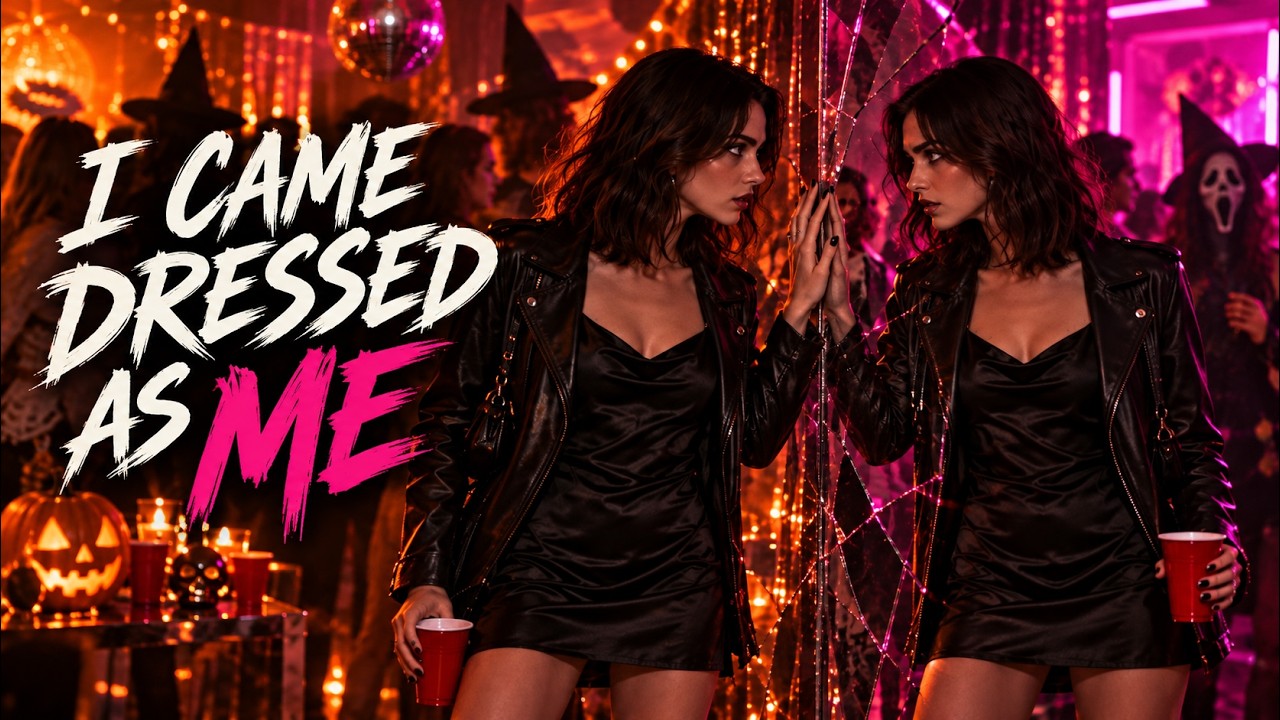
Vesper Mourdant arrives at a Halloween party without a costume—and finds another woman wearing her face, her clothes and her memories.
WRITING THE SONG
She came as herself.
That should have made the evening simple.
Then she sees the other woman.
Same face.
Same clothes.
Same memories.
The question at the centre of I Came Dressed as Me arrives immediately:
“I came dressed as me—
So who the hell is she?”
The party offers plenty of explanations for strange appearances.
This one becomes harder to explain away.
Halloween gives people permission to become someone else for a night.
Vesper does the opposite.
She arrives without a costume. Her identity is the one thing she expects to bring into the room without ambiguity.
That makes the double’s appearance especially unsettling.
Someone has chosen—or somehow acquired—the identity Vesper never thought of as a disguise.
The title begins as a straightforward statement.
The story turns it into a claim she may have to defend.
A matching outfit could be coincidence.
A convincing resemblance could be a trick.
Shared memories make the situation more difficult.
The published concept moves beyond visual duplication. The other woman appears to possess parts of Vesper’s life that an imitation should not contain.
That changes the threat.
Vesper is facing someone who can do more than look like her.
The double can make a competing claim to being her.
The party becomes increasingly impossible as the people around Vesper seem more certain about her identity than she does.
That is an important escalation.
At first, the problem is between Vesper and the other woman.
Then the room becomes part of it.
Other people’s confidence begins to weigh against Vesper’s own understanding of what is happening. The setting that should help confirm her identity instead makes it harder to hold onto.
A familiar face ought to provide reassurance.
Here, recognition becomes unreliable.
The party setting gives the impossible event somewhere to hide.
Everyone is already expecting disguises, performances and mistaken identities.
A strange encounter can be dismissed as part of the entertainment. A disturbing resemblance can be treated as an impressive costume.
That delays the moment when the situation becomes undeniable.
It also gives Vesper a particular kind of isolation.
She may be frightened in a room full of people who still think they are enjoying themselves.
The social setting remains active while her certainty begins to fail.
The central hook carries the premise without needing a long explanation:
“I came dressed as me—
So who the hell is she?”
The first half establishes Vesper’s confidence.
The second half breaks it.
The wording also keeps her reaction direct. She does not begin with an elaborate theory about doubles or supernatural forces.
She sees someone who should not be there.
She wants to know who that woman is.
The horror grows around a question the listener can understand immediately.
At the beginning, I Came Dressed as Me means that Vesper did not wear a costume.
Once the double appears, the same phrase becomes less secure.
It raises the possibility that “me” might be something another person can wear convincingly enough to be accepted.
That is the identity horror underneath the party story.
Vesper knows who she believes herself to be.
The room may no longer agree.
The published recording is described as a blend of dark electropop, UK garage and unsettling club energy.
That musical setting keeps the story inside the party.
The atmosphere can remain sleek and inviting while the situation becomes more disturbing. The surrounding nightlife does not have to stop for Vesper’s experience to turn frightening.
That contrast gives the music its tension.
The party continues.
Her understanding of it does not.
The recovered Short concept called for the identical woman to appear within the opening seconds.
That reflects the strength of the central visual idea.
The audience needs to see Vesper and someone who looks like her, then understand that Vesper did not expect this encounter.
The duplication supplies the immediate question.
The shared memories and the reactions of other people deepen it afterward.
The story can begin with a clear image and gradually make that image harder to interpret.
The double threatens more than Vesper’s appearance.
She threatens Vesper’s ability to be recognized as herself.
That makes the surrounding people important. Identity is personal, but it is also reinforced by other people remembering us, addressing us and believing our accounts of our lives.
When those forms of recognition become uncertain, Vesper loses the ordinary support that would help her challenge the impossible.
The question expands from who the other woman is to why everyone else seems so comfortable with her presence.
The strongest part of the premise is the collision between Vesper’s certainty and the evidence around her.
She knows she came as herself.
There is another woman who appears able to say the same thing.
The music leaves the listener inside that contradiction.
A Halloween costume is supposed to let someone borrow an identity temporarily.
I Came Dressed as Me asks what happens when the identity being borrowed is yours—and the person wearing it seems to know it as well as you do.
SOURCES & REFERENCES
Source status applies to the referenced material, not to the original Rhialto song.
I Came Dressed as Me is presented as an original Rhialto Halloween concept.
This Song Note draws on the published video description and recovered promotional development notes.
The central premise is an identical woman appearing at a Halloween party, with matching appearance, clothing and memories, followed by growing uncertainty about how the surrounding people recognize Vesper.
The doppelgänger is used as a horror motif. No specific literary work is claimed as the source.
Source status: Reference Sources Only