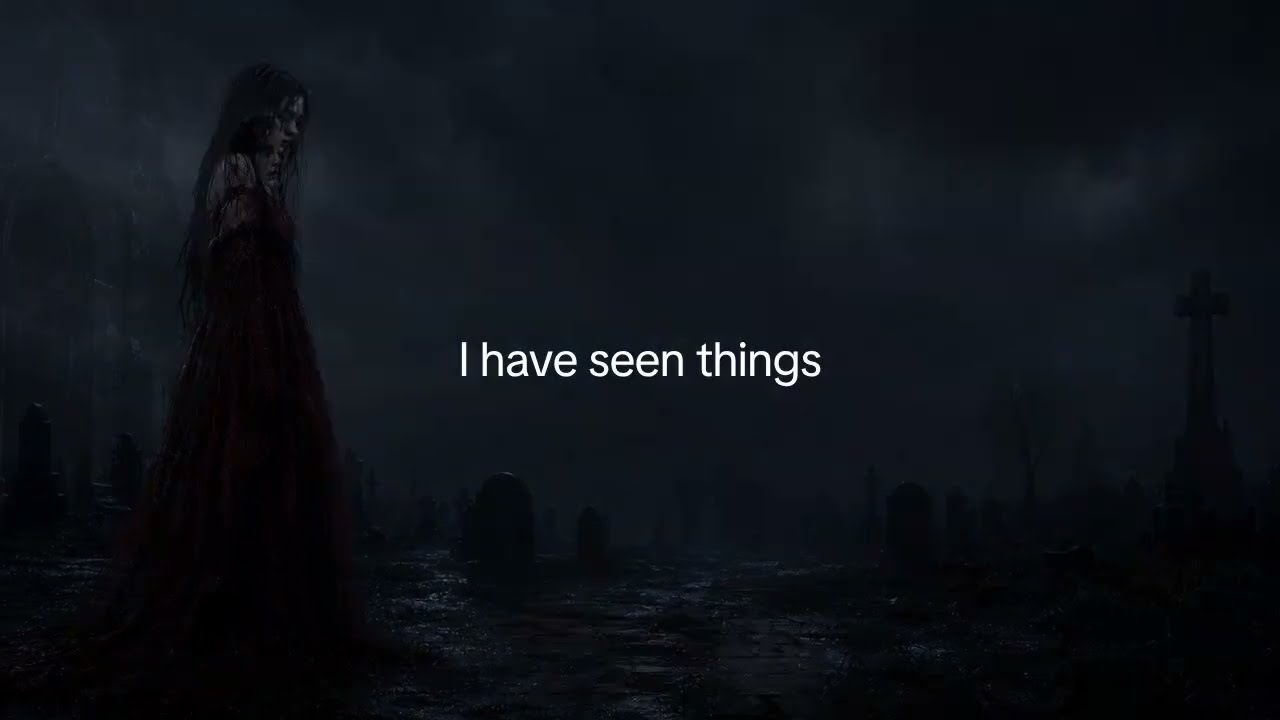
How three blunt lines became Vesper Mourdant’s ritual-darkwave confession about survival, guilt, black water, storms and coming back changed.
WRITING THE SONG
The song began with a chorus:
“I have seen things.
I have done things.
I have drowned in the rain.”
Everything else had to earn those three lines.
The first statement makes Vesper a witness.
The second makes her something more difficult.
The third makes the whole confession impossible.
You cannot literally drown in ordinary rain.
But that is precisely why the image works.
This is not a story about getting wet.
It is about surviving so much that even something as ordinary as rain begins to feel deep enough to disappear inside.
The first part of the hook could have produced a straightforward survivor anthem.
Vesper has crossed dark places.
She has seen violence, death, fear and things that should have remained hidden.
The imagery surrounding the song is deliberately gothic:
Chapel stone.
Black water.
Wolves.
Graves.
Storm clouds.
Ghosts.
Fire.
Knives.
The important thing, though, is that the song does not stay comfortably on the side of what happened to her.
The next line changes everything.
“I have done things.”
That is the dangerous line.
Vesper is not presenting herself as an untouched innocent who simply endured a hostile world.
She has acted inside it.
She has made choices.
Some may have been necessary.
Some may have been unforgivable.
Some may be impossible to classify cleanly from the other side.
That ambiguity gives the song more weight than a conventional survival narrative.
There is guilt inside the endurance.
There is agency inside the trauma.
The narrator does not ask the listener to decide whether she was right.
She simply refuses to lie about her own hands.
That makes the confession darker:
I survived what happened.
I also survived what I became capable of doing.
The title image was deliberately strange from the beginning.
I Have Drowned in the Rain.
Rain comes from above.
Drowning happens below the surface.
Putting the two together creates an impossible vertical world where there is nowhere obvious to stand.
That suits Vesper.
The song repeatedly surrounds her with water, storm and submerged imagery, but the title is less about a specific physical event than accumulated pressure.
One drop is nothing.
A thousand drops are weather.
Enough weather becomes a world.
The emotional logic is similar.
One memory can be carried.
One mistake can perhaps be explained.
One loss can eventually acquire a before and an after.
But when they accumulate, the distinction between walking through the storm and being underwater begins to disappear.
That is the meaning inside the impossible claim:
The rain became deep enough.
The song is not primarily about whether Vesper survives.
The title already tells us she does.
Someone is here to sing the confession.
The more interesting question is:
Who came back?
Survival is often treated in music as proof of restoration.
The narrator passes through the ordeal, reaches the final chorus and emerges stronger.
I Have Drowned in the Rain is less comfortable than that.
Vesper survives.
But survival does not restore an earlier version of her.
The person who returns has memories she cannot remove and actions she cannot undo.
The ghosts do not need to be literal.
They can be the people she remembers.
The choices she remembers.
The versions of herself she remembers.
Survival therefore becomes transformation rather than victory.
She came through.
That does not mean she came through unchanged.
The visual vocabulary gives the confession the scale of gothic myth without requiring a single literal storyline.
Chapel stone suggests judgment.
Grave soil suggests consequences that cannot be reversed.
Black water suggests depth without visibility.
Wolves introduce the feeling of being hunted—or of having learned how to hunt.
Storm clouds turn the landscape itself unstable.
These motifs work because Vesper is not simply travelling through a sequence of spooky places.
Each one reflects a different pressure inside the confession.
The chapel asks:
What do you answer for?
The grave asks:
What cannot be brought back?
The water asks:
How far down have you gone?
And the storm asks the question the title eventually answers:
How much can fall on one person before it becomes an ocean?
The production was designed specifically to avoid becoming a conventional slow gothic confession.
The original musical direction called for ritual darkwave built from primal percussion, a dark electronic pulse, deep drums, eerie synth drones and cathedral-scale reverb.
The opening was meant to begin immediately.
No spoken introduction.
Instead:
Wet, unfamiliar percussion.
Low humming.
Then the vocal.
That decision matters.
Vesper does not arrive to explain what happened before the song starts.
We enter after the ritual has already begun.
The verses remain tense and controlled.
Then the chorus opens dramatically around the central confession.
The contrast creates the sense that Vesper can contain individual memories—until the hook forces everything out at once.
Percussion is central to the track.
The original production idea used primal or tribal-feeling drums and a heavy floor-tom pulse almost like an enlarged heartbeat.
That physical rhythm makes the song feel less like someone remembering events and more like someone reliving them bodily.
The drums do not simply accompany the confession.
They make it ceremonial.
Each return of the hook feels like another repetition of something Vesper has already told herself many times:
I have seen things.
I have done things.
I have drowned in the rain.
The words begin as information.
Repetition turns them into an incantation.
One of the key production choices was a half-time ritual section.
Instead of continuing to escalate in the most obvious way, the track suddenly gains weight by moving more slowly.
The space between beats becomes larger.
The drums become heavier.
The atmosphere becomes more exposed.
That section gives the listener time to feel the accumulated images rather than simply hear them.
The song has been moving through storm, water, grave imagery and confession.
The half-time break turns those elements into something almost ceremonial.
It feels less like a bridge away from the song and more like descending further into it.
Then the full pulse can return.
Not as release.
As recurrence.
The verses and visual world can carry elaborate gothic imagery because the chorus does not.
That contrast was deliberate.
The central hook uses extremely ordinary words:
Seen.
Done.
Drowned.
Rain.
There is almost nothing decorative about them.
That gives the chorus authority.
After black water, chapel stone, wolves, storms and ghosts, Vesper does not need another elaborate metaphor.
She reduces everything to three statements.
The first is about memory.
The second is about responsibility.
The third is about survival becoming impossible to describe literally.
That simplicity is what allows the chorus to carry the entire track.
The production direction also called for ghostly backing harmonies.
They serve an interesting role.
A traditional harmony can make a lead vocal feel supported.
Here, the backing voices can feel less like support and more like recurrence.
Memories returning.
Past selves answering.
The dead refusing to remain entirely absent.
Or simply the central confession becoming too large for one voice.
The song never has to specify which interpretation is correct.
The effect is more useful if the listener cannot determine whether Vesper is being accompanied—or haunted.
Despite its imagery, the track was also meant to retain movement.
The original production brief described it as darkly danceable.
That contradiction is important.
A purely mournful arrangement would position Vesper outside the experience, looking backward.
Rhythm keeps her inside it.
The body continues moving even while the lyrics deal with death, guilt, memory and survival.
That fits the narrator.
She has not stopped.
Whatever happened, whatever she did, whatever followed her home—she is still moving.
The music therefore does not offer stillness as the answer.
The last chorus grows rather than resolves.
That distinction matters.
A larger final chorus normally implies emotional breakthrough.
Here it can feel more like accumulated evidence.
Everything we have heard returns behind the three central lines.
The graves.
The water.
The storm.
The ghosts.
The choices.
The survival.
The hook has not changed.
Vesper has.
By the time she sings it again, the listener understands more of what those simple statements contain.
Then the track moves toward a haunted outro rather than a clean conclusion.
Because there is no clean conclusion available.
The past has happened.
Survival has happened.
Transformation has happened.
What remains is the sentence Vesper carries out of the storm:
“I have seen things.
I have done things.
I have drowned in the rain.”
The song does not ask whether she escaped.
She did.
It asks what escape means when part of the darkness comes home with you.
SOURCES & REFERENCES
Source status applies to the referenced material, not to the original Rhialto song.
Original Rhialto concept
I Have Drowned in the Rain originated from the three-line hook “I have seen things / I have done things / I have drowned in the rain” and was developed as a gothic survivor confession built around black water, storms, graves, chapel stone, wolves, ghosts, guilt and transformation.
The piece does not derive from a specific public-domain literary work. Its primary source is the original Rhialto writing and production process.
The source status is therefore Reference Sources Only, distinguishing it from Rhialto adaptations built directly from public-domain literature, folklore or traditional music.