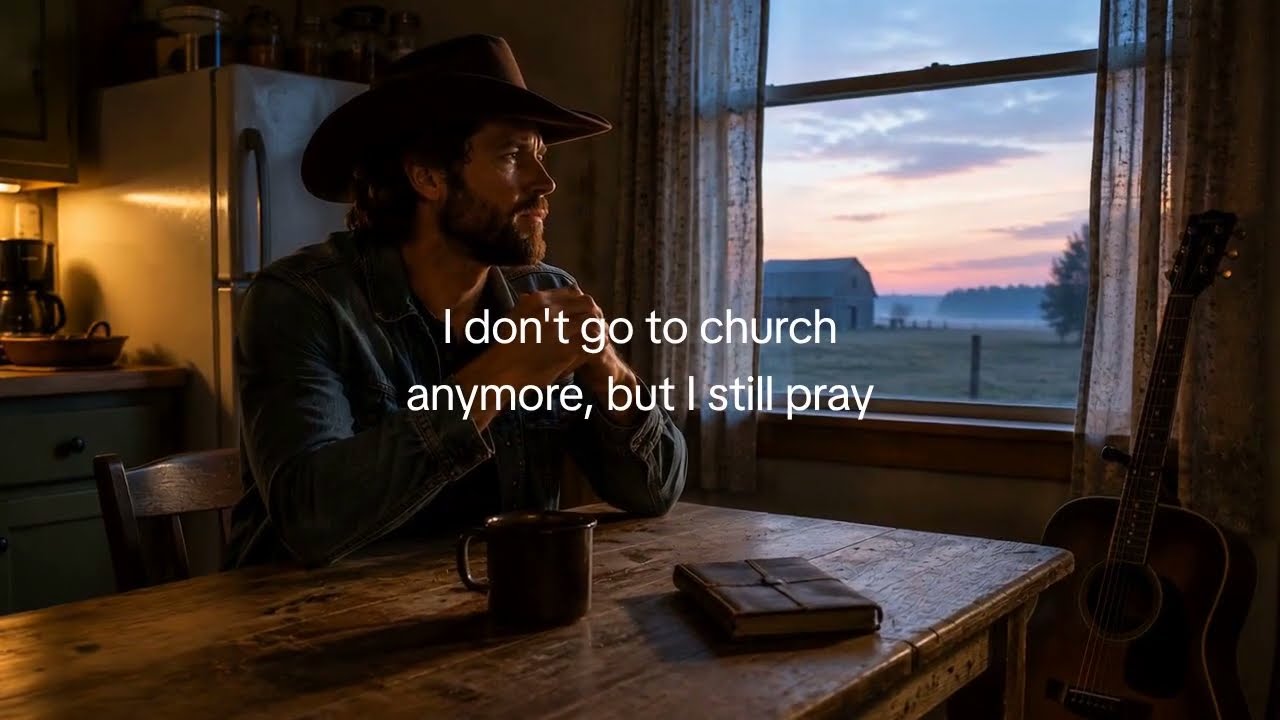
How a personal Baptist upbringing and later distance from organized religion became Mercy Road’s country-gospel reflection on belief, prayer and faith without easy certainty.
WRITING THE SONG
I was raised Baptist.
Sunday school was part of every week.
So was church.
As I got older, there were church youth groups and the wider community that came with them.
Faith was not an abstract idea I discovered later in life.
It was part of how I grew up.
Then I left Campbellton.
And gradually, something changed.
I did not stop believing in God.
I did not make a dramatic decision to reject religion.
I simply lost the church community that had once surrounded my faith.
I tried to find another church.
More than once.
But I never quite found one that fit the person I had become.
The belief remained.
The institution did not.
And through all of that—
I still prayed.
That is where I Still Pray really came from.
Growing up Baptist meant religion had structure.
There was Sunday school.
There were services.
There were youth groups.
There were familiar people, familiar rituals and a shared vocabulary for faith.
When you grow up inside that environment, belief and church can feel almost inseparable.
They arrive together.
God.
The building.
The congregation.
The hymns.
The people who teach you.
The people you grow up beside.
For a long time, I probably did not need to separate those things.
Then life did it for me.
Leaving Campbellton meant leaving more than a town.
It meant leaving the religious community I understood.
Once that happened, faith was no longer automatically attached to a particular place or congregation.
I tried to find that connection again.
I looked for churches that might feel right.
But the fit was never quite there.
Part of that was probably because I had changed.
My beliefs had become more personal.
My questions had become more complicated.
The kind of certainty that had felt natural when I was younger no longer fit as comfortably.
I had not stopped believing.
But I was no longer the same person who had sat in Sunday school every week.
That experience became one of the most important ideas behind the song.
There was no great break.
No moment when I said:
I am done with God.
If anything, the opposite was true.
I still wanted the connection.
What I could not find was an institution that felt like home.
That distinction matters because people often treat religion and belief as though they must rise and fall together.
For me, they did not.
My relationship with organized religion became distant.
My belief in God remained strong.
That personal history eventually became one of the defining ideas in the writing:
“I left the building years ago
But not the conversation.”
That line is much closer to autobiography than metaphor.
The building represents organized religion.
The conversation is prayer.
I may not have found another church community that fit who I had become.
But I never felt that leaving the building meant God had disappeared with it.
The conversation simply became more private.
That is also why I Still Pray became such an important early Mercy Road track.
Mercy Road could occupy a space I understood personally.
Not conventional worship music.
Not anti-religious music.
Not a rejection of God because organized religion had become complicated.
Something between those positions.
The core idea became:
Faith can survive even when your relationship with religion changes.
That felt much more honest to me.
One of the central lines became:
“Maybe faith is not an answer
Maybe it’s who you call.”
That gets close to how my own understanding of faith evolved.
When I was younger, religion often came packaged with answers.
As you get older, the questions become harder.
Why do certain things happen?
Why do prayers sometimes seem unanswered?
Why do good people suffer?
Why can sincere people believe very different things?
Eventually I became less interested in pretending I had solved those questions.
But uncertainty did not eliminate belief.
It changed what belief meant.
Faith became less about possessing an explanation for everything and more about maintaining the relationship.
Who do you speak to when you do not understand?
For me, the answer remained God.
That is why the title uses the word still.
I Still Pray.
The word carries the history.
After leaving Campbellton.
After drifting away from organized religion.
After trying unsuccessfully to find another church that felt right.
After becoming less certain about institutions and some of the answers they offered.
I still pray.
The habit survived because the belief survived.
One of the smallest lines in the song became one of the most important:
“Please come with me.”
I like it because it does not ask God to solve everything.
It does not demand a miracle.
It does not insist on understanding.
It simply asks for presence.
That feels closer to the kind of prayer that becomes important when certainty is gone.
Sometimes the prayer is not:
Fix this.
It is:
Do not let me face this alone.
Another central line became:
“I pray because the darkness
Feels different when I do.”
That may be the simplest explanation of why prayer persisted.
Prayer does not always change circumstances.
It does not guarantee that the thing you fear will disappear.
It does not guarantee an obvious answer.
Sometimes the darkness remains exactly where it was.
But the experience of standing inside it changes.
That difference is enough to matter.
For a long time, organized religion offers both belief and belonging.
When the belonging disappears, you find out whether the belief can stand by itself.
In my case, it did.
That did not mean I stopped missing the community.
There is something powerful about sharing faith with other people.
I tried to find that again.
But forcing myself into a church that did not feel right would have been less honest than admitting I had not found one.
So belief became more individual.
Prayer became less public.
But neither disappeared.
That is also why the song could not end with a conventional return-to-church narrative.
There was no point where I suddenly rediscovered the perfect congregation and everything snapped back into place.
That would not have been true.
The real ending is less tidy.
I still believe in God.
I still pray.
I still do not have every answer.
And I still have not found an organized religious home that feels completely right.
That unresolved truth is more important than manufacturing a neat conclusion.
This helped define Mercy Road as more than a country-folk persona.
Mercy Road could write about belief from the perspective of someone who still believes but has questions about institutions.
Someone who respects faith without pretending every church experience fits every person.
Someone who can pray without preaching.
Someone who can doubt without abandoning God.
That opened a much more interesting lane.
The musical direction needed to remain grounded.
The original production lane was contemporary country-gospel / Americana.
Warm acoustic guitar.
Piano.
Organ.
Bass.
Natural drums.
Pedal steel.
A weathered male vocal.
The arrangement begins intimately because the subject is intimate.
This is not a congregation singing.
It is one person talking to God.
The track specifically needed to avoid becoming a conventional modern worship production.
No enormous choir.
No giant inspirational climax.
No sermon.
No moment where the music announces that all doubt has been defeated.
That would contradict the whole reason the song exists.
Faith is present.
Uncertainty is present.
Neither has to eliminate the other.
Mercy Road needed a warm, weathered male vocal.
Not polished enough to sound like performance first.
Human first.
The singer should sound like someone who has actually spent years thinking about these questions.
That became one of Mercy Road's most important characteristics.
He does not need to sound certain.
He needs to sound sincere.
One of the production ideas was to reduce the arrangement around:
“Please come with me.”
That phrase needs space.
The music can almost step out of the way.
Then the instruments can gradually return.
The production should support the prayer rather than turn it into spectacle.
The final chorus can grow.
But it should never sound like a victory lap.
More harmony.
A fuller band.
More emotional weight.
But no sudden certainty.
The song does not end with:
Now I understand.
It ends with something much closer to my own experience:
I still believe.
I still pray.
And for this song, that is enough.
Several hooks ultimately tell different parts of the same story:
“I left the building years ago
But not the conversation.”
That is about organized religion.
“Maybe faith is not an answer
Maybe it’s who you call.”
That is about how belief changed.
And:
“I pray because the darkness
Feels different when I do.”
That is about why prayer remained.
Together, those lines explain the song better than any theological argument could.
When I think about I Still Pray, I do not see it as a song about losing religion.
I see it as a song about discovering what remained after parts of religion fell away.
I was raised Baptist.
I went to Sunday school.
I attended church and youth groups.
That shaped me.
Then I left Campbellton and gradually drifted away from organized religion.
I tried to find another church that fit.
I never quite did.
But somewhere underneath all those changes, one thing remained remarkably consistent.
I believe in God.
And I still pray.
SOURCES & REFERENCES
Source status applies to the referenced material, not to the original Rhialto song.
Personal Rhialto story
I Still Pray grew directly from Scott LeBrun’s own religious history: being raised Baptist in Campbellton, attending Sunday school and church youth groups, then drifting away from organized religion after leaving Campbellton while retaining a strong belief in God and continuing to pray.
The song was developed as a foundational Mercy Road track about the separation between institutional religion and personal faith: leaving the building without ending the conversation.
The piece is an original Rhialto concept rather than an adaptation of a specific scripture, hymn or public-domain work.