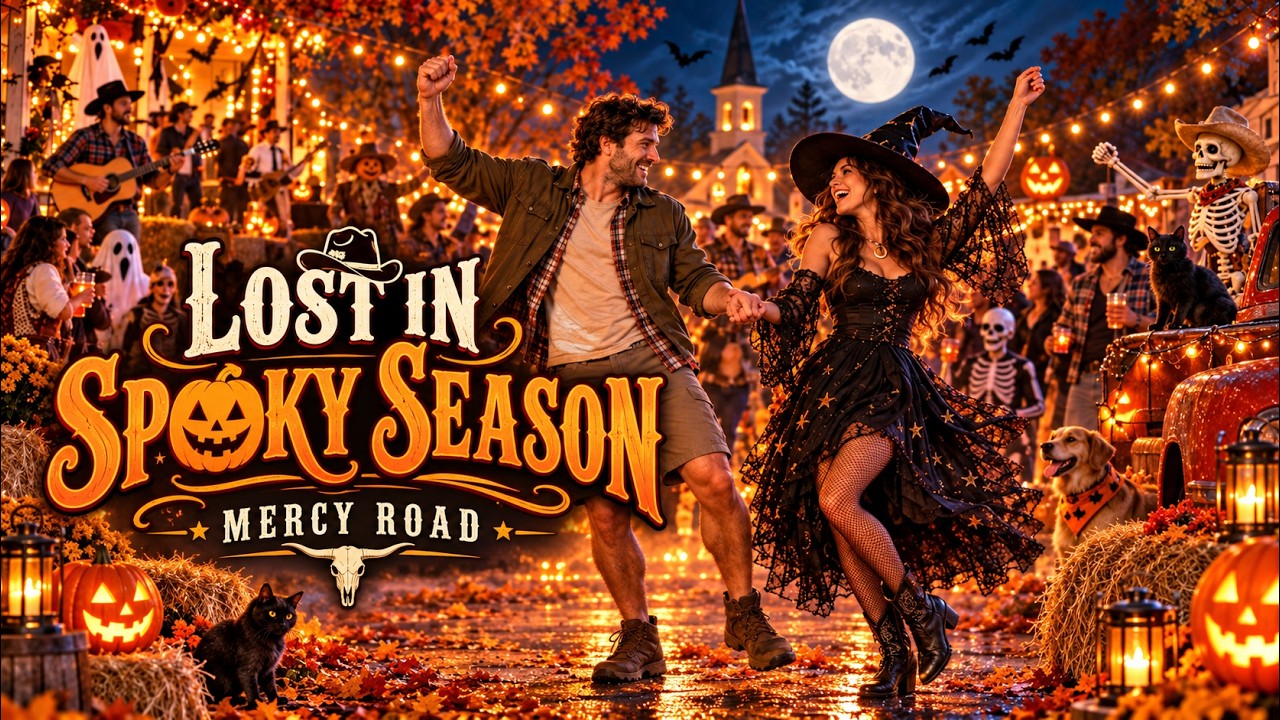
Mercy Road turns an unexpected Halloween takeover into a fast, flirtatious country party, where being unprepared soon becomes an excuse to stay.
WRITING THE SONG
October has arrived.
The decorations are already up. Costumes are appearing everywhere. Someone has decided that an ordinary trip to the pharmacy needs a witch.
The narrator is still catching up.
Lost in Spooky Season begins with that familiar feeling of a season arriving before you are ready for it—and turns it into a fast, flirtatious Halloween party.
The original brief called for a silly spooky-season track with heavy Halloween imagery, a retro party feel and a narrator who has become lost in the excitement.
The central phrases give that idea its shape:
“Lost in spooky season.”
“I wasn’t ready for this.”
One names the situation. The other supplies the reaction.
Being unprepared gives the narrator somewhere to begin. He can complain about the sudden Halloween takeover while gradually finding reasons to enjoy it.
That is where the humour lives.
His words suggest he has been caught off guard. His attention suggests he might be quite happy to stay.
The early lyric draft brings Halloween into everyday life.
A pharmacy witch is especially useful because she places the seasonal invasion somewhere familiar. The narrator does not have to enter a haunted castle to discover that October has taken over.
He encounters it while going about his day.
The phrase “three fake vampires ago” extends the joke. Costumed people have become so common that they can almost serve as a way of measuring time.
These details make the setting recognizable.
Halloween is spreading through shops, streets and social plans faster than the narrator can adjust.
The midnight-witch costume gives the party a more personal attraction.
The development draft describes a black dress, tall boots, a silver moon chain and a crooked hat.
Those details establish a particular person within the surrounding Halloween crowd. The narrator’s attention has shifted from the season in general to someone he wants to keep looking at.
That shift helps the premise move forward.
At first, he is overwhelmed by everything happening around him.
Then he finds something—or someone—that makes the confusion appealing.
His lack of readiness starts to sound less like a complaint and more like an admission.
The vampires, witch costumes and broom joke belong to a social Halloween world.
People are dressing up, showing off and enjoying the permission to be a little ridiculous.
The original request was for a silly seasonal party track, and the writing keeps that mood at the centre. The narrator can be surprised, distracted and tempted without the evening becoming a nightmare.
The costumes give him things to react to.
His reactions give the track its personality.
The musical brief combined 1950s rockabilly, early-1960s dance-party energy and modern country.
The intended pace was fast: roughly 150–160 BPM.
Development notes called for upright bass, twangy electric guitar, acoustic rhythm, drums, organ, sax or brass accents, and group backing vocals. Those were the requested ingredients for the arrangement, rather than a claim about how every sound in the finished recording was produced.
The aim was a lively Halloween party with a country-folk personality.
The brief also asked to avoid a novelty-record feel. That distinction matters to the writing: the seasonal jokes should support a track people can enjoy dancing to.
The narrator’s humour needs to travel with the rhythm.
The title allows two readings.
The narrator has lost track of how quickly the season arrived. He is surrounded by decorations, costumes and plans he did not quite prepare for.
He is also becoming absorbed in it.
The party, the flirtation and the surrounding spectacle give him reasons to stop trying to get his bearings.
That makes Lost in Spooky Season a useful title for the whole experience. It holds both the initial confusion and the enjoyment that follows.
The recovered lyric draft closes with:
“Wake me up sometime in November.
Maybe.”
The final word completes the joke.
November offers a way out of the seasonal chaos, but the narrator no longer sounds entirely committed to taking it.
He was not ready for Halloween.
Now he may not be ready for it to end.
Lost in Spooky Season turns the feeling of falling behind October into the pleasure of getting carried away by it.
SOURCES & REFERENCES
Source status applies to the referenced material, not to the original Rhialto song.
This is an original Rhialto concept developed for Mercy Road.
The note draws on the original creative brief, recovered lyric and musical-development drafts, and the published video description.
Quoted lines come from the development draft. No specific nursery rhyme or literary work is claimed as a source.
Source status: Reference Sources Only.