How the public-domain Ta-Ra-Ra Boom-De-Ay cadence became a Vesper Mourdant monster-ballroom anthem where Victorian etiquette collapses into decadent Halloween chaos.
WRITING THE SONG
Manners Be Damned began with a piece of music almost everyone recognizes even if they cannot name it:
Ta-ra-ra boom-de-ay.
The phrase comes from the late-19th-century music-hall song “Ta-Ra-Ra Boom-De-Ay.”
That instantly suggested something theatrical.
Old-fashioned.
A little ridiculous.
And potentially perfect for Halloween.
The idea was not to reproduce the original song.
Instead, I wanted to take the recognizable rhythmic shape of its chorus and collide it with a completely different world:
a formal Victorian monster party that gradually loses all sense of decorum.
That contrast became the entire concept.
At the beginning, everything is elegant.
The invitation has been sent.
The room is dressed properly.
Crystal catches the candlelight.
The guests arrive looking as though they have stepped out of another century.
They are expected to behave.
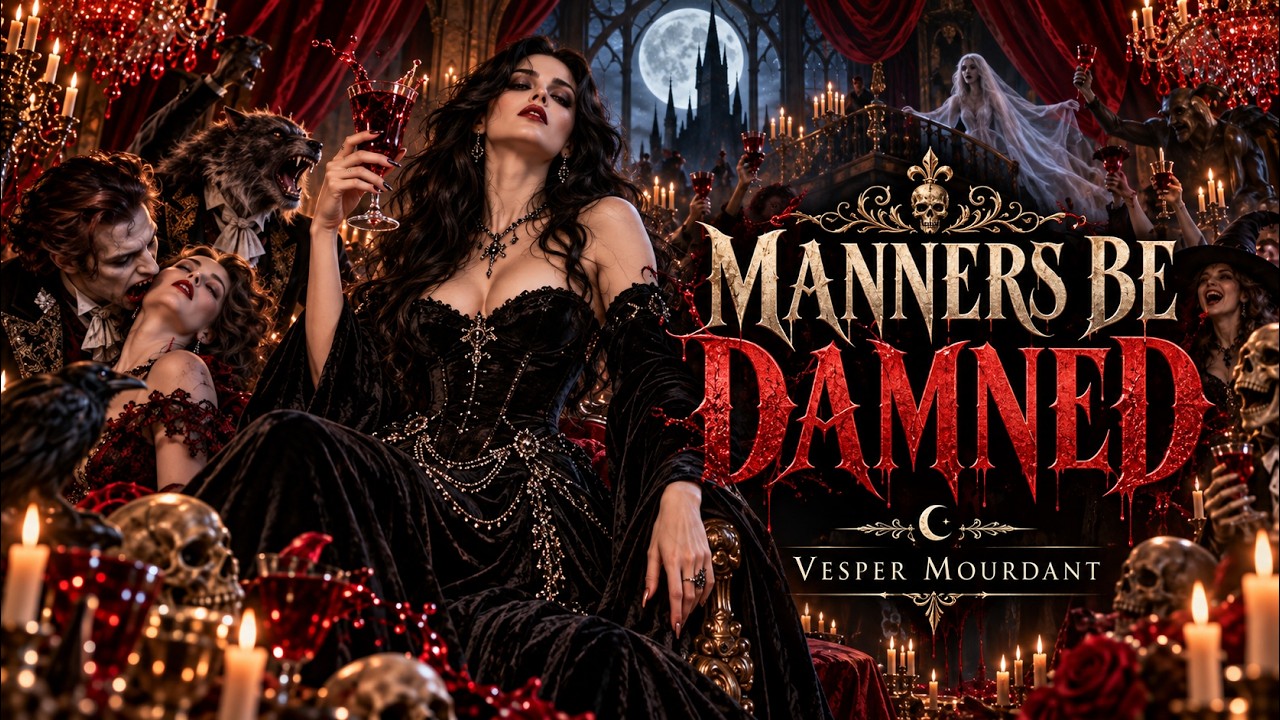
Unfortunately, the guest list includes vampires, ghosts, witches, demons and werewolves.
So good manners never really have much of a chance.
The title came from the moment when everyone finally stops pretending.
Manners Be Damned.
That phrase gave Vesper the right role in the piece.
She is not frightened by the party.
She is not trying to escape it.
She is effectively hosting the collapse.
The monsters do not scare her.
Bad behaviour does not offend her.
If anything, she seems disappointed that everyone spent so much time pretending to be civilized.
That makes this a different kind of Vesper Halloween track.
There is horror imagery, but the song is not really about fear.
It is about permission.
Permission to stop behaving.
Permission to ruin the room.
Permission to become exactly what the costumes and titles have been hiding.
The early verses therefore keep one foot in formal society.
There are glasses.
Introductions.
Polite conversation.
A sense that someone might still be keeping track of which fork belongs to which course.
Then the evening begins slipping.
The Count overdoes the drinks.
A ghost passes directly through a duchess.
A femur rolls across the floor.
The werewolf destroys the settee.
A witch decides the pianist is playing the wrong music and solves the problem herself.
Each incident pushes the room further away from etiquette.
And each time, the party gets better.
That progression was important.
The ballroom does not suddenly become chaotic.
Civilization disappears one rule at a time.
That is where the old music-hall cadence becomes useful.
The familiar rhythm carries something that initially sounds almost respectable and theatrical.
Then the chorus detonates:
TA-RA-RA—BOOM-DE-AY
MANNERS BE DAMNED—MISBEHAVE
The old cadence survives.
But the meaning has been completely repurposed.
The hook is no longer introducing a polite music-hall performer.
It is giving an entire ballroom permission to lose control.
From there, the monster behaviour escalates.
Vampires raid the cellar.
Witches change the music.
Ghosts waltz straight through the crowd instead of around it.
A demon and a debutante decide introductions are unnecessary.
The werewolf wrecks another piece of furniture and—perhaps out of habit—still apologizes afterward.
That small contradiction is one of my favourite parts of the concept.
Even after civilization has collapsed, pieces of etiquette remain.
The monsters cannot quite decide whether they are behaving badly or simply enjoying themselves properly for the first time.
That leads to another important Vesper line:
Ruin it beautifully.
That is almost the philosophy of the song.
Chaos does not have to be ugly.
The ballroom can be destroyed with style.
A chandelier can fall in the middle of the dance floor and become part of the party.
A formal waltz can mutate into something much heavier and more modern.
The monsters can abandon every social rule while still looking spectacular doing it.
That balance keeps the track inside Vesper Mourdant’s world.
She is not hosting a sloppy costume party.
This is decadent chaos.
Velvet.
Candlelight.
Champagne.
Blood-red crystal.
Formalwear.
Fangs.
Broken furniture.
And people dancing through the wreckage as though the destruction was part of the entertainment.
Musically, the song was designed to bridge two periods.
The public-domain “Ta-Ra-Ra Boom-De-Ay” cadence gives it an immediate connection to late-19th-century popular entertainment.
But the finished track pushes that material into a much more modern Halloween-party sound.
The goal was not nostalgia.
It was collision.
Victorian ballroom energy meets gothic club music.
Old theatrical rhythm meets modern percussion and low-end.
Polite social choreography eventually becomes a full monster dance floor.
That also gave the track a strong visual identity.
The room should begin almost too perfect.
Everyone posed properly.
Everything symmetrical.
Nothing out of place.
Then each chorus should loosen the frame.
Guests move faster.
Costumes become less composed.
Furniture shifts.
Glasses spill.
The supernatural guests stop hiding what they are.
By the end, the ballroom should look magnificent and completely destroyed.
And still nobody wants to leave.
The climax comes when the chandelier finally falls.
That should normally end a party.
Here, everyone simply keeps dancing.
Because by then the room has accepted its new rule:
Manners be damned.
The final joke is that after all the destruction, all the monsters, all the broken furniture and supernatural misconduct, somebody can still look across the wreckage and say:
Well. That was civilized.
That line closes the circle.
The guests began the evening trying desperately to behave like respectable people.
They end it surrounded by destruction.
And somehow, in their own world, they still consider the evening a social success.
SOURCES & REFERENCES
Source status applies to the referenced material, not to the original Rhialto song.
Public-domain music source
Manners Be Damned takes inspiration from the recognizable chorus cadence of the late-19th-century popular song “Ta-Ra-Ra Boom-De-Ay.”
A published 1891 score survives in the New York Public Library Digital Collections. The library identifies that historical score as public domain in the United States.
Rhialto does not reproduce a modern recording or arrangement. The new song uses the old public-domain musical idea as a starting point and supplies an original Halloween story, lyrics, hooks, arrangement, production and monster-ballroom setting.
Original Rhialto concept
The Victorian monster party, Vesper’s role as instigator, the escalating breakdown of etiquette, monster-party incidents, “Manners Be Damned — Misbehave,” “Ruin it beautifully,” the falling chandelier and the closing joke are original Rhialto creative elements.