How Vesper Mourdant turned a masked midnight midway into the seductive entry point of The Carnival After Midnight, where one rule matters: don’t take off your mask.
WRITING THE SONG
Midnight on the Midway was built to be one of the most immediately inviting tracks on The Carnival After Midnight.
That mattered because the carnival could not become frightening too quickly.
If every attraction announced itself as dangerous, nobody would willingly keep walking deeper inside.
So this track had a different job.
Make the carnival irresistible.
The lights are spinning.
The rides are moving.
Performers drift through the crowd.
Masked strangers dance between the tents.
Music spills from every direction.
For a few minutes, this strange place feels less like a trap and more like the best Halloween night imaginable.
That is where the main hook came from:
Meet me at midnight on the midway.
It needed to arrive quickly.
Almost like an invitation shouted across the carnival.
Not:
Be careful.
Not:
Something is wrong.
Just:
Meet me there.
That makes Vesper important.
She is not standing outside the carnival warning the listener away.
She is already inside.
And she knows exactly where to go.
That is one of the first clues that her relationship with the carnival is not normal.
She never seems lost.
She does not study a map.
She does not hesitate at the intersections.
She knows which path leads deeper.
At this stage of the album, that familiarity can still feel exciting.
Vesper is the perfect guide.
Later, it becomes suspicious.
The story takes place in that space before suspicion becomes certainty.
The midway is crowded.
People are laughing.
Rides throw coloured light across the tents.
Barkers call from painted booths.
Shadows stretch across the ground.
Reflections appear in mirrors and polished ride metal.
Almost everyone is wearing a mask.
That gave the song its second major hook:
Don’t take off your mask.
At first, that can sound playful.
It is Halloween.
Everyone is dressed for the night.
Keeping the mask on fits the party.
Then the line repeats.
And begins to feel less like a suggestion.
Why shouldn't you take it off?
Nobody explains.
That was important.
The carnival works best when its rules arrive before their explanations.
By the time someone asks why a rule exists, they are already depending on it.
The masks also serve several purposes inside the larger story.
They hide identity.
They make strangers interchangeable.
They allow people to become performers without realizing it.
And they make it difficult to tell who arrived tonight and who has always belonged to the carnival.
That uncertainty becomes increasingly important later in the album.
At midnight, it is still mostly atmosphere.
You pass someone wearing a beautiful porcelain mask.
Then perhaps see the same mask ten minutes later on the other side of the midway.
Maybe it is the same person.
Maybe it is not.
A performer disappears into a crowd.
Someone with the same coat emerges somewhere else.
Reflections do not always match the people standing in front of them.
Nothing is openly attacking anyone.
But the carnival has started bending slightly around the people inside it.
The moment the clock reaches twelve is therefore the turning point.
Before midnight, the carnival feels strange.
After midnight, it begins to respond.
Lights flash in sequence.
Ride machinery starts without operators touching it.
The crowd changes direction almost as one body.
The Ferris wheel lights form patterns that seem deliberate.
A row of bulbs goes dark just as someone passes beneath them.
A shadow moves in the wrong direction.
The effect should be subtle.
This is not yet Dance of the Crooked Clowns.
Nobody is running.
There is no survival rule beyond the mask.
There is only the growing sense that the carnival is aware of its guests.
That is why Midnight on the Midway needed to be musically accessible.
The foundation is gothic dark synthpop / electropop.
Strong synth bass.
Fast sequencers.
A clear dance groove.
Processed carnival organ.
Calliope fragments.
A chorus that arrives quickly and can stand on its own outside the album.
Among the Carnival tracks, this was meant to feel like one of the most conventional singles.
The darkness sits around the edges rather than dominating the song.
That restraint matters.
If the production becomes too warped too early, the listener understands the carnival's true nature before the story wants them to.
So the first sections should feel exciting.
The bass drives forward.
The chorus feels big.
The midway seems alive.
Vesper's vocal remains controlled and inviting.
She is not frightened.
She wants you to follow.
Then small musical problems begin appearing.
The carnival organ drifts slightly out of tune.
A sound returns from the wrong side of the stereo field.
A clock appears in the mix.
The calliope phrase feels older every time it repeats.
A background vocal echoes a fraction too late.
Nothing destroys the dance track.
But something has entered it.
The lyric idea “Keep your eyes on me, not the time” became another important clue.
On the surface, it sounds flirtatious.
Vesper is telling the listener not to worry about the hour.
Stay with her.
Keep dancing.
Ignore the clock.
But within the album, the line becomes more suspicious.
Why does she specifically not want you watching the time?
Because midnight matters here.
Time behaves strangely inside the carnival.
Later tracks make that much clearer.
The Ferris wheel can trade years between riders.
The carousel can steal decades.
Dawn does not necessarily release anyone.
So Midnight on the Midway quietly introduces time as something the carnival can manipulate before the listener knows how dangerous that will become.
That gives the track another role inside the album.
It establishes the carnival's language.
Masks.
Circles.
Clocks.
Lights.
Repeated melodies.
Reflections.
Shadows.
Vesper's familiarity.
None of those details has to be explained yet.
They simply accumulate.
The listener should finish the track having had a good time while also feeling that something has shifted.
That is the precise emotional target.
Attraction with the first trace of unease.
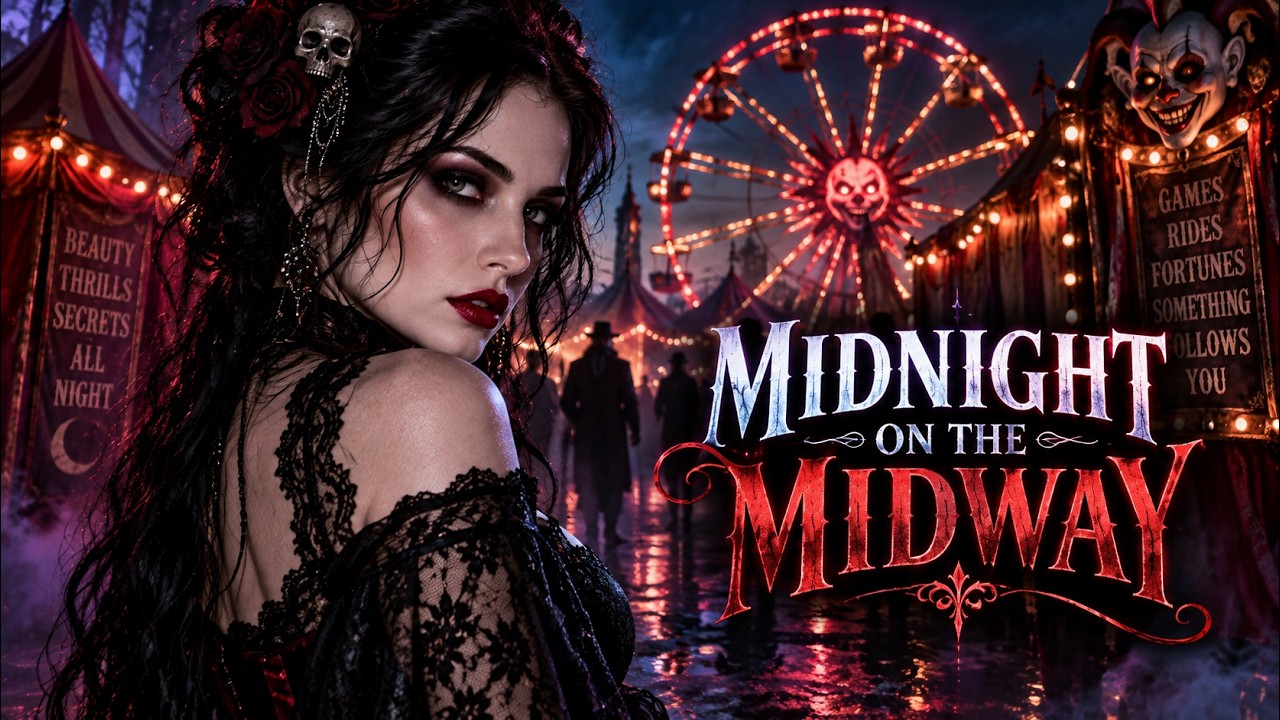
Visually, the midway should feel enormous.
The Ferris wheel dominates the distance.
Rows of old bulbs stretch into darkness.
Canvas tents create corridors.
Masked people pass close to the camera.
Performers appear and disappear.
Fog catches the coloured light.
The palette stays inside the wider Carnival world:
Black.
Midnight blue.
Deep violet.
Tarnished gold.
Hints of sickly green.
Occasional red.
Vesper remains the visual anchor.
The crowd can become confusing.
She does not.
That supports another recurring idea:
Keep your eyes on me.
The listener begins using Vesper as the one stable point in an increasingly unstable place.
Which becomes dangerous because Vesper is also leading them farther inside.
That ambiguity is essential.
Is she protecting the listener?
Guiding them?
Recruiting them?
Repeating something that was once done to her?
The album eventually provides more information, but Midnight on the Midway should not answer those questions.
It only needs to plant them.
The final chorus should feel larger than the earlier ones.
The carnival is now fully awake.
The crowd is dancing.
The lights are moving faster.
Everything reaches the peak promised by the title.
Meet me at midnight on the midway.
Then the music stops.
Abruptly.
No long fade.
No elegant conclusion.
The dance disappears.
What remains is distant machinery.
A ride still turning.
Metal moving somewhere beyond the lights.
Perhaps a generator.
Perhaps the Ferris wheel.
The carnival continues even though the song has stopped.
That ending is the first real crack in the fantasy.
The party seemed to exist because people were there.
The final seconds suggest something else.
The carnival does not need them.
It was already running.
It will keep running.
And now that midnight has arrived—
the listener is inside.
SOURCES & REFERENCES
Source status applies to the referenced material, not to the original Rhialto song.
Original Rhialto concept
Midnight on the Midway is an original Rhialto / Vesper Mourdant supernatural dark-carnival story developed for The Carnival After Midnight.
The midnight invitation, masked midway crowd, Vesper's unexplained familiarity with the carnival, the instruction “Don't take off your mask,” the hook “Meet me at midnight on the midway,” the time warning “Keep your eyes on me, not the time,” and the abrupt machinery-only ending are original Rhialto creative elements.
The track uses general travelling-carnival imagery — midway lights, Ferris wheels, barkers, masks, tents, performers and illuminated rides — as setting and genre vocabulary rather than adapting a specific literary work, legend or historical event.