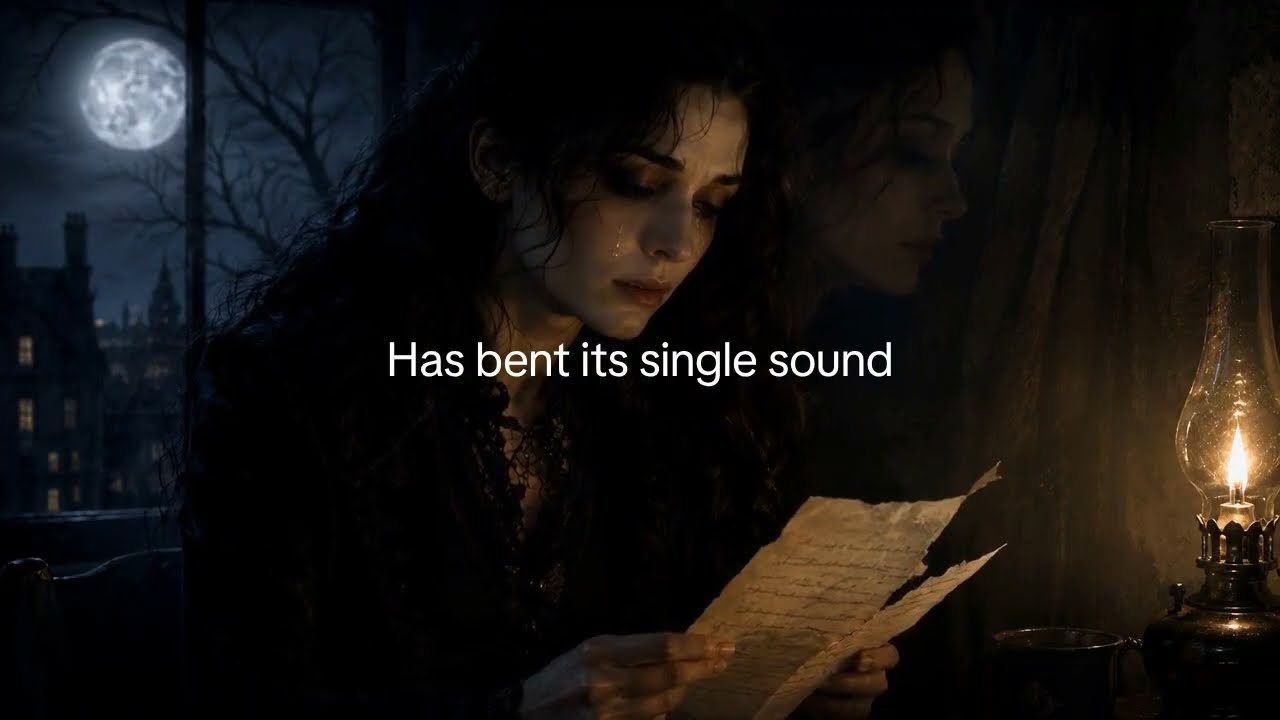
How Shakespeare’s Sonnet 71 became gothic darkwave about grief, fading memory and loving someone enough to let them forget you.
WRITING THE SONG
No Longer Mourn began with Shakespeare’s Sonnet 71.
Its opening line is remarkably direct:
“No longer mourn for me when I am dead.”
There is no attempt to avoid mortality.
The speaker imagines the funeral bell already ringing.
He imagines himself gone from the world.
He even imagines his body physically returning to the earth.
But the poem’s real concern is not his death.
It is what his death will do to the person left behind.
That reversal is what interested me.
Most writing about loss concentrates on the survivor:
How do I remember you?
How do I keep you with me?
How do I survive your absence?
Shakespeare turns the perspective around.
The dead person effectively says:
Do not let loving me become something that keeps hurting you.
That is a difficult kind of love.
And it gave the Rhialto version its emotional centre.
The title phrase—
No Longer Mourn
—can sound cold if separated from its context.
But the poem is not telling the beloved to stop caring.
Quite the opposite.
The speaker loves this person enough that he would rather be forgotten than remain the cause of their pain.
That makes forgetting an act of tenderness.
Which is a strange and powerful idea.
The music therefore needed to avoid becoming a conventional gothic lament.
The obvious treatment would be:
death,
graveyard,
bells,
darkness,
mourning,
huge emotional climax.
Those elements are present.
But they are not the point.
The real conflict is between memory and mercy.
If remembering someone keeps reopening grief, is forgetting them a betrayal?
Or can letting them fade become one final form of love?
That question shaped the adaptation.
One of the most important images in Sonnet 71 is the written page itself.
Shakespeare imagines the beloved reading his words after his death.
The poem has survived him.
His hand has not.
That creates an eerie situation.
The speaker is dead, but his voice is still present because the reader is holding the thing he wrote.
In a modern context, that idea becomes even stronger.
A recording can outlive the singer.
A video can continue playing.
A voice can still fill a room after the person who made it is gone.
A message can appear on a screen years later.
That gave No Longer Mourn another layer.
The music itself becomes the surviving object.
The listener is hearing someone who is simultaneously asking not to be remembered.
That paradox suited darkwave perfectly.
The production needed to feel as though it already belonged to memory.
Not completely distant.
Not completely present.
A low electronic pulse.
Muted drums.
Long reverberant synths.
Sparse piano.
Occasional guitar textures that appear and disappear before they fully resolve.
And underneath it—
a bell.
The bell comes directly from Shakespeare’s poem.
But I did not want a giant theatrical funeral bell crashing through the arrangement.
It works better if the bell feels far away.
Something heard through fog.
Or through walls.
A sound that confirms an event already happened.
The singer does not react to it dramatically.
The bell is simply there.
Death is not approaching.
It has already been accepted.
That distinction changes the entire performance.
The vocal should not sound terrified.
It should sound intimate.
Controlled.
Almost conversational.
This is someone trying to prepare the person they love for an absence that cannot be prevented.
That makes restraint more effective than melodrama.
The darkest image in the sonnet is also one of its most physical.
The speaker imagines himself returned to clay and the earth.
Shakespeare refuses to romanticize the body after death.
That gave the visual concept a useful contrast.
The remembered person can appear almost beautiful:
old photographs,
soft light,
letters,
a silhouette,
a familiar room.
But the language keeps reminding us that memory is preserving something the physical world does not.
The body disappears.
The name remains.
The handwriting remains.
The voice remains.
For a while.
That phrase—
for a while
—became important to the Rhialto interpretation.
Because Sonnet 71 eventually asks for even the name to disappear.
Do not keep repeating it.
Do not preserve grief forever.
Let love end when the life ends if continuing it causes pain.
That is an astonishing request for a writer.
A writer normally hopes words will survive.
Shakespeare creates a speaker who effectively says:
If these words hurt you—
put them down.
That became the emotional turning point of the track.
The first half still holds onto memory.
Objects remain.
The voice remains.
The room remains recognizable.
But gradually the arrangement begins removing things.
Percussion becomes simpler.
The bass pulse weakens.
Instrumental layers stop returning.
The bell becomes less frequent.
The backing vocals disappear.
The music begins performing the act the speaker is requesting.
It starts forgetting itself.
That was the production idea I found most interesting.
Instead of building toward the conventional huge final chorus, No Longer Mourn should gradually lose information.
A melody that appeared clearly earlier returns only partially.
A harmony arrives without one of its notes.
A vocal phrase loses its answer.
Reverb lasts longer than the sound that created it.
The music becomes less complete as it moves forward.
Like memory.
At first, we remember everything.
The voice.
The face.
A room.
A particular day.
A sentence someone used to say.
Then details disappear.
Not necessarily because we chose to erase them.
Because memory changes.
That natural fading becomes the mercy Shakespeare’s speaker is asking for.
The visual language can follow the same progression.
At the beginning, the lost person appears in recognizable fragments.
A hand writing.
A coat hanging beside a door.
A photograph.
A chair.
A page containing words.
Later, those objects remain but their significance begins slipping.
The photograph fades.
The handwriting becomes harder to read.
The coat disappears from the hook.
Dust covers the desk.
The room stops looking inhabited.
Nothing supernatural needs to happen.
Time is enough.
That is what makes the concept gothic without requiring a ghost.
Absence itself becomes the haunting.
The world moves on.
And that movement creates another important idea from the sonnet.
Shakespeare’s speaker worries not only about the beloved’s private grief but about the world witnessing it.
The outside world can be cruel.
It can judge.
Mock.
Misunderstand.
That adds another reason for the request to let go.
The speaker does not want the beloved permanently identified by mourning.
Do not become:
the person who lost me.
Do not let my death become your identity.
That interpretation made the piece feel more contemporary.
People often describe grief as proof of love.
The deeper the grief, the deeper the love.
The longer someone mourns, the more faithful they appear.
Sonnet 71 challenges that idea.
The speaker does not ask for endless suffering as evidence that the relationship mattered.
He asks for the opposite.
Live.
Forget me if necessary.
Do not perform grief for anyone.
That is why the song’s emotional direction ultimately moves away from darkness.
Not toward happiness exactly.
Toward release.
The final section should sound almost empty.
The bell does not return.
The rhythm stops.
The huge gothic space that surrounded the vocal earlier has disappeared.
Only a small fragment remains.
Perhaps voice.
Perhaps piano.
Perhaps neither for very long.
The final effect should not feel like someone being violently erased.
It should feel like someone quietly stepping out of the room.
That is the difference between abandonment and permission.
The speaker is not saying:
You will forget me.
He is saying:
You are allowed to.
That is what No Longer Mourn ultimately became for me.
A piece about the strange generosity contained inside a request most people would be afraid to make:
When I am gone,
do not prove your love by suffering forever.
If remembering me becomes a wound—
let me disappear.
SOURCES & REFERENCES
Source status applies to the referenced material, not to the original Rhialto song.
William Shakespeare — Sonnet 71
The principal literary source for No Longer Mourn is Shakespeare’s public-domain Sonnet 71, beginning:
“No longer mourn for me when I am dead.”
In the sonnet, the speaker imagines his own death and asks the beloved not to prolong their grief. He even asks that his name and written words be forgotten if remembering him would cause pain.
The poem is notable for turning remembrance into a complicated form of love: the speaker values the beloved’s future peace more than his own continued presence in memory.
Rhialto’s adaptation develops that idea into a contemporary gothic-darkwave meditation on recorded voices, fading objects, memory, grief and the possibility that letting someone disappear can itself become an act of love.