How a glamorous midnight masquerade became a gothic dance track about a ballroom full of people who died decades ago — and somehow never noticed that the party was supposed to end.
WRITING THE SONG
The idea behind Nobody Told the Dead started with a sentence:
Nobody told the dead the party ended years ago.
That immediately created the entire scene.
Not a graveyard.
Not zombies climbing out of the earth.
Not ghosts wandering sadly through an abandoned house.
A party.
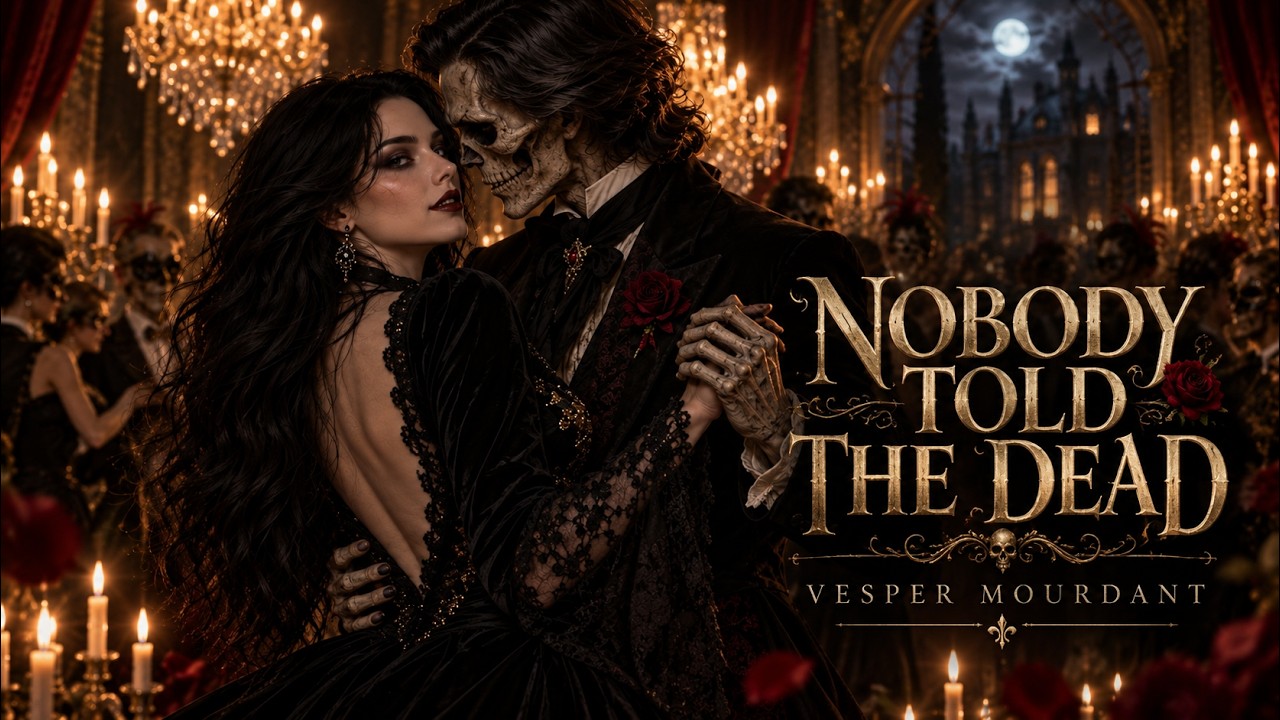
An extravagant midnight masquerade.
Music.
Dancing.
Beautiful clothes.
People moving through a ballroom as though the night has only just begun.
Vesper arrives expecting an elaborate Halloween celebration.
At first, nothing is obviously wrong.
That is important.
The guests should look too elegant to be frightening.
The room should feel too alive to be haunted.
The horror begins only when small details stop making sense.
The fashions belong to another decade.
Someone refers to a place that no longer exists.
A conversation seems strangely rehearsed.
Nobody leaves.
Nobody checks the time.
And eventually the truth becomes unavoidable:
everybody at the party is dead.
Not recently dead.
They have been dead for years.
Perhaps decades.
But nobody seems particularly concerned about it.
That became the central comic-horror reversal.
Most ghost stories revolve around dead people who cannot move on.
Nobody Told the Dead asks a slightly different question:
What if they simply do not know they are supposed to?
The title makes the situation sound almost administrative.
Someone forgot to send the announcement.
The building closed.
The years passed.
The living moved on.
But nobody told the ballroom.
So the orchestra keeps playing.
The guests keep dancing.
The masks stay on.
And midnight never quite finishes.
That tone mattered.
The idea is creepy, but it should also be fun.
This is not one of Vesper’s bleakest songs.
It has a streak of dark absurdity running through it.
The dead are not chasing Vesper.
They are hosting.
That lets the song function as both gothic horror and dance music.
The beat should make the listener understand why somebody might stay for another song even after discovering the truth.
That is where the dark-disco side of the concept becomes useful.
A traditional ghost scene asks you to run.
This one gives you a dance floor first.
The danger is not necessarily that the dead will hurt you.
The danger may be that the party is good enough to make you forget to leave.
Vesper is the perfect outsider for that scene because she would notice the supernatural truth without reacting like a conventional horror protagonist.
She does not scream.
She watches.
She understands.
And, for at least a little while, she keeps dancing.
That creates another question underneath the title:
Who exactly is the strange person in this room?
The guests who died decades ago?
Or the living woman who realizes that fact and decides the evening is still interesting?
The masquerade setting helps because everybody is already hiding something.
Masks make the living and the dead harder to distinguish.
A ballroom full of masked strangers already asks:
Who are you really?
The supernatural version adds:
And when were you?
The reveal should therefore happen gradually rather than with one obvious corpse.
A perfect dress with an impossible date attached to it.
An old photograph containing somebody currently dancing across the room.
A guest remembering an event as though it happened last week when it happened fifty years ago.
The party itself becomes evidence.
And the longer it continues, the stranger the title becomes.
Nobody told the dead.
But perhaps they already know.
Perhaps pretending the party continues is simply preferable to whatever comes after it.
That interpretation gives the track a little sadness underneath the fun.
Maybe this is not a failure to understand death.
Maybe it is a refusal to acknowledge that something beautiful has ended.
That makes the ballroom a metaphor as well as a supernatural setting.
People do this while alive.
We stay at jobs that ended emotionally years earlier.
We keep relationships moving after their natural ending.
We repeat traditions because stopping would force us to admit that time passed.
The dead just take that instinct to its logical extreme.
Musically, the song works best where gothic electronic music meets dark disco.
The rhythm should remain inviting.
The atmosphere supplies the warning.
You should be able to dance to the track while gradually realizing that something about the room is terribly wrong.
That contrast is the core of Nobody Told the Dead:
the party is over.
Nobody stopped dancing.
And eventually Vesper has to decide whether she is going to be the person who tells them.
SOURCES & REFERENCES
Source status applies to the referenced material, not to the original Rhialto song.
Original Rhialto concept
Nobody Told the Dead is an original Rhialto / Vesper Mourdant concept.
The midnight masquerade, ballroom of long-dead guests, continuing party and title premise are original creative elements rather than an adaptation of a specific ghost story, legend or historical event.
The public Rhialto release describes Vesper entering what she believes is an elaborate Halloween masquerade before discovering that the ballroom guests died decades earlier.
The song uses familiar gothic imagery — ghosts, masquerades, old ballrooms and the dead who remain among the living — but does not retell a particular source.