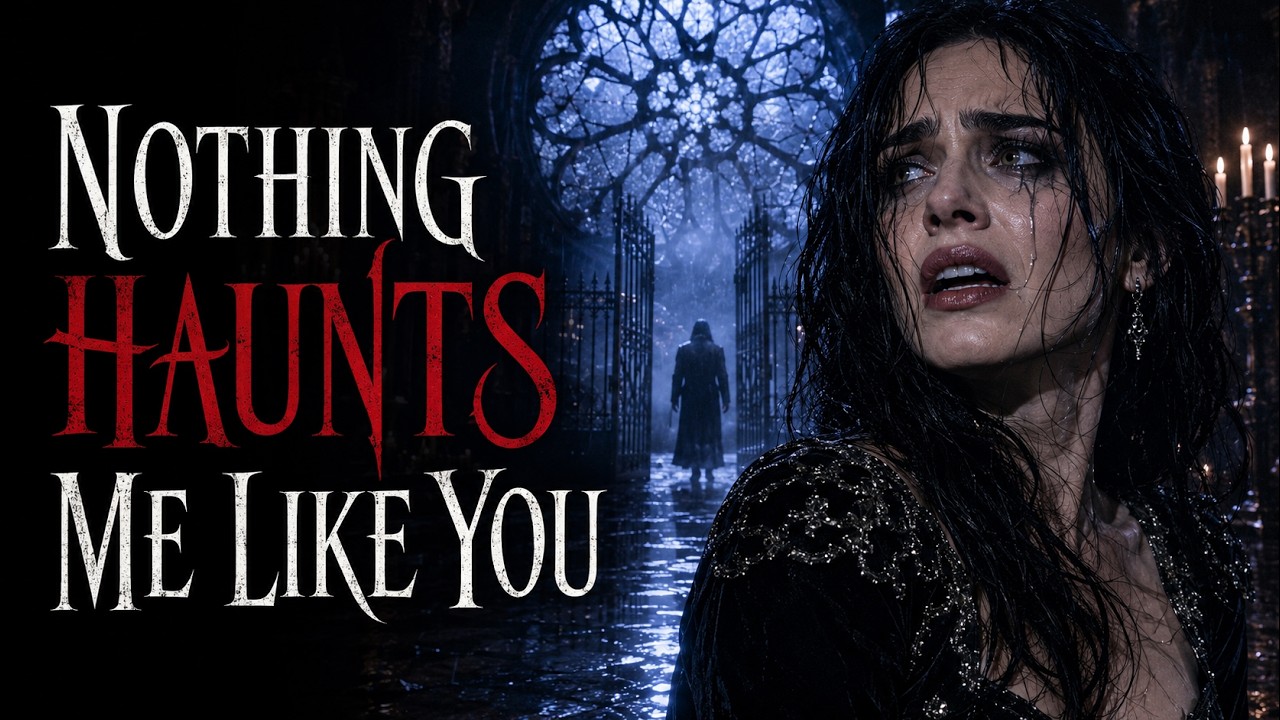
Vesper Mourdant’s gothic rock power ballad follows the regret, unanswered questions and enduring love left behind by someone whose fate remains uncertain.
WRITING THE SONG
Vesper can live with ghosts.
What she cannot live with is the silence of someone she still loves.
Nothing Haunts Me Like You began with that distinction: ordinary hauntings are bearable, but a loved one’s unexplained absence leaves questions that never stop asking themselves.
Are they gone forever? Have they chosen to disappear? Did something she said make them leave?
The song deliberately leaves their fate unresolved. Its emotional certainty belongs to Vesper: whatever happened, she has not stopped loving them.
The original concept imagined a woman who could dismiss the supernatural disturbances around her. Familiar hauntings had become manageable.
One absence remained unbearable.
A ghost would at least offer an explanation. Someone who might still be alive, might still remember her, and might simply be choosing silence leaves her suspended between grief and hope.
That uncertainty gives the title its force.
“Nothing haunts me like you” becomes a confession about the person who occupies her thoughts even when there is no evidence they will ever return.
The early development leaned heavily on haunted rooms, ominous surroundings and gothic imagery.
During revision, the direction became more precise: the lyrics were too long and descriptive, and Vesper needed to sound heartbroken.
The writing moved toward a shorter, more direct power ballad. Supernatural atmosphere receded so that regret, longing and emotional exposure could carry the song.
That change matters to its identity.
Vesper’s world still gives the title its language, but the listener does not need to imagine a haunted manor to understand what she is experiencing. The unanswered questions could belong to anyone who has waited for a message that never came.
The recovered development drafts introduce the possibility that Vesper helped create the separation.
One revised passage makes that responsibility painfully clear:
“I said I never loved you.
That was never true.”
Those words complicate her grief.
She is remembering something she said that contradicted what she felt. Now she has no assurance that she will get another chance to correct it.
The emotional weight falls on the distance between the message she delivered and the truth she withheld.
Her regret cannot tell her whether the other person knows the difference.
A revised chorus asks:
“Are you gone, or are you hiding?”
The question preserves the central ambiguity.
Being unable to return and choosing not to return would demand different kinds of mourning. Vesper cannot establish which one she faces.
That keeps hope alive, but makes it difficult to rest.
The song’s uncertainty is intentional. It gives the listener room to recognize their own experience without assigning the absent person a definitive fate.
The development called for one decisive vocal revelation.
In the later lyric draft, that moment becomes:
“I STILL LOVE YOU!”
Its power comes from its simplicity.
After denial, questions and attempts to explain the absence, Vesper reaches the thing she knows. She still loves this person.
Saying it does not guarantee an answer. It does not undo what she said before.
It does end her ability to hide behind those earlier words.
The later musical brief proposed a piano opening, large melodic choruses and a slow power-ballad pace, with only a faint gothic colouring.
Those were arrangement intentions designed to support the revised emotional focus.
The quiet opening would give the confession intimacy. The expanding choruses would give feelings she could no longer contain somewhere to go.
The writing was shortened for the same reason: fewer descriptive passages, more space for the central admission to register.
The song can reach emotional clarity without solving the disappearance.
Vesper can acknowledge her love and her possible responsibility while still not knowing whether anyone will hear her.
That is the ache at its centre.
Nothing Haunts Me Like You gives a voice to the words that arrive too late—and the hope that there might still be someone left to hear them.
SOURCES & REFERENCES
Source status applies to the referenced material, not to the original Rhialto song.
Based on the recovered original concept and lyric-development exchanges. Quoted lines are identified as development-draft material. No specific literary source is claimed.
This is an original Rhialto concept developed for Vesper Mourdant. Musical arrangement directions are described as creative intentions.
Source status: Reference Sources Only.