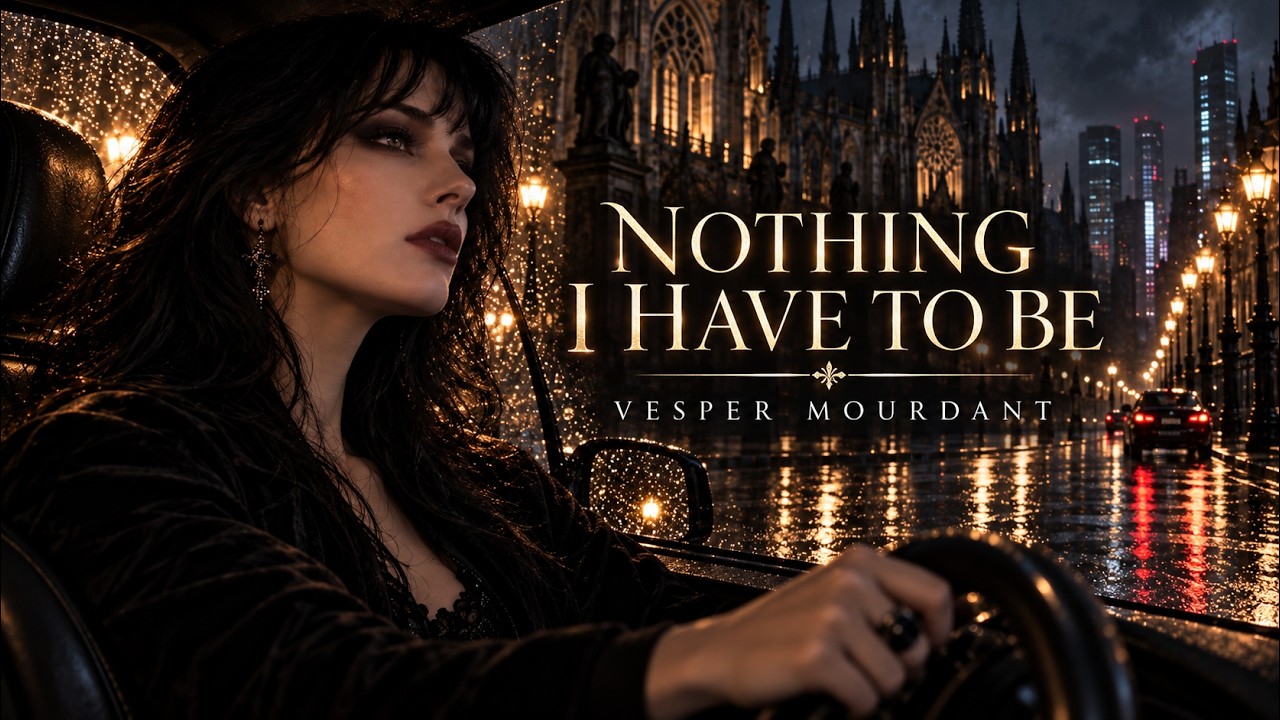
Vesper Mourdant’s gothic melodic house song finds quiet freedom in an unclaimed hour: no urgent destination, no role to perform, and a little more night to call her own.
WRITING THE SONG
The night does not need to end yet.
There is no urgent destination, no role waiting to be performed, no reason to turn a quiet moment into something useful.
Nothing I Have to Be gives Vesper a different kind of freedom: the chance to remain outside a little longer, without having to explain herself.
The original development centred on relief from roles, expectations and observation. For this stretch of the night, simply being present is enough.
The recovered hook revision begins with a small request:
“Not yet.
Not yet.
Let the hour keep going.”
The words ask for time.
They do not demand a permanent change or promise that tomorrow will be different. They protect the moment already happening.
That modest scale gives the hook its emotional force. Sometimes the thing a person wants most is another few minutes before returning to the expectations that organize the rest of their life.
The repetition lets that wish linger.
The hook eventually arrives at:
“Nothing I have to be.”
The important words are “have to.”
The title creates space around obligation. Vesper can exist without immediately becoming someone’s answer, fulfilling an expectation or presenting a version of herself for approval.
That gives “nothing” an unexpectedly generous meaning.
It opens a pause in which identity does not need to be demonstrated. She can feel the night around her without turning the experience into a performance.
The recovered visual-development direction placed the song among rain on black glass, empty intersections and cathedral stone reflected in modern towers.
Those images give the freedom a setting.
The city remains substantial and recognizable. Buildings, streets and reflections surround the narrator, but the quieter hour changes how she can move among them.
An empty intersection offers a pause. Dark glass holds the surrounding lights. Old stone and modern surfaces share the same reflection.
These were visual intentions developed around the song. They suggest a city that can be experienced slowly, once the demands of the day have loosened.
The concept makes the narrator’s choice important.
She stays because she wants the hour to continue. The emotional emphasis is on quiet freedom and the pleasure of having no immediate destination.
That keeps the song close to an ordinary, recognizable experience: finding yourself comfortable somewhere and realizing that you do not have to leave just because you usually would.
The night becomes valuable through that small permission.
Vesper can choose another moment for herself.
The musical direction placed the song in dark melodic and deep house, with a gothic nocturnal atmosphere.
That setting suits a hook built around continuation.
A repeating pulse can give the listener somewhere to remain. The recurring words can return without requiring a new explanation each time.
“Not yet” works within that musical idea because its meaning changes through duration. Each repetition extends the pause it asks for.
The atmosphere allows stillness and movement to coexist: the music can carry the night forward while the narrator remains reluctant to bring it to an end.
The concept gives Vesper room to be unobserved.
She does not need a dramatic confrontation to make the moment meaningful. The emotional movement comes from allowing herself to stay, listen and occupy the space around her.
That restraint is central to the song.
The title leaves room for listeners to bring their own expectations into it—the roles they fulfil, the explanations they give, the ways they feel required to appear.
For a few minutes, those demands can wait.
The song’s request remains deliberately limited.
One night cannot remove every obligation. A quiet walk cannot settle every question about who a person is supposed to become.
But the moment can still matter.
There is pleasure in recognizing that the next step belongs to you, even if the choice is simply to take it later.
Nothing I Have to Be gives a voice to the relief of an unclaimed hour: nowhere you need to go, no part you need to play, and a little more night to call your own.
SOURCES & REFERENCES
Source status applies to the referenced material, not to the original Rhialto song.
Based on the recovered hook revision, concept discussion and visual-development direction. Quoted words are identified as development material. The discussion of repetition and musical atmosphere interprets the documented dark melodic/deep-house direction. No specific literary source is claimed.
This is an original Rhialto concept developed for Vesper Mourdant.
Source status: Reference Sources Only.