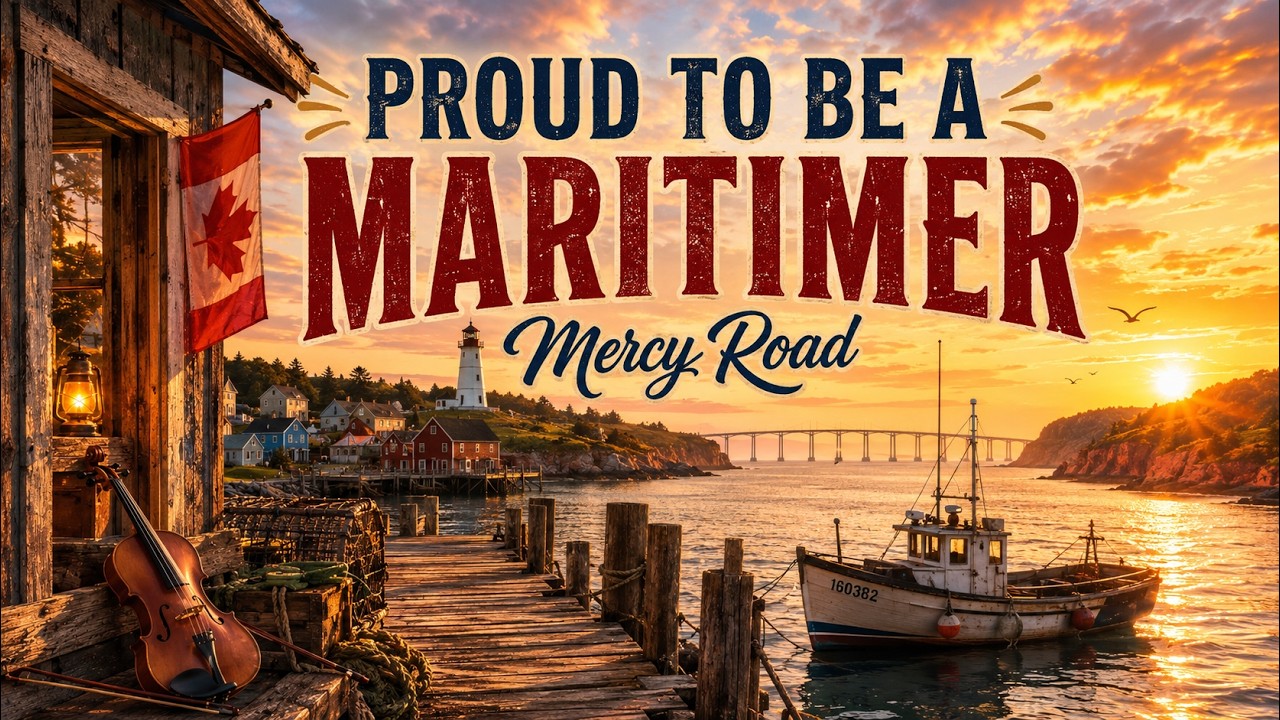
How a regional country-folk anthem became less about famous landmarks and more about the small things that make the Canadian Maritimes feel like home: familiar roads, rivers, towns, people and memories that stay with you even after you leave.
WRITING THE SONG
The starting point for Proud to Be a Maritimer was not really patriotism in the flag-waving sense.
It was home.
The original public description called the song a tribute to:
the places, people, rivers, roads and memories that make the Maritimes feel like home.
That distinction matters.
A regional anthem can easily become a list of landmarks.
Name the provinces.
Mention the ocean.
Add a lighthouse.
Put a fiddle underneath it.
Done.
That was not the interesting version.
The stronger idea was to ask why somebody who has moved away can still hear the name of one particular road or river and immediately know exactly where they are.
That is a different kind of geography.
It is geography stored in memory.
For this song, Campbellton and northern New Brunswick provided much of the emotional starting point.
Not because the song is meant to belong only to one town.
Quite the opposite.
The specific details give it somewhere real to stand before the chorus opens outward toward the larger Maritime identity.
A hometown matters because somebody knows which road bends where.
Which river is just beyond the trees.
Which businesses disappeared.
Which families everyone seemed to know.
Which drive took twenty minutes when you were a child and somehow feels much shorter when you return as an adult.
Those details are what turn a region on a map into a place someone belongs to.
That is why the title uses Maritimer rather than simply “Canadian.”
The word carries a more specific identity.
Technically, Canada’s Maritime provinces are New Brunswick, Nova Scotia and Prince Edward Island. Newfoundland and Labrador is part of Atlantic Canada but not one of the three Maritime provinces.
But a song cannot build identity from a definition.
It has to build it from recognition.
So the useful images are ordinary ones.
A road you have driven hundreds of times.
A river that tells you you are almost home.
A kitchen where people stay talking long after the meal is finished.
Someone recognizing your family name.
Weather everybody complains about but misses when they leave.
Distances described by how long the drive takes rather than kilometres.
The places outsiders might pass through without realizing that somebody else’s whole childhood happened there.
That is where the word proud becomes interesting.
The song is not saying that the Maritimes are perfect.
Pride does not require that.
Regional pride can include knowing exactly what frustrates you about a place.
People leave.
Work disappears.
Towns change.
Buildings come down.
Families spread across the country.
Young people grow up expecting that they may eventually have to go somewhere else.
And yet leaving does not necessarily erase where you are from.
Sometimes it makes the connection more obvious.
You discover which things you assumed were universal but were actually part of home.
An accent.
A phrase.
A way people speak to strangers.
A certain landscape.
A certain kind of humour.
The expectation that somebody will probably know somebody you know.
That gave the song an emotional structure that fits Mercy Road particularly well.
Mercy Road is strongest when the subject is ordinary life rather than mythology.
Family.
Home.
Growing older.
Coming back.
Realizing that something mattered only after enough time has passed to see it clearly.
Proud to Be a Maritimer belongs in that world.
The title sounds like an anthem.
But the song works better when the verses earn that anthem.
The chorus can be broad because the details underneath it are personal.
That also prevents the track from becoming simply a New Brunswick tourism song.
Campbellton may be part of its emotional origin, but the larger idea travels.
Someone in Nova Scotia will have a different river.
Someone on Prince Edward Island will have a different road.
Someone from another part of New Brunswick will substitute another town.
The details change.
The feeling does not.
That is also why Maritime music has such a natural relationship with memory.
Regional folk traditions have long carried stories through families and communities because music is one of the easiest ways to turn a place into something portable.
You can leave the town.
The song comes with you.
That idea sits underneath this track.
Home is not only where you live.
Sometimes it is the collection of things that still feel immediately familiar after years away.
A bend in the road.
A river.
A voice.
A kitchen table.
A town name on a highway sign.
And perhaps the clearest sign that a place is still home is how little explanation those things require.
You recognize them before you have time to think.
That is what Proud to Be a Maritimer is really celebrating.
Not the idea that one region is better than another.
The much simpler idea that:
these are the places that made me.
And wherever you end up,
some part of you still knows the road back.
SOURCES & REFERENCES
Source status applies to the referenced material, not to the original Rhialto song.
The Canadian Maritimes
This geographical reference provides context for the regional identity used in the song. The track is not an adaptation of this source.
Original Rhialto concept
Proud to Be a Maritimer is an original Rhialto / Mercy Road concept.
The public Rhialto framing describes it as a personal tribute to the places, people, rivers, roads and memories that make the Maritimes feel like home, with Campbellton and New Brunswick forming part of its original regional perspective.
The lyrics, narrative approach and Mercy Road country-folk treatment are original creative elements rather than an adaptation of a traditional Maritime song.