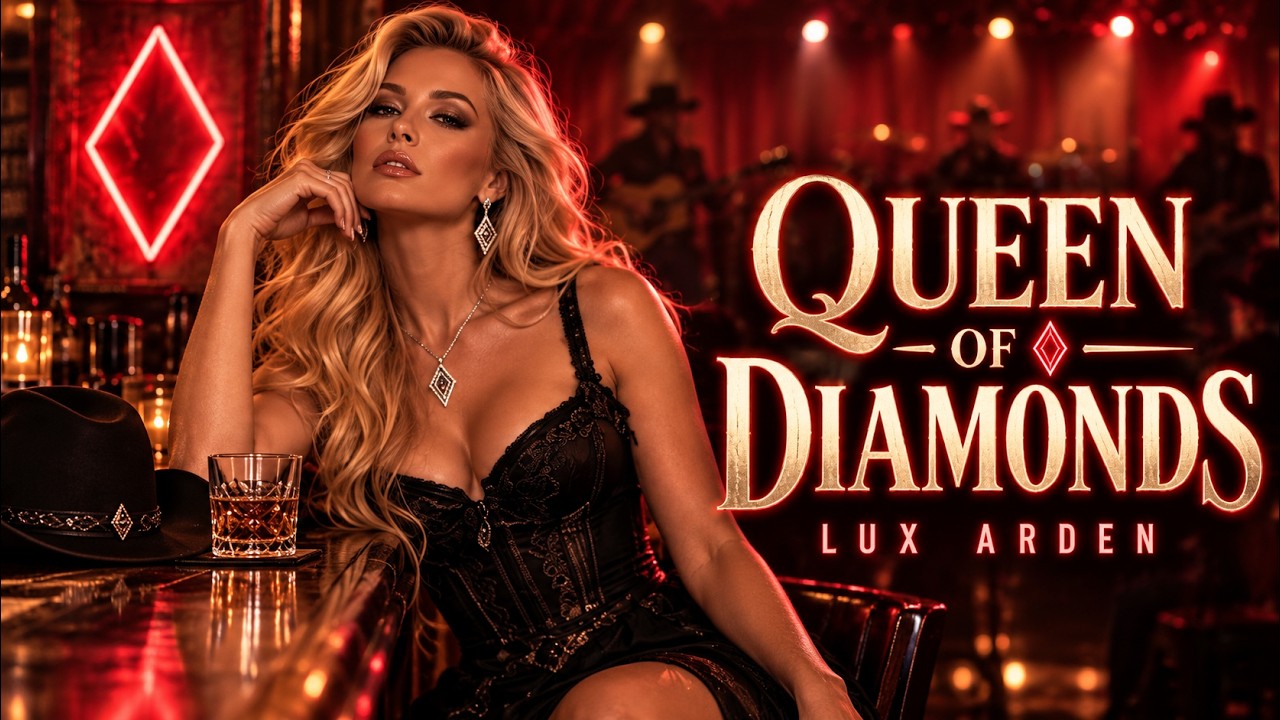
How one piece of card-table wordplay became a dark-country relationship story about two people who thought they were playing the same hand — until “diamonds” and “clubs” turned out to mean completely different futures.
WRITING THE SONG
Queen of Diamonds started with one line:
I was the Queen of Diamonds. He was the King of Clubs.
On the surface, they belong together.
Two face cards.
Two suits.
Two people apparently sitting at the same table.
But the entire song comes from the fact that the suits mean something different outside the deck.
For her, diamonds mean jewelry.
Eventually, a ring.
Commitment.
The possibility of a full house in the sense that matters beyond poker: a real home and a life built together.
For him, clubs mean somewhere else entirely.
Bars.
Nightlife.
Closing time.
Another night out instead of another step forward.
That turns a simple card metaphor into the central problem of the relationship: they are both gambling, but they are not playing for the same prize.
The core idea became: “I was the Queen of Diamonds. He was the King of Clubs. Unfortunately, we weren’t playing the same game.”
From there, poker language could carry the entire emotional story.
She goes all-in on forever.
He keeps delaying the hand.
Promises become bluffs.
Commitment gets pushed toward some imaginary future card.
The river becomes the moment when there is nowhere left for the relationship to hide.
And eventually she has to decide whether continuing to bet is loyalty or simply refusing to fold a losing hand.
The strongest part of the concept is that the metaphors work in more than one direction.
A full house can be a poker hand.
Or the life she wanted.
A diamond can be a playing-card suit.
Or the ring that never arrived.
A club can be another suit.
Or another place where he stayed until closing time.
That double meaning keeps the song from becoming a collection of poker jokes. The card language is there because it mirrors the relationship.
At first, the metaphor is flirtatious.
They seem perfectly matched.
Then it gradually becomes evidence that they never wanted the same thing.
The emotional arc moves through: attraction → optimism → waiting → suspicion → recognition → leaving.
And importantly, Lux does not lose the title when the relationship ends.
She remains the Queen of Diamonds.
By the end, it is no longer the name of a card in somebody else’s hand.
It belongs to her.
Musically, the song sits in dark neo-traditional country / honky-tonk noir: enough barroom energy to make the King of Clubs world believable, but enough weight in Lux Arden’s vocal to make the story land as something more serious than a drinking-song punchline.
The central contrast can be summarized in one line:
She went all-in on forever. He went all-in on closing time.
SOURCES & REFERENCES
Source status applies to the referenced material, not to the original Rhialto song.
Original Rhialto concept
Queen of Diamonds is an original Rhialto story concept. There is no underlying historical event, literary work or traditional song being adapted. The relationship narrative, the Queen of Diamonds / King of Clubs wordplay, and the use of card-table language to represent incompatible ideas of commitment are original creative elements.
Poker terminology