How a familiar house became a Vesper Mourdant gothic-horror story about footsteps, a locked bedroom and the realization that the thing outside the door was never the real threat.
WRITING THE SONG
Right Behind Me began with one of the simplest horror ideas possible: You hear something in the house when you know you are alone.
The challenge was making that fear continue to grow for an entire piece without revealing the threat too early.
So the story starts small.
The narrator knows the house. She knows every pipe, every timber and every ordinary settling noise. That familiarity is important because it removes the easiest explanation. If this were an unfamiliar building, every creak could simply be the house. But she knows what the house sounds like.
And this is different.
At first, she does what people often do when something frightens them: she explains it away.
There’s probably nobody there.
That line became one of the most useful devices in the piece because its meaning changes every time it returns. The first time, it is reassurance. Then it becomes denial. Eventually it sounds almost absurd because the evidence has become overwhelming.
A hallway light fails. A door handle moves. A footprint appears on the stairs.
Then come the footsteps.
Three steps above her. Three steps back. A pause. Another sound.
The horror is built through distance.
Whatever is in the house keeps getting closer. That makes the structure almost spatial. The audience can mentally follow the threat through the building: first somewhere in the house, then in the hallway, then on the stairs, then outside the bedroom.
By the time the narrator says “There’s somebody coming up here,” there is almost no distance left.
From there, the music stops pretending that the noises might be innocent.
A cupboard slams. A chair falls. Glass breaks. Something heavy hits the bedroom door.
The handle twists. The hinges scream. The pounding becomes violent enough that the room itself seems to be coming apart.
Then the imagery gets more physical: the chain scrapes closer, nails tear through wood, the lock bends, and the door begins to split.
At that point, both the narrator and the listener are waiting for the same event: the door opening.
That expectation is what makes the ending work.
The final blow seems inevitable. She closes her eyes. She prepares to scream.
And then—nothing.
The door never opens.
For a moment, that should almost feel like relief.
Then comes the real reveal:
There’s nobody outside the door.
Followed immediately by:
There’s somebody here in the dark.
And finally:
There’s somebody right behind me.
That was the destination of the whole piece.
Everything before it trains the listener to look in the wrong direction: the stairs, the hallway, the bedroom door, the thing trying to get inside.
But the title has quietly told us the truth from the beginning.
Right Behind Me.
The threat was never simply approaching. It was already closer than the narrator understood.
That makes the final instruction — Don’t turn around. — more disturbing than showing the creature would have been.
Once the listener knows something is directly behind her, describing it would probably reduce the fear. The imagination can do more than the lyric needs to.
So the piece ends without explaining what the presence is. Ghost. Demon. Intruder. Something else. It does not matter.
The important thing is proximity.
It is there. And she knows it.
Musically, the arrangement follows the same escalation. The beginning leaves room around the vocal so small noises feel significant. As the threat moves through the house, the production becomes heavier and more chaotic. Impacts, screams, storm sounds and increasingly aggressive dynamics turn the building itself into part of the percussion.
The repeated phrases also become more forceful: There’s probably nobody there gradually gives way to There’s somebody standing out there, then There’s somebody coming up here, then There’s somebody trying to get in, and finally There’s somebody right behind me.
That progression is essentially the whole story in five sentences.
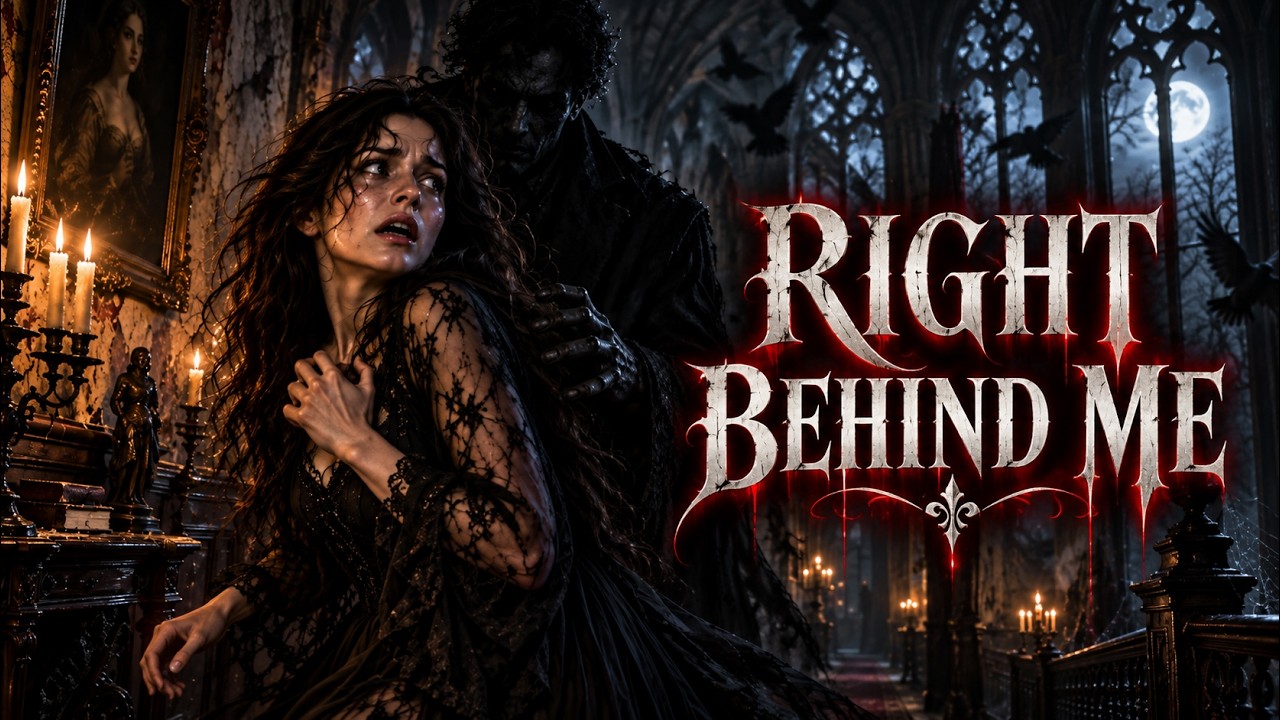
The visual language follows classic haunted-house horror: dark corridors, mirrors, staircases, doors, storm light and spaces where the audience can see slightly less than they want to.
But the most important visual principle is the same as the lyric: Do not show the threat too clearly.
The frightening part of Right Behind Me is not what the creature looks like.
It is realizing where it is.
SOURCES & REFERENCES
Source status applies to the referenced material, not to the original Rhialto song.
Original Rhialto concept
Right Behind Me is an original Rhialto / Vesper Mourdant horror narrative.
The story, house, unseen presence, escalating pursuit and final reversal are original creative elements rather than adaptations of a specific literary work, film, legend or historical event.
The piece uses familiar haunted-house and supernatural-horror imagery — footsteps, dark corridors, mirrors, stairs, doors and unseen movement — as genre vocabulary, but the narrative structure and final reveal were developed specifically for this music.