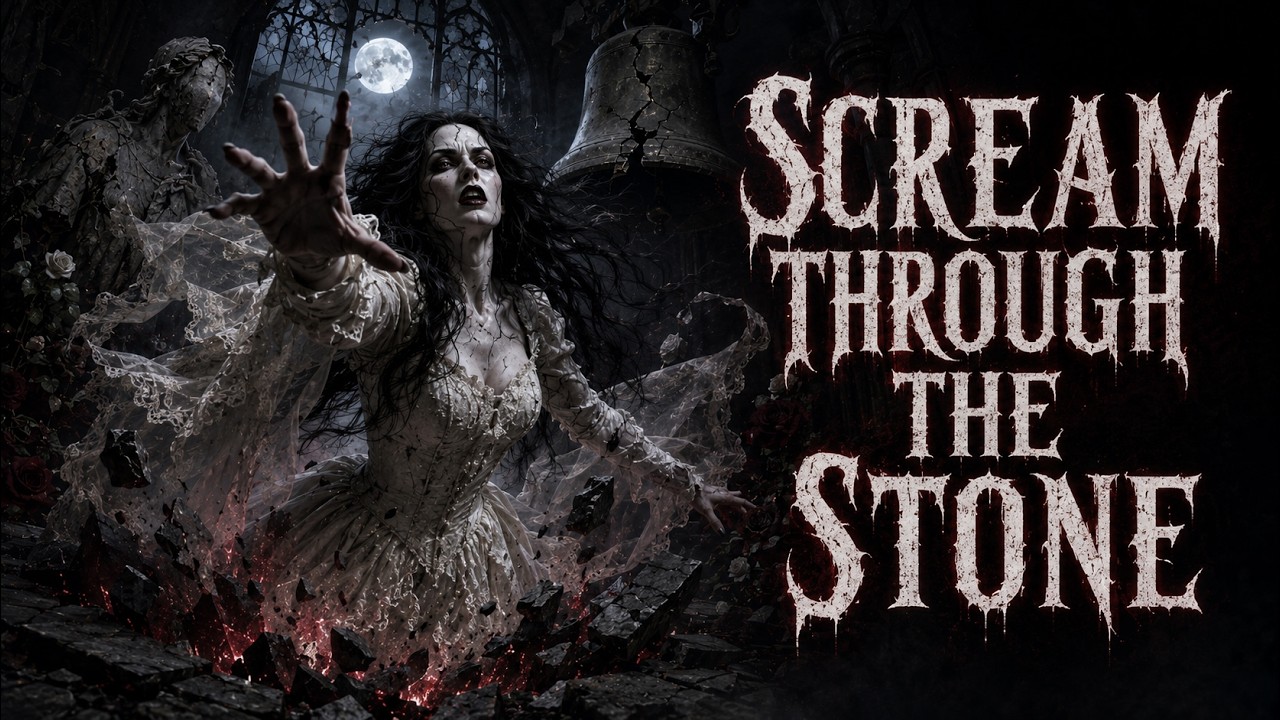
How a murdered bride buried beneath a chapel became a cinematic gothic-metal revenge story: she hears her killer repeat his vows with another woman and fights her way back through the stone.
WRITING THE SONG
Scream Through the Stone began with one image:
a murdered bride trapped beneath the floor while another wedding takes place above her.
That immediately created two stories happening in the same physical space.
Above:
Candles.
Wedding clothes.
A groom.
A nervous bride.
A ceremony beginning.
Below:
Darkness.
Stone.
A coffin.
And someone who should have been dead long ago.
The track opens with the buried bride awakening as the chapel bell begins ringing at midnight.
That bell matters.
It is cracked.
Old.
Wrong.
The chapel should feel abandoned enough that no ceremony should be happening there at all.
Yet footsteps begin crossing the floor above her.
Then voices.
Then vows.
At first she does not understand what she is hearing.
The sound reaches her imperfectly through stone and earth.
Fragments rather than full sentences.
But one voice changes everything.
The groom.
She knows him.
Hearing him forces the memory of her own wedding night back into place.
She remembers the chapel.
The promises.
The ring.
And finally what happened after the ceremony.
The man now standing at the altar above her is the same man who murdered her.
That turns the song from supernatural imprisonment into urgency.
This is not simply a ghost trying to escape a grave.
There is another woman upstairs.
Another bride.
And the ceremony is repeating.
The groom is preparing to do it again.
That realization gave the chorus its central transformation.
At first:
SCREAM THROUGH THE STONE!
means:
Hear me.
She is trapped.
Nobody can hear her.
Her voice has to somehow pass through coffin wood, earth and chapel floor.
But the meaning changes as the story develops.
The scream becomes:
Listen to me.
Then:
Run.
And finally:
I'm coming.
That escalation was essential.
I wanted the same hook to perform three different jobs across the track:
distress,
warning,
and vengeance.
The vows provided the countdown.
To have.
The buried bride remembers.
To hold.
The stone begins to crack.
Until death—
That is the phrase she cannot allow him to finish.
Because she has already experienced exactly what his version of “until death” means.
The wedding language therefore becomes increasingly violent without changing very much.
Ordinary ceremonial words acquire a completely different meaning once we know the groom's history.
That contrast is one of the reasons the story works so well as gothic metal.
A wedding ceremony already contains ritual.
Repeated language.
Candles.
Formal clothes.
A procession.
A symbolic ring.
An altar.
Promises about death.
Gothic horror only has to tilt those elements slightly before the romance becomes threatening.
The chapel itself became almost another character.
The bride is physically underneath the ceremony.
Every heel against the floorboards reaches her.
Every bell vibration moves through the walls.
The organ travels through the stone.
When the congregation stands, she feels it before she hears it.
That vertical relationship shaped the whole visual idea.
The living occupy the chapel.
The murdered bride occupies the crypt beneath it.
And the song gradually destroys the barrier between those two worlds.
The first cracks should be small.
Dust falls.
Mortar moves.
A stone shifts.
The new bride hears something beneath her feet.
Perhaps the groom tells her it is only the building settling.
Then the warning becomes impossible to ignore.
Blood begins appearing between the floorstones.
Not a giant explosion.
A thin line at first.
Something seeping upward from where nothing living should exist.
That is the moment the ceremony stops feeling merely strange.
The buried bride is getting through.
Musically, Scream Through the Stone needed far more physical force than many Vesper tracks.
This is cinematic gothic metal.
Downtuned guitars.
Cathedral organ.
Cracked wedding bells.
Ritual drums.
Low choir.
Coffin creaks and subterranean textures.
The arrangement begins relatively restrained because the bride begins powerless.
She can scream.
But stone does not care.
As her memory returns, the guitars become heavier.
The drums become more ritualistic.
The choir widens.
And Vesper's vocal performance moves from haunted clean singing toward increasingly aggressive screams.
The screams could not be decorative.
They are part of the plot.
Each one represents the bride becoming harder for the world above her to ignore.
That is why the vocal progression matters:
desperation → recognition → warning → rage → vengeance.
The first scream asks for help.
The final scream does not.
By the climax, the chapel itself begins answering her.
The organ distorts.
The bell strikes out of rhythm.
The floor fractures.
The wedding guests move backward.
The new bride finally understands that the thing beneath the chapel is not coming for her.
It is trying to save her.
That relationship was important.
The two brides should never become rivals.
The murdered woman does not resent the woman standing at the altar.
She recognizes her.
Not personally.
But as the next victim.
That turns the resurrection into something more than revenge.
She is breaking through for herself.
But she is also breaking through because nobody broke through for her.
Then the groom reaches the final vow.
The floor gives way.
The bride who was hidden beneath the chapel finally enters her own wedding story again.
Not in white.
Not walking down an aisle.
Coming upward through broken stone.
The image should be violent but still recognizably gothic rather than splatter horror:
dust,
cracked marble,
wedding flowers scattered across the floor,
dark fabric,
blood,
candlelight,
the ruined altar,
and the bride rising through the place where she was meant to remain forgotten.
At that point, SCREAM THROUGH THE STONE has completed its transformation.
She no longer needs anyone to hear her.
She has arrived.
The groom retreats toward the crypt.
The new bride survives.
The ceremony that was supposed to repeat his crime instead becomes the moment his past literally breaks through the floor.
The final image was deliberately small.
After all the guitars, screams, bells and collapsing stone:
his wedding ring rolls into the open crypt.
That felt more effective than explaining exactly what happens to him.
The ring circles.
Slows.
Falls.
The object that represented his promises ends up disappearing into the same darkness where he tried to hide the consequences of breaking them.
That is where the story ends.
Not with another scream.
With the ring.
SOURCES & REFERENCES
Source status applies to the referenced material, not to the original Rhialto song.
Original Rhialto concept
Scream Through the Stone is an original Rhialto / Vesper Mourdant gothic-horror narrative.
The murdered bride secretly entombed beneath an isolated chapel, the repeated midnight wedding, the returning groom and second bride, the vow-driven countdown, the bride's attempt to warn her successor, the blood rising through the floorstones, her resurrection during the final vows, and the wedding ring falling into the crypt are original Rhialto story elements.
The track draws on broad Gothic traditions — ruined chapels, crypts, bells, wedding imagery, premature burial and supernatural revenge — as genre vocabulary rather than adapting a specific novel, legend or historical event.