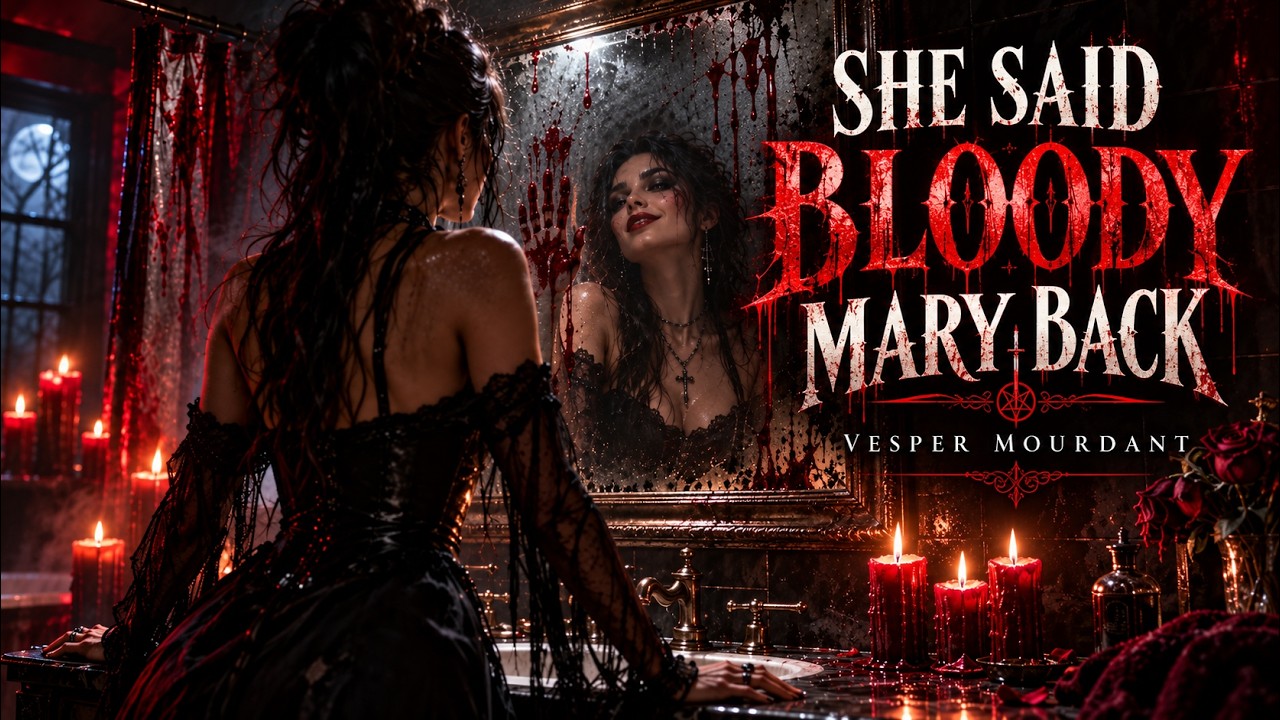
Vesper Mourdant turns the Bloody Mary mirror dare into gothic dance music: she says the name twice, and the presence in the glass completes the ritual.
WRITING THE SONG
She says the name once.
Then twice.
Before she can say it a third time, the mirror answers.
She Said Bloody Mary Back takes a familiar supernatural dare and removes the one protection its narrator believes she still has: the choice to stop before completing it.
She has been counting.
Something in the glass has been counting too.
The Bloody Mary mirror legend circulates in different forms. One commonly recorded version involves entering a darkened bathroom and repeating the name three times before a mirror, expecting a frightening apparition.
That version supplies the starting point for this track.
The important detail is the count.
Three repetitions establish a threshold. Until the last one, the narrator can believe she has only begun the dare.
There is still time to laugh, turn on the light or walk away.
The track interrupts that confidence.
The published premise is direct:
The narrator says Bloody Mary twice.
The mirror says it the third time.
That changes who controls the encounter.
The narrator has initiated something, but she is no longer the only participant. The presence in the glass can answer, act and complete the sequence without her permission.
The ritual becomes a conversation she did not expect to have.
Its other participant knows what comes next.
The first central hook carries the encounter in two lines:
“I said Bloody Mary /
She said Bloody Mary back.”
The repeated name makes the exchange easy to follow.
The first line belongs to the narrator.
The second gives the mirror a voice.
“Back” is the unsettling word. It turns an invocation into a response and suggests that someone has been listening on the other side.
The narrator expected to test a story.
Instead, the story addresses her.
The second hook sharpens the problem:
“I only said it twice /
She didn’t wait for three.”
The narrator reaches for the rule she thought governed the dare.
She has not completed it.
That should matter.
Her protest also reveals how quickly the situation has changed. She is already trying to explain why this should not be happening.
The presence has moved beyond the boundary she trusted.
Knowing the instructions offers little reassurance when the thing being summoned can finish them itself.
The third hook reduces the explanation to a brief exchange:
“I never said it three times…
She did.”
The pause gives the narrator’s defence room to stand.
Then the final two words overturn it.
The count was completed. The narrator simply was not the person who completed it.
That is the central horror of the track: an apparent escape clause becomes evidence that the presence has its own agency.
It does not need her to keep speaking.
The recovered development draft extends the premise into a reflection that answers and steps out of frame.
A mirror normally repeats what is placed before it.
Here, the image begins making its own decisions.
That gives the story a clear visual progression. First, the voice behaves independently. Then the reflection’s movement does the same.
The familiar surface becomes harder to understand.
The narrator is facing something that looks like an image but behaves like a person.
The musical-development brief called for a gothic Halloween club track at roughly 122–126 BPM.
Its requested ingredients included a four-on-the-floor beat, pulsing synth bass, crisp club drums, dark arpeggiators, glassy textures and distorted guitar.
The intended structure moved from intimate, rhythmic verses into a large club chorus, with a stripped spoken breakdown before the final escalation.
These were arrangement directions. The published description characterizes the finished music through its pulsing gothic club beat and dark electronic rhythms.
The dance setting gives the repeated phrases a practical role.
They can return as hooks while the story becomes more threatening.
The narrator keeps counting.
The music keeps moving.
Each hook contributes a different piece of the same event.
The first establishes the response: she said the name back.
The second identifies the broken expectation: she did not wait.
The third explains how the ritual was completed: she supplied the final repetition.
That progression lets the premise deepen without requiring a complicated explanation.
The listener hears the encounter, then the objection, then the answer.
All three lead back to the same disturbing fact.
The mirror was never waiting passively.
The strongest part of the idea is the narrator’s reasonable belief that stopping early should leave her safe.
She remembers the rule.
She knows how many times she spoke.
Her account can be entirely accurate, and the danger can still be real within the story.
She Said Bloody Mary Back turns a familiar mirror dare into a loss of control: the narrator stops at two, but the thing she called knows how to finish.
SOURCES & REFERENCES
Source status applies to the referenced material, not to the original Rhialto song.
This is an original Rhialto treatment of the Bloody Mary mirror legend, developed for Vesper Mourdant.
The note draws on recovered creative-development material and the published video description, which supplies the premise and the three quoted hooks.
The USC Digital Folklore Archives records a version of the three-repetition mirror dare. It provides folklore context; its wording is not used as lyrics.
No particular historical person is identified as the origin of the apparition.
Source status: Reference Sources Only.