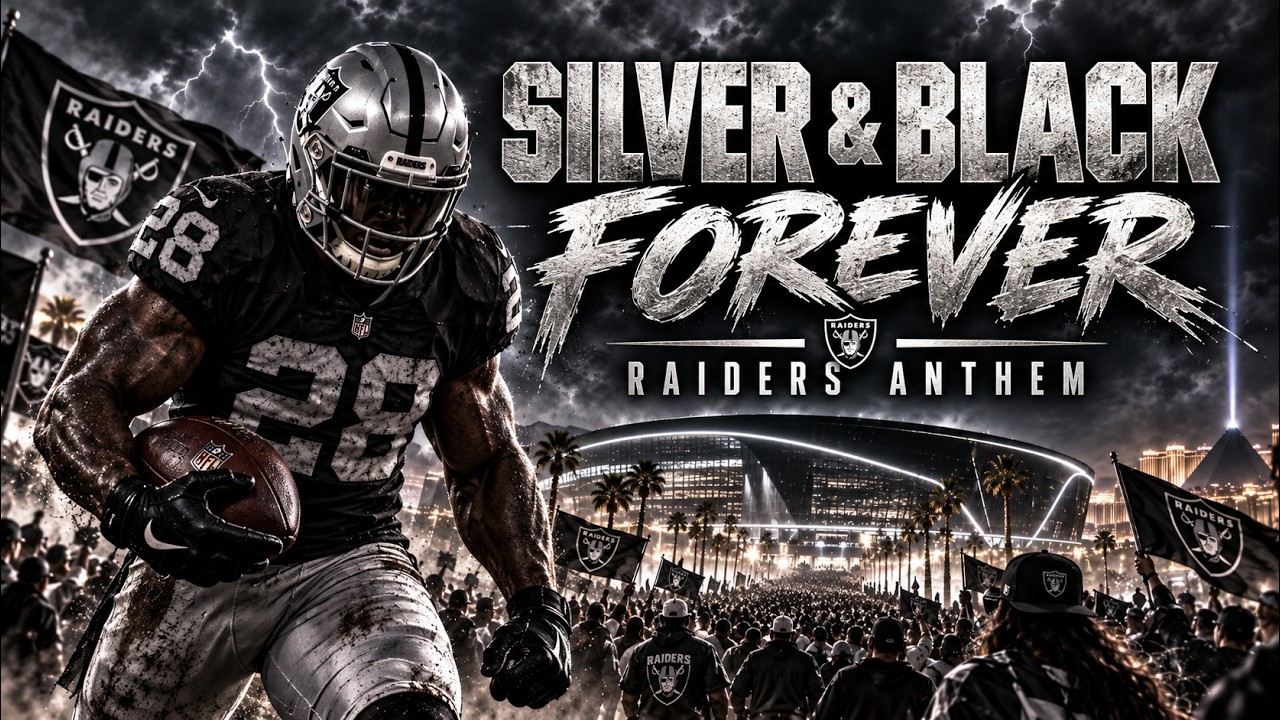
How decades of following my favourite football team — from becoming a Raiders fan as a teenager through Oakland, Los Angeles and Las Vegas — became an anthem about the history, defiance and enduring loyalty of Raider Nation.
WRITING THE SONG
Silver & Black Forever is personal for me in a way that most of the Rhialto sports music is not.
The Raiders are my favourite team, and I have followed them since I was a teenager.
Long before Rhialto existed, before the team played in Las Vegas, and before I ever thought about making music for sports fans, I was watching the Raiders.
That history matters to this piece.
I did not start with the question:
What would make a good Raiders anthem?
I started with decades of already knowing what being a Raiders fan felt like.
The colours.
The shield.
The personalities.
The great teams and the terrible seasons.
The moves from Oakland to Los Angeles, back to Oakland and eventually to Las Vegas.
The legends I grew up watching and hearing about.
And the peculiar loyalty of Raider Nation, which has always felt bigger than whatever city happened to be printed beside the team name.
That became the central idea of the music:
cities change, players change, but silver and black remain.
For someone who has followed the team for decades, that is not just franchise history.
It is part of my own history too.
I have watched different generations wear those colours.
I have watched eras end and new ones begin.
There were years when being a Raiders fan was considerably easier than others.
But I never went looking for another team.
That is the point of the title.
Silver & Black Forever.
Not silver and black while they are winning.
Not silver and black while a particular player is there.
Not silver and black while they are playing in the city where you first discovered them.
Forever.
The anthem is not really about Las Vegas alone.
Las Vegas is the current home.
But a Raiders anthem that ignored Oakland and Los Angeles would miss what makes the franchise interesting.
The history travels with the team.
So the piece deliberately moves through generations.
Al Davis.
John Madden.
Ken Stabler.
Jim Plunkett.
Bo Jackson.
And then forward into the modern era with Maxx Crosby.
Those names are not there simply to create a checklist of famous Raiders.
They represent different versions of the same identity.
The organization changes.
The uniform almost refuses to.
That visual consistency is incredibly useful for music.
There are very few sports colour combinations that immediately communicate an attitude before anything else happens.
Silver and black already sound like the title of something aggressive.
That led to one of the simplest lines in the release:
Silver on the helmet.
Black upon the soul.
That was the tone I wanted.
Not polished.
Not cheerful.
Not a generic stadium chant that could belong to any team after changing the name.
The Raiders have always carried a certain amount of menace with them.
The pirate logo.
The Black Hole.
The outlaw reputation.
The idea that the rest of the league does not particularly need to like you.
In fact, being disliked can almost become part of the attraction.
So Silver & Black Forever needed to sound less like a corporate sports anthem and more like something Raider Nation could claim.
Heavy.
Simple.
Defiant.
Easy to shout.
That also explains why the history matters.
Al Davis gave the Raiders one of the most durable attitudes in professional sports:
Just win, baby.
It is brutally uncomplicated.
No philosophy lecture.
No explanation.
Win.
That simplicity fits a chorus.
But the music is not really about winning records.
If it were, loyalty would disappear during bad seasons.
Raider Nation provides evidence of the opposite.
The deeper subject is belonging.
Fans stayed through relocations.
Through rebuilding years.
Through great teams.
Through terrible ones.
Through Oakland, Los Angeles and Las Vegas.
The address changed.
The identity did not.
That is where the word Forever earns its place in the title.
It does not mean the roster lasts forever.
It means the allegiance survives the roster.
That is also why Maxx Crosby needed to be in the music.
I did not want this to become a nostalgia piece written entirely about the Raiders I remembered from decades ago.
I have followed the team long enough to have favourites from different generations, but the anthem needed somebody who connected that history to the Raiders I still follow now.
For me, Crosby does that.
He has the intensity, aggression and refusal to quit that fit the Raiders identity I grew up with.
Putting him beside names from earlier generations makes the point:
the players change,
the era changes,
the stadium changes,
but every generation needs someone who looks right in silver and black.
The anthem also deliberately avoids trying to describe every great Raider.
That would turn the song into a roll call.
Instead, a handful of names create a line through time.
Then the chorus belongs to everybody.
That was important.
The legends establish the mythology.
Raider Nation provides the voice.
There is also something unusually portable about Raiders fandom.
A franchise can leave a city and normally risk breaking its identity.
The Raiders somehow accumulated identities instead.
Oakland remains part of them.
Los Angeles remains part of them.
Las Vegas becomes part of them.
That gives the phrase Silver & Black Forever a second meaning.
The colours become the constant when everything else moves.
Cities change.
Players change.
Coaches change.
Seasons turn over.
The shield survives.
And that is why the strongest visual language in the piece is not complicated.
Silver.
Black.
Smoke.
Lights.
Helmets.
Crowds.
The shield.
You do not need much else.
The imagery already has decades of emotional weight attached to it.
The reaction to Silver & Black Forever became especially meaningful because I was not approaching Raider Nation as an outsider trying to manufacture a sports anthem.
These were my people too.
I had been a Raiders fan since I was a teenager.
So when Raiders fans started finding the music, sharing it and returning around games, it felt different from simply seeing a video perform well.
The music had reached the community it was written for.
That was also an important lesson for Rhialto.
The video became one of our first major examples of an existing community discovering the music before most of them had any idea what Rhialto was.
Within its first stretch of release, the long-form video passed 20,000 views and became a significant source of new subscribers for the channel.
But the numbers are only part of the story.
For me, the satisfying part was seeing something built from decades of being a Raiders fan begin circulating among other Raiders fans.
I was not borrowing their identity.
It was already mine.
That lesson has influenced what came afterward.
Find the community first.
Understand what matters to them.
Then make something specific enough that it could not simply have another team’s name pasted over the top.
For the Raiders, that meant history.
Defiance.
The travelling identity.
The legends.
Maxx Crosby carrying the colours forward.
And the simplest possible statement of loyalty:
Silver and black forever.
Not because the team never changes.
Because everything else does.
SOURCES & REFERENCES
Source status applies to the referenced material, not to the original Rhialto song.
Raiders history and identity
Original Rhialto concept
Silver & Black Forever is an original Rhialto anthem built from my own decades-long connection to the Raiders, my favourite football team since I was a teenager.
The music uses Raiders history, public sports references and current-team context as subject matter. Its lyrics, structure, production and central framing are original Rhialto creative elements rather than an adaptation of an existing Raiders song.