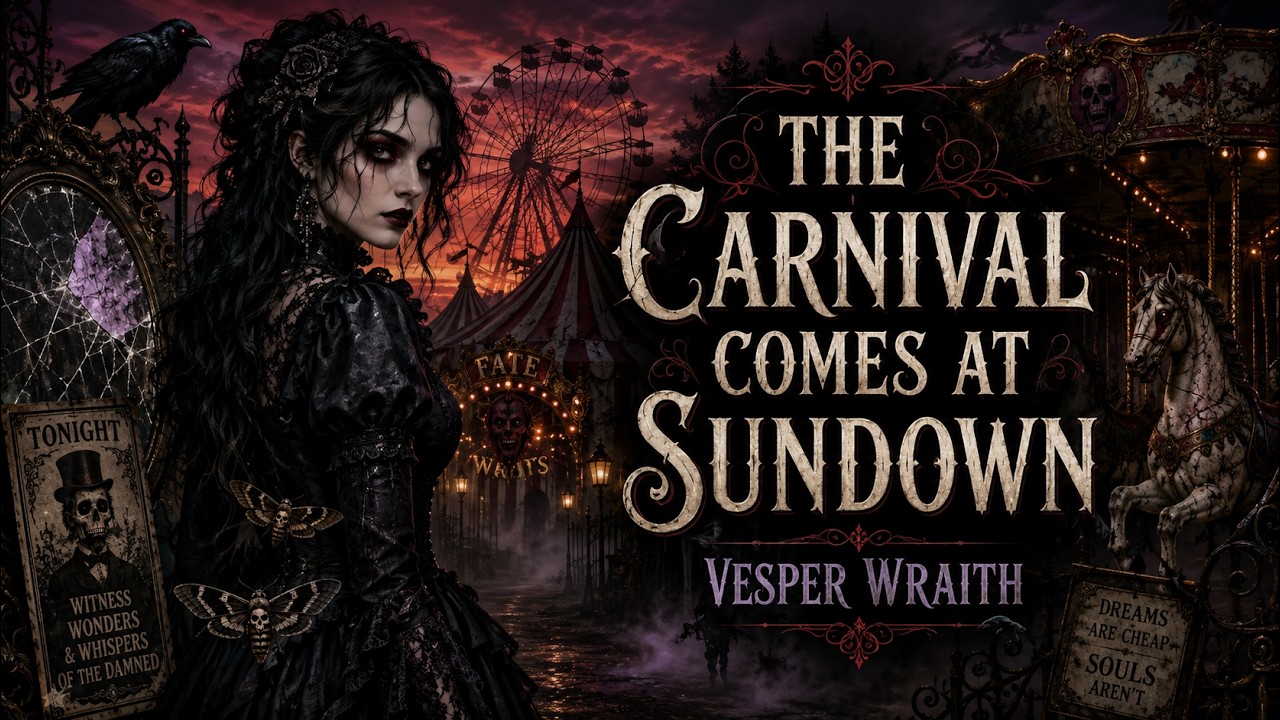
Vesper Mourdant invites the listener toward a carnival that appears at sunset, where beautiful lights and the promise of one night only make danger feel like an opportunity.
WRITING THE SONG
An empty field waits outside town.
At sunset, the lights appear.
Nobody has seen the trucks arrive or the tents being raised. Music begins drifting toward the streets, and a painted sign promises one night only.
Vesper invites the listener closer.
The Carnival Comes at Sundown opens The Carnival After Midnight with the feeling that something extraordinary has arrived—and that missing it would be a mistake.
The locked album concept begins with a supernatural carnival appearing on Halloween night.
Its first requirement is attraction.
The lights, music and spectacle must give people a reason to approach. The listener needs to understand why someone would cross the field, join the crowd and buy a ticket.
That desire supports the whole story.
The carnival’s later dangers become more effective because entering once seemed like a good idea.
This opening track establishes the pleasure that makes the invitation persuasive.
The carnival’s arrival leaves a gap in ordinary explanation.
An empty field becomes a destination without anyone witnessing the work required to build it.
That impossible beginning is easy to overlook once the lights are on.
There is suddenly something to see, and other people are heading toward it. Curiosity can move faster than suspicion.
The concept lets the listener encounter the spectacle before fully considering its arrival.
The question remains behind the invitation: how did all of this get here?
Sundown gives the track a visible threshold.
The field changes as daylight fades. Lights become brighter against the surrounding dark, and the carnival begins to define what can be seen.
The published description emphasizes that transformation: the lights come alive, the music grows strange, and leaving becomes less straightforward.
The time of day therefore does more than establish atmosphere.
It marks the beginning of the carnival’s influence over the setting.
The familiar landscape is still present, but something else has become its centre.
The album blueprint pairs the title hook with a short recurring invitation:
“Come inside.”
The phrase asks for a small action.
Move closer. Cross the boundary. See what is waiting.
Its simplicity makes it useful throughout the album. The words can sound welcoming before the listener understands the place, then become more troubling as its rules emerge.
At the opening, Vesper can appear to be sharing the discovery.
The invitation feels personal enough to follow.
The locked concept gives Vesper a deliberate ambiguity.
On a first listen, she can seem like another visitor drawn toward the carnival. On a later listen, her familiarity with the place becomes more significant.
That gives the opening a second life.
The words do not have to change.
What changes is the listener’s understanding of the person saying them.
The track plants that uncertainty gently. Vesper needs to be interesting and persuasive before the album begins making the listener question how much she already knows.
The painted promise of a single night adds urgency.
An ordinary attraction might still be there tomorrow.
This one offers a brief opportunity.
That makes delay feel like a possible loss. The listener can remain outside and wonder, or step closer while the lights are still burning.
The phrase also introduces time as part of the carnival’s power.
Sundown begins the visit.
Midnight and dawn will acquire their own significance as the album continues.
The musical blueprint called for cinematic gothic electropop, beginning with distant calliope and a quiet vocal entrance.
The arrangement was intended to gather gradually, with the first full chorus arriving later.
That design follows the listener’s approach.
At a distance, the carnival is something heard across the field. As the track develops, its musical presence becomes larger and more immediate.
These are documented creative intentions. The published release describes its musical world through dark gothic carnival music and gothic alternative.
The opening needs enough melody and momentum to draw the listener toward the gates.
The album blueprint introduces a short recurring carnival melody here.
Its purpose is continuity.
As the listener moves between attractions, altered versions of that musical idea can suggest that each apparently separate experience belongs to the same place.
The opening establishes something recognizable before later tracks complicate it.
That gives familiarity an unsettling potential.
A melody first associated with arrival and excitement can carry different implications after the listener has travelled deeper into the carnival.
The published description raises the possibility that leaving may require more than finding the gate.
That warning changes how the entrance can be understood.
A visible opening suggests a simple boundary: outside on one side, inside on the other.
The album gradually tests that assumption.
For now, the listener is still approaching. The next track, Tickets for the Dead, will turn curiosity into a transaction.
The opening’s job is to make that next step feel natural.
The album closes with a reprise of The Carnival Comes at Sundown.
In the locked concept, the lights appear in another empty field, near another town.
That return gives the first track a larger meaning.
What initially feels like the beginning of one unusual evening becomes part of a repeating pattern. The familiar invitation reaches a new audience.
The opening can still sound beautiful.
The listener now has reasons to hear it differently.
The Carnival Comes at Sundown makes the first step into danger feel like an opportunity: the lights are coming on, the music is calling, and Vesper is waiting for you to come inside.
SOURCES & REFERENCES
Source status applies to the referenced material, not to the original Rhialto song.
This is an original Rhialto concept developed for Vesper Mourdant’s The Carnival After Midnight.
The note draws on the locked album blueprint and the published video description.
The empty field, unseen arrival, one-night sign, recurring invitation and closing reprise come from the album blueprint. Musical and structural intentions are identified as development choices.
No specific literary work or historical carnival is claimed as its source.
Source status: Reference Sources Only.