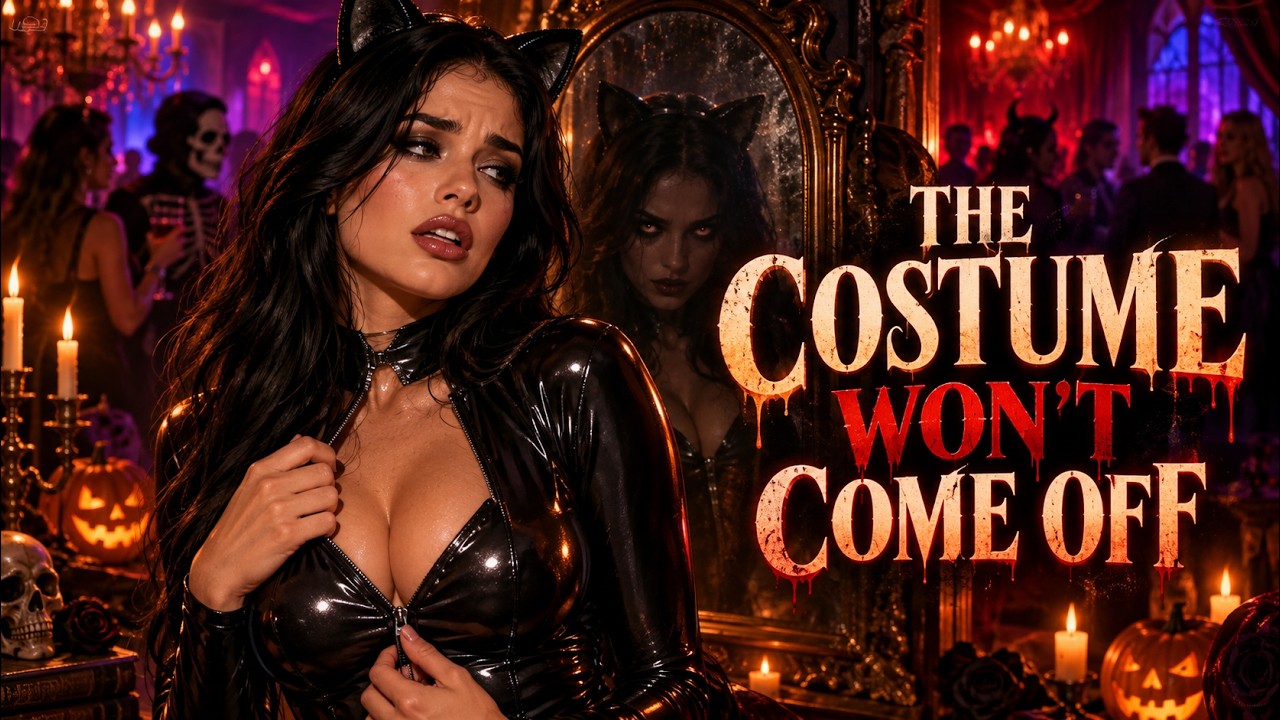
Vesper Mourdant turns a seductive Halloween fantasy into dark dance music about confidence, temptation and the moment a costume begins deciding who is wearing whom.
WRITING THE SONG
She puts it on for Halloween.
It makes her hotter.
Bolder.
More dangerous.
For a while, that is exactly what she wants.
Then she tries to take it off.
The Costume Won’t Come Off begins with the pleasure of becoming someone else for a night. Its horror develops when that borrowed identity stops feeling temporary.
The costume gives her something.
It may also be taking something.
The central creative instruction was to make this a sexy Halloween piece.
Seductive.
Stylish.
Provocative.
The attraction had to work before the threat became clear.
That gives the transformation an emotional reason to continue. Vesper enjoys the confidence the costume offers. She likes how she moves, how she feels and how other people respond.
Taking it off would mean surrendering those pleasures.
So the danger arrives inside something she already wants.
The costume does not begin as an obvious punishment. It begins as permission.
During development, the title and hook shifted toward Fits Too Well.
That phrase approaches the premise through attraction rather than explanation.
A costume fitting well should be good news. It suggests that someone has found the right look, the right shape, the right version of herself for the evening.
“Too well” introduces doubt.
Perhaps it is becoming difficult to distinguish the garment from the person wearing it.
Perhaps it understands her desires unusually well.
Perhaps the role feels so natural that returning to her ordinary identity begins to seem like the stranger choice.
The published title, The Costume Won’t Come Off, makes the consequence explicit. Fits Too Well preserves the temptation that leads her there.
The first change is something Vesper can welcome.
She becomes bolder.
She allows herself to be seen.
She moves with less hesitation.
That is a recognizable part of dressing for Halloween: clothing can provide an excuse to behave differently.
The music takes that ordinary experience and allows it to become increasingly unsettling.
What begins as confidence may be another presence finding a way to act through her.
The difficult question is where one ends and the other begins.
A costume normally comes with an agreement.
You can enter the role.
You can enjoy it.
You can leave it afterward.
The title breaks the last part of that agreement.
Vesper has accepted the transformation without necessarily agreeing to its permanence.
That gives the story its turn. Something she chose for one night may be making choices about the rest of her life.
The pleasure remains part of the problem.
If the new identity feels powerful, seductive and comfortable, escape can become more complicated than simply wanting the costume gone.
The September lyric development explored uncertainty about identity as well as the physical costume.
The unsettling possibility is that the outfit has revealed something Vesper already carried.
Another possibility is that it has introduced something foreign and made that presence feel familiar.
Those readings can coexist.
The story does not need to settle whether the transformation is discovery, surrender or possession to make the attraction dangerous.
Vesper can enjoy the experience while losing confidence in her understanding of it.
The musical development explored dark electropop and club music before moving toward electroclash, UK bass and alt-R&B.
That later direction brought the performance closer to the listener.
A low, conversational vocal could make the temptation feel intimate. An increasingly addictive groove could give the music the same pull as the costume.
The production notes also explored an answering “costume voice” and a lead voice gradually becoming part of the instrumentation.
As a creative device, that suggests a changing balance of control.
The wearer begins as the person telling the story.
The costume starts answering.
The idea of an answering costume voice makes the possession personal.
The threat is close enough to share Vesper’s rhythm and interrupt her account of what is happening.
That is especially effective within seductive dance music. An answering voice can sound inviting before it sounds invasive.
The same musical intimacy that supports attraction can support unease.
The listener is left wondering whether Vesper is hearing an influence, expressing a desire or beginning to lose the distinction between them.
The music’s appeal is part of its storytelling.
The dance track keeps offering pleasure while the premise becomes more disturbing.
That relationship mirrors Vesper’s experience. She receives something desirable from the costume even as its hold becomes harder to dismiss.
The groove therefore has a reason to remain compelling.
If the audience still wants to stay inside the music, it becomes easier to understand why she might hesitate to leave the fantasy.
The Costume Won’t Come Off describes a physical problem immediately.
Its meaning expands through the story.
A look becomes a role.
A role becomes a source of confidence.
That confidence becomes something Vesper may struggle to surrender.
By the time she tries to remove the costume, the question is larger than clothing.
How much of the person she has become belongs to her?
And how much intends to stay?
SOURCES & REFERENCES
Source status applies to the referenced material, not to the original Rhialto song.
The Costume Won’t Come Off was developed as an original Rhialto Halloween concept.
This Song Note draws on the September creative discussion, the Fits Too Well development direction and the description of the published recording.
The starting point was a seductive costume fantasy becoming an unsettling, potentially permanent transformation.
No specific literary adaptation is claimed.
Source status: Reference Sources Only