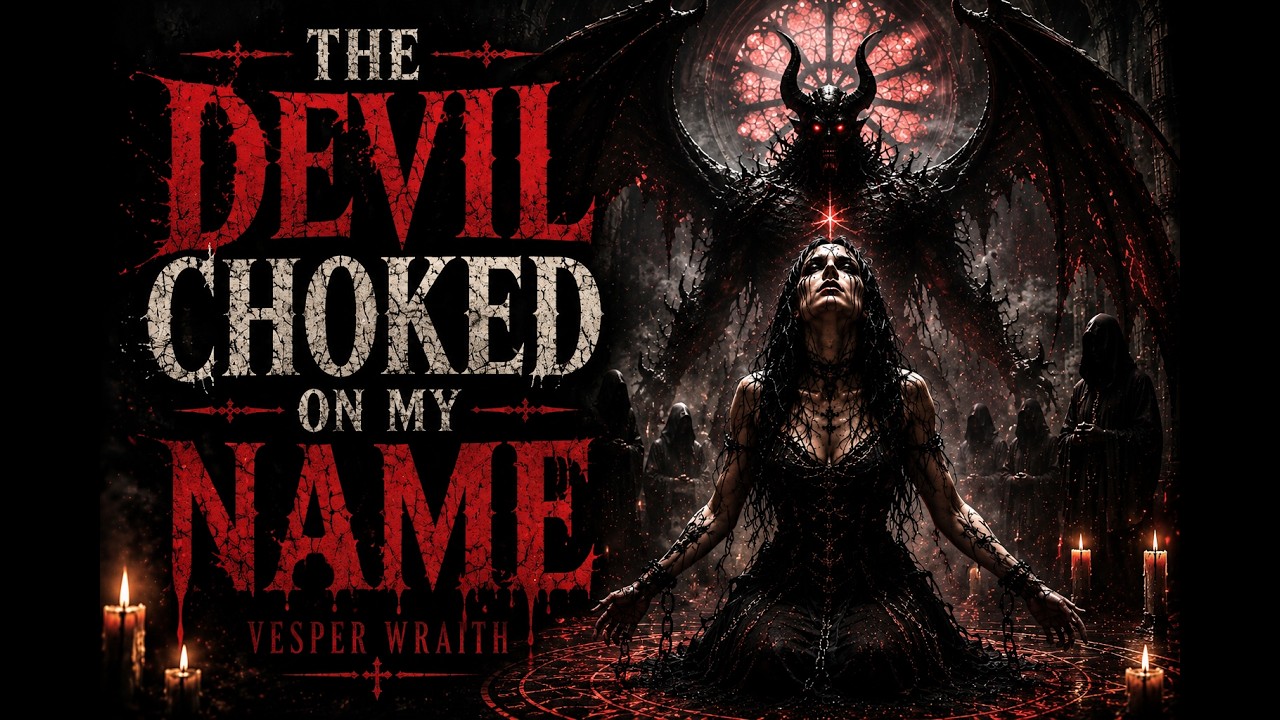
Vesper Mourdant reverses the sacrificial ritual in gothic horror metal: Hell expects a helpless offering, but the Devil cannot even speak her name.
WRITING THE SONG
They bring her into the ritual as a sacrifice.
The circle is drawn. Hell opens.
Then the beings waiting on the other side discover that they have misunderstood what has been delivered to them.
The Devil Choked on My Name begins with a familiar horror arrangement: a captive woman, a ritual and a power that expects to consume her.
The reversal comes when that power discovers it has summoned the wrong victim.
The original concept placed Vesper in the role of the intended offering.
That position gives the opening a clear imbalance.
Other people appear to control the ritual. They have chosen her place within it and expect the supernatural forces to accept what they provide.
The early production direction kept the opening inside that apparent danger. The reveal was intended for the midpoint, allowing the listener to encounter Vesper as the sacrifice before learning what that assumption leaves out.
The reversal needs that initial expectation.
The ritual’s participants believe they know what she is.
Their mistake drives the story.
The published description gives the reversal its clearest expression:
“You wanted a lamb?
YOU OPENED A CAGE.”
The first line names their expectation.
The second replaces it with something far more dangerous.
A lamb can be offered.
A cage contains something that may have been kept from the people outside it for a reason.
That image changes the meaning of the ritual. What looked like a delivery of helpless flesh becomes an act of release.
The participants have not simply chosen badly.
They have removed a barrier.
The published premise describes breaking chains, rising dead and a Devil who demands Vesper’s name.
These events expand the consequences beyond the ritual circle.
The forces that expected to dominate the encounter now face something they cannot comfortably command.
The original development concept framed the ritual as delivering Hell to her.
That is the deeper reversal.
Vesper has been brought to the place where she is supposed to lose all power. Instead, the encounter exposes how little the others understood about hers.
The title is literal within the developed story.
The Devil demands her name, then cannot repeat it.
That gives the supernatural confrontation a precise point of failure.
He can issue the demand.
He cannot manage the answer.
The name becomes more than an introduction. It is evidence that the person before him exceeds the role he assigned to her.
The title compresses that moment into a physical reaction.
The power expected to terrify her is the one that chokes.
The recovered lyric draft includes:
“I WAS THE INVITATION.”
That line gives Vesper a different relationship to the ritual.
She is no longer merely its object.
Her presence is part of what makes the encounter possible.
The phrase also leaves room for unease. An invitation can bring something into a place, but it does not guarantee that the guest will control what happens after arrival.
The ritual has opened a connection.
Vesper understands its significance differently from the people who arranged it.
The published recording is described through downtuned guitars, crushing drums, a dark cathedral atmosphere and extreme female vocals, including screams and growls.
The development brief also called for organ, chains and double-kick energy.
Those requested textures gave the concept a gothic horror-metal setting. The published description presents the finished track as Vesper in full rage mode.
That vocal direction matters to the reversal.
Her voice must carry the force of someone whose apparent helplessness has been badly misread.
The confrontation becomes something she can seize and answer.
The final production direction specified one lead vocalist rather than a call-and-response structure.
That kept the narrative centred on Vesper.
Other figures can draw the circle, open Hell and demand her name, but her voice carries the account of what their actions unleash.
The midpoint reveal was also part of that direction.
The listener was meant to spend time inside the apparent sacrifice before the track exposed the larger threat.
The change in understanding gives the later declarations their weight.
The same woman has been there throughout.
The audience’s idea of her has changed.
Another declaration in the recovered lyric draft is:
“I LET HELL OUT.”
By this point, the language belongs to someone claiming an action.
The line gives the release an agent.
It also keeps the ending dangerous. Vesper’s reversal does not promise that everything has become safe simply because the intended sacrifice can fight back.
Something has been unleashed.
The power balance has changed, and the consequences extend beyond the people who expected to control the ritual.
The central idea is a reversal of recognition.
The ritual’s participants see a victim.
The Devil demands a name as though the answer will place her within his authority.
Both assumptions fail.
That makes the title the point where the story’s imbalance becomes unmistakable. The figure who should command the encounter cannot even speak her identity.
The Devil Choked on My Name turns the sacrificial ritual against its makers: they expect a helpless offering, and discover too late that they have opened a cage.
SOURCES & REFERENCES
Source status applies to the referenced material, not to the original Rhialto song.
This is an original Rhialto gothic horror concept developed for Vesper Mourdant.
The note draws on recovered lyric and production-development material and the published video description.
The sacrifice, reversal, breaking chains, rising dead and confrontation over her name come from that material. Arrangement instructions are distinguished from the published description of the finished recording.
No specific literary work is claimed as its source.
Source status: Reference Sources Only.