How Edgar Allan Poe’s vision of human life as a doomed theatrical performance became an Orpheus Shade gothic-rock piece where death is no longer merely the final conqueror — it is the ruler the entire performance was serving all along.
WRITING THE SONG
The central image in The Emperor Worm comes from one of Edgar Allan Poe’s strangest poems:
“The Conqueror Worm.”
The poem begins like a performance.
There is a theatre.
An audience of angels.
An orchestra.
Actors moving across the stage.
A story apparently concerned with human hopes and fears.
Then the performance begins to reveal what it really is.
The actors are not entirely in control.
They move like puppets.
Something unseen shifts the scenery.
The same motions repeat.
Madness and sin accumulate.
And finally something enters the stage that makes everything else irrelevant:
the worm.
That image is what made the poem such a natural fit for Orpheus Shade.
The horror is not simply that everybody dies.
Poe makes death part of the structure of the production.
The audience was watching a tragedy from the beginning.
The actors just did not know what role they were playing.
That became the foundation of the Rhialto version.
The music does not treat the worm as a creature crawling out of a grave.
It treats it almost like the final performer.
The theatre has been waiting for it.
The orchestra has been building toward it.
The scenery exists for its entrance.
Everybody else onstage is temporary.
That is where the title changes.
Poe calls it:
The Conqueror Worm.
Rhialto calls it:
The Emperor Worm.
The difference is small, but it changes the relationship.
A conqueror wins.
An emperor rules.
If the worm always appears at the end of every human performance, perhaps it did not really conquer anything.
Perhaps the theatre belonged to it from the beginning.
That produced the central attitude of the song:
Bow down.
Not because the worm is impressive.
Not because it deserves worship.
Because every king, lover, murderer, saint and fool eventually becomes part of the same audience.
The crown is grotesque precisely because its authority is absolute.
That idea also shaped the visual world.
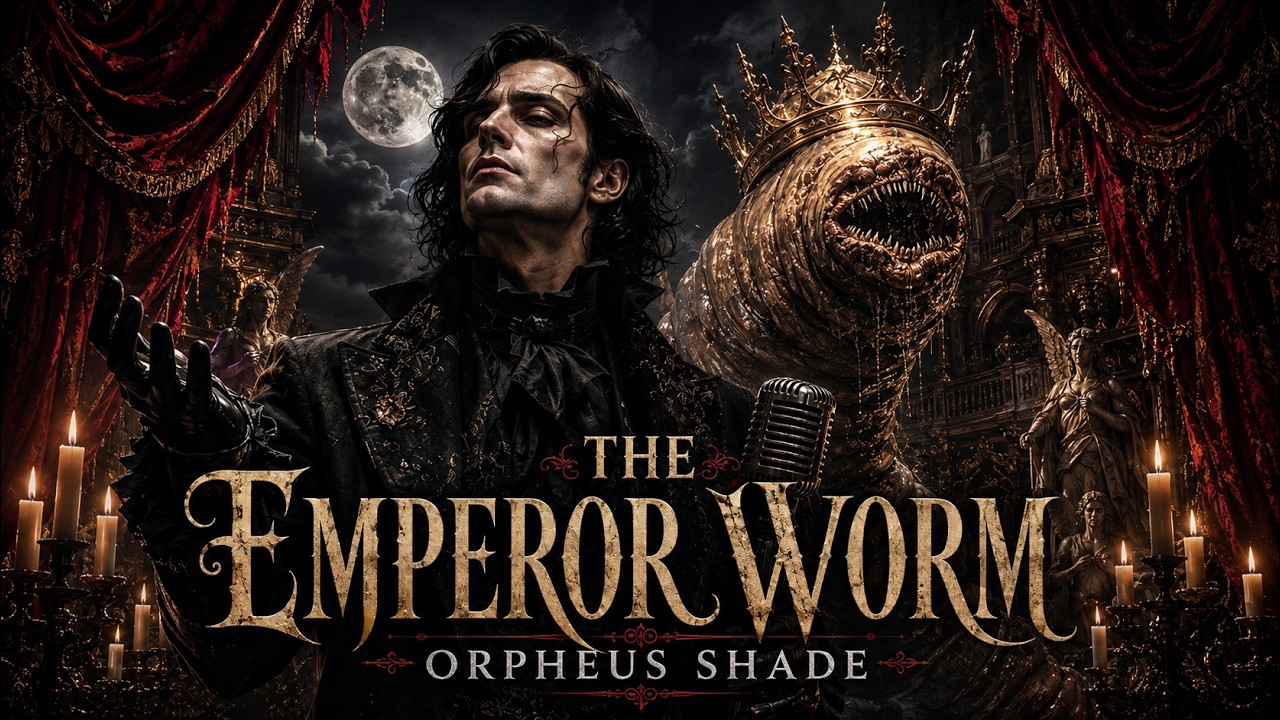
The public Rhialto release places the song inside a ruined gothic opera house:
torn velvet,
candlelight,
weeping angels,
rotting grandeur,
and the sense that a magnificent performance has continued long after the building itself should have collapsed.
The setting matters because decay is everywhere before the worm even appears.
The theatre already knows the ending.
So does the audience.
Only the actors continue pretending otherwise.
That makes the song less about death itself than about human importance.
We spend enormous amounts of time assigning ourselves roles.
Hero.
Villain.
King.
Victim.
Winner.
Failure.
The performance feels enormous while we are inside it.
Poe’s poem reduces all of that to one title:
the tragedy, Man.
The Rhialto version keeps that scale but gives it Orpheus’s heavier musical personality.
His voice works here because the track needs somebody who can sound less like a frightened participant and more like the person standing at the edge of the stage explaining what everybody else refuses to see.
The production therefore leans toward gothic rock, gothic soul and dark orchestral rock rather than a delicate poetry setting.
Deep vocals.
Funeral-cabaret drama.
Heavy low-end.
Orchestral weight.
A stage large enough for something terrible to enter it.
The track should feel theatrical because the poem is theatrical.
But it should not feel elegant all the way through.
The performance needs to decay.
The beautiful theatre becomes a slaughterhouse.
The ceremony becomes consumption.
The curtain becomes something closer to a burial shroud.
And when the worm finally occupies the centre of the stage, the music no longer needs to pretend there is another act coming.
That is the meaning of the crown.
Everyone else had a scene.
The worm gets the theatre.
There is also a useful irony in turning something as physically insignificant as a worm into an emperor.
Human beings build monuments.
Dynasties.
Religions.
Armies.
Cities.
Stages.
Then something tiny and blind inherits all of it.
That imbalance is more disturbing than a conventional monster.
The Emperor Worm does not need claws.
It does not need intelligence.
It does not even need intention.
It only needs time.
That is why the song does not attempt to defeat it.
There is no heroic final battle.
There is only recognition.
The final actor has taken the stage.
The lights are going out.
And the audience finally understands what play they have been watching.
SOURCES & REFERENCES
Source status applies to the referenced material, not to the original Rhialto song.
Public-domain literary source
Rhialto reinterpretation
The Emperor Worm is a Rhialto / Orpheus Shade reinterpretation inspired by Poe’s poem rather than a direct musical recitation.
The title change from Conqueror to Emperor, the crowned-worm imagery, ruined opera-house setting, “bow down” framing, orchestral gothic-rock treatment and Orpheus Shade performance are Rhialto creative elements.
The reinterpretation pushes one question beyond Poe’s original image: if death wins every performance, was it ever really a contestant — or was it running the theatre?