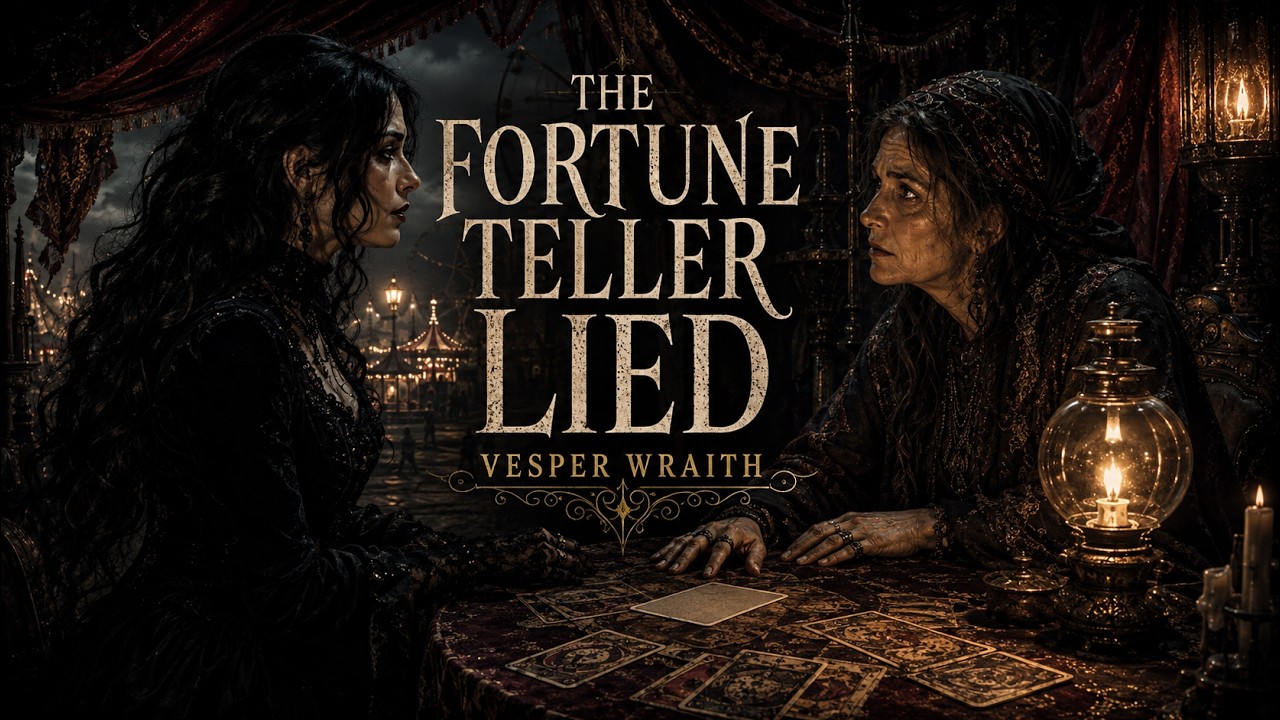
Vesper Mourdant receives a promise of eternal life, but the carnival’s weary fortune teller makes knowing the future more frightening than uncertainty.
WRITING THE SONG
The fortune teller has spent years giving people predictions they do not want to hear.
They keep coming true.
Then Vesper sits across from her and receives what should be wonderful news:
“You’re going to live.”
Inside this carnival, that promise offers little comfort.
The Fortune Teller Lied explores the moment when knowing the future becomes more frightening than uncertainty.
This is Track 7 of The Carnival After Midnight, following The Haunted House Knows Your Name and preceding Carousel of Bones.
The haunted house has already demonstrated an impossible knowledge of its visitors’ private lives.
The fortune teller extends that threat into the future.
The listener now seeks an explanation. Sitting down for a reading feels like a reasonable attempt to understand what is happening.
That desire brings them closer to another attraction.
The carnival gains their attention by offering something they want: an answer.
The original brief deliberately avoided a flamboyant mystical performance.
This fortune teller is weary.
Her authority comes from the reliability of her predictions and the exhaustion of having watched them come true.
That makes the encounter more intimate. She does not need to shout or threaten.
She can speak quietly and still change the meaning of the night.
Her reluctance also creates a question: how much does she know that she would rather leave unsaid?
The locked central hook is:
“The fortune teller lied /
She said I’d never die.”
Its strength comes from the disagreement between the accusation and the promise.
Never dying could sound like a gift.
Vesper calls it a lie.
The creative brief kept several interpretations open. The teller might have lied literally. She might have spoken a truth whose meaning Vesper rejects. Eternal existence inside the carnival might be so far from living that the promise becomes cruel.
The track does not need to choose one explanation.
The uncertainty is part of the hook.
The published premise raises the possibility that living forever could be worse than dying.
Within the album’s development, that fear is connected to the possibility of never being allowed to leave.
Duration alone does not make a future desirable.
The question becomes what kind of existence is being promised—and who controls its conditions.
Vesper understands the prediction as bad news.
Her reaction gives the listener another reason to wonder how well she already knows this place.
The published description then moves the encounter toward the listener.
You sit down.
The fortune teller turns one card.
She refuses to finish the reading.
That refusal becomes its own message.
A person whose predictions have been dependable suddenly withholds one. The absence of an answer feels more significant because the story has established her ability to give it.
The listener wanted information.
Now they must interpret why she has stopped.
The original development brief connected the unfinished reading to a future that may no longer exist outside the carnival.
That is the underlying story idea, rather than an explanation the track needs to announce outright.
The published description preserves the uncertainty with another possibility: perhaps the fortune teller is reading what the carnival has already decided.
Prediction begins to resemble a verdict.
The teller’s knowledge may be accurate because the place around her has already narrowed the available outcomes.
That gives her weariness a different weight.
She may be reporting something she cannot change.
The album blueprint called for gothic piano and a low electronic pulse evolving into dark trip-hop.
The detailed brief imagined a private encounter inside a small tent while the midway continued outside.
That direction supplied a deliberate reduction after the haunted house’s larger horror.
Close piano, restrained rhythm and an intimate vocal were intended to bring the listener toward the table.
The fear would come through attention.
A quiet sentence could carry the most disturbing information in the room.
These are documented creative directions; the published recording is classified through gothic, dark electronic, electropop and dark trip-hop music.
The structural brief delayed the full chorus until roughly the middle of the track.
The purpose was to establish the fortune teller’s reliability before introducing the accusation that she lied.
The listener first encounters someone whose predictions come true.
Then Vesper challenges the meaning of what she has been told.
That sequence gives the title its tension.
The hook is memorable on its own, but the readings before it make its contradiction more unsettling.
One of the locked development choices was a late change in the hook:
“She said I’d never die”
becomes:
“She said you’d never die.”
A single pronoun redirects the prophecy.
What initially appears to concern Vesper becomes something addressed to the listener.
The brief called for that change to receive clear musical space. Its importance comes from how little wording has to change for the encounter to become personal.
You have been listening to her reading.
Now the promise is yours.
The musical brief also proposed unstable tuning and branching harmonic possibilities as storytelling devices.
The same phrase could seem to lead toward different outcomes. A reassuring harmony could gradually become uncertain. At the refused reading, those possibilities could collapse into something sparse and unresolved.
These were production ambitions, rather than a measurement of the finished recording.
Their purpose was precise: make the music suggest a future that appears open until suddenly it does not.
The track could become quieter while its implications grew more disturbing.
The fortune teller’s most frightening act is withholding the rest.
She knows enough to stop.
Vesper knows enough to distrust the promise.
The listener is left between those two forms of knowledge, trying to understand what has already been decided.
The Fortune Teller Lied turns the promise of never dying into a question about whether a future still belongs to the person expected to live it.
SOURCES & REFERENCES
Source status applies to the referenced material, not to the original Rhialto song.
This is an original Rhialto concept developed for Vesper Mourdant’s The Carnival After Midnight.
The note draws on the locked album blueprint, the detailed Track 7 creative brief, recovered development exchanges and the published video description.
Structural and musical intentions are identified as development choices. No specific literary work or historical fortune-telling tradition is claimed as the source.
Source status: Reference Sources Only.