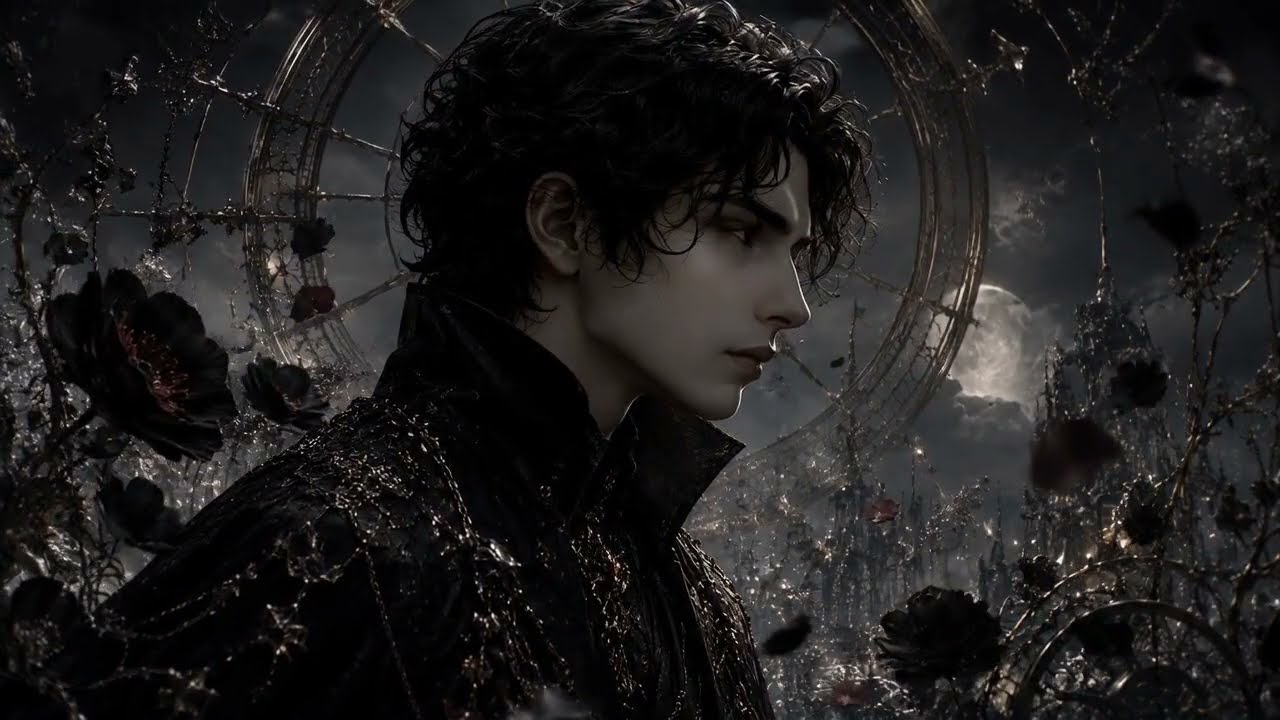
How Swinburne’s The Garden of Proserpine became industrial gothic rock about exhaustion, black flowers, broken clocks and the desire to finally stop.
WRITING THE SONG
The Garden Below began with Algernon Charles Swinburne’s “The Garden of Proserpine.”
The poem does not treat death primarily as terror.
It treats it as rest.
That distinction was the reason I wanted to work with it.
Swinburne’s speaker is exhausted by both sides of life.
Joy and sorrow.
Hope and fear.
Love and loss.
Work and reward.
Even the possibility of heaven or hell feels like another demand.
What remains attractive is something quieter:
sleep.
Not victory.
Not punishment.
Not transcendence.
Simply an end to striving.
That became the emotional centre of The Garden Below.
The source poem is filled with fading flowers, poppies, weary rivers, dead years and a world moving eventually toward stillness.
I wanted to preserve that sense of surrender without simply setting the poem to music.
So the adaptation became heavier.
More physical.
More industrial.
Instead of a quiet Victorian garden, I imagined a world above it built from machinery.
Engines.
Wires.
Clocks.
Metal.
Noise.
Production.
Ambition.
Everything moving because it is expected to keep moving.
And somewhere beneath all of that—
the garden.
That gave the music its basic vertical structure.
Above: machinery.
Below: silence.
The narrator begins in the upper world.
The rhythm feels mechanical.
Percussion strikes like factory equipment.
Guitars grind rather than shimmer.
Low synths and distorted textures make the environment feel constructed rather than natural.
There is always another pulse.
Another demand.
Another turn of the machine.
That is where the first major hook came from:
Take me where the black flowers grow.
The black flowers are not meant to be a literal detail from Swinburne.
They are the Rhialto image that grew out of his bloomless poppies, pale fields and exhausted natural world.
They represent something that should feel impossible:
life growing inside surrender.
Not bright flowers reaching toward the sun.
Flowers adapted to darkness.
The narrator does not want to rescue them.
He wants to join them.
Then comes the second hook:
Lay me in the garden below.
That line carries most of the emotional weight.
It is not:
Save me.
It is not:
Bring me back.
It is:
Let me stop.
That makes the song darker than a conventional death narrative, but I did not want it to feel nihilistic.
The garden is not presented as violence.
It is presented as relief.
The world above keeps asking:
What next?
What more?
What did you accomplish?
What did you earn?
What do you believe?
Where are you going?
The garden asks nothing.
That idea comes directly from what attracted me to Swinburne’s poem.
His speaker is tired not only of pain but also of pleasure.
Even happiness requires participation.
Even hope keeps the future alive.
The garden represents freedom from both.
That made the adaptation less about death itself and more about exhaustion with continuation.
One of the lines that shaped the concept most strongly was the poem’s movement toward release from hope and fear.
Those are opposites, but both keep a person attached to what happens next.
Hope says something better may come.
Fear says something worse may come.
The garden removes the question.
There is no next thing to prepare for.
That is why time became an important Rhialto image.
Clocks appear throughout the visual and lyrical world of the track.
Not elegant antique clocks.
Industrial ones.
Factory clocks.
Broken faces.
Hands still moving even after the machinery around them has stopped.
Eventually that leads to the breakdown:
STOP THE CLOCK.
Then:
CUT THE WIRE.
Those are much more aggressive phrases than Swinburne uses.
But emotionally they serve the same transformation.
The poem asks for release.
The Rhialto version has to physically disconnect the machine.
STOP THE CLOCK.
Time no longer owns you.
CUT THE WIRE.
The system no longer owns you.
The breakdown is the moment when surrender becomes an action.
Before that, the narrator is asking to be taken to the garden.
Now he begins dismantling what keeps him above it.
That was also the point where the industrial-rock treatment became essential.
A gentle arrangement would have captured the sleep and stillness of the poem.
But it would have missed the contrast I wanted.
The garden only feels truly silent if the world above it is unbearably loud.
So the production uses that difference.
The verses are built around mechanical percussion, heavy low guitars and a cavernous male vocal.
The voice should feel as though it is travelling through a large concrete space.
Not polished.
Not intimate.
Almost architectural.
The low choir expands the choruses without turning them heroic.
That was important.
This is not a victory anthem.
When the chorus opens up around:
Take me where the black flowers grow
the scale increases, but the emotional direction still points downward.
Toward soil.
Roots.
Stone.
Sleep.
The production becomes enormous while the narrator is asking to disappear.
That contradiction became one of the strongest parts of the piece.
The imagery follows the same path.
At first:
machinery.
Metal corridors.
Power lines.
Clocks.
Industrial ruins.
Then nature begins appearing inside them.
Roots through concrete.
Black flowers beside rusted equipment.
Poppies growing where machinery has stopped.
Water crossing abandoned floors.
The natural world is not reclaiming civilization in the usual optimistic sense.
It is absorbing it.
Everything built to continue forever eventually becomes part of the garden.
That led to another recurring image:
silver roots.
The roots move through metal like veins.
Not violently.
Patiently.
The machine may be louder.
The roots have more time.
As the descent continues, the imagery becomes less industrial and more mythic.
Poppies.
Asphodel.
Dark water.
Ruined columns.
Bones beneath roots.
The boundary between Swinburne’s Proserpine and the older mythic underworld begins to blur.
But I did not want the track to become a literal retelling of Persephone or Proserpine.
There is no narrative about abduction, seasons or returning from the underworld.
The goddess matters primarily because of what she represents in Swinburne’s poem:
the keeper of a place beyond ordinary human striving.
The garden is her territory.
And unlike most mythic underworlds, it is not frightening because of punishment.
It is attractive because nothing follows you there.
That idea becomes clearest near the end.
The clocks are gone.
The percussion begins falling away.
The machinery loses power.
The giant arrangement that has been pushing through most of the track starts removing itself piece by piece.
Guitar.
Percussion.
Noise.
Electrical hum.
Eventually even the choir disappears.
The destination of the music is silence.
That is unusual for a track built from industrial rock.
Normally escalation promises a bigger ending.
Here, the biggest possible ending is the absence of everything.
The narrator finally reaches the garden.
And when he does—
the production no longer needs to describe it.
The lack of sound becomes the description.
That is where Swinburne’s original idea and the Rhialto adaptation finally meet.
The Victorian poem and the industrial track take very different routes.
But they arrive at essentially the same place.
A world beyond ambition.
Beyond pleasure.
Beyond fear.
Beyond the machinery of being alive.
The final request remains simple:
Lay me in the garden below.
And then—
nothing.
SOURCES & REFERENCES
Source status applies to the referenced material, not to the original Rhialto song.
Algernon Charles Swinburne — “The Garden of Proserpine”
The principal source for The Garden Below is Algernon Charles Swinburne’s public-domain poem “The Garden of Proserpine,” first published in the Victorian period.
Swinburne’s poem imagines Proserpine’s garden as a place beyond ordinary human desire, where weariness, love, sorrow, hope and fear ultimately give way to sleep and stillness.
Rhialto’s adaptation does not simply set the original poem to music.
Instead, it takes Swinburne’s themes of exhaustion, mortality and release and rebuilds them inside an industrial gothic world of machinery, clocks, wires, ruins and encroaching roots.
The hooks “Take me where the black flowers grow,” “Lay me in the garden below,” and the breakdown phrases “STOP THE CLOCK / CUT THE WIRE” are original Rhialto elements.