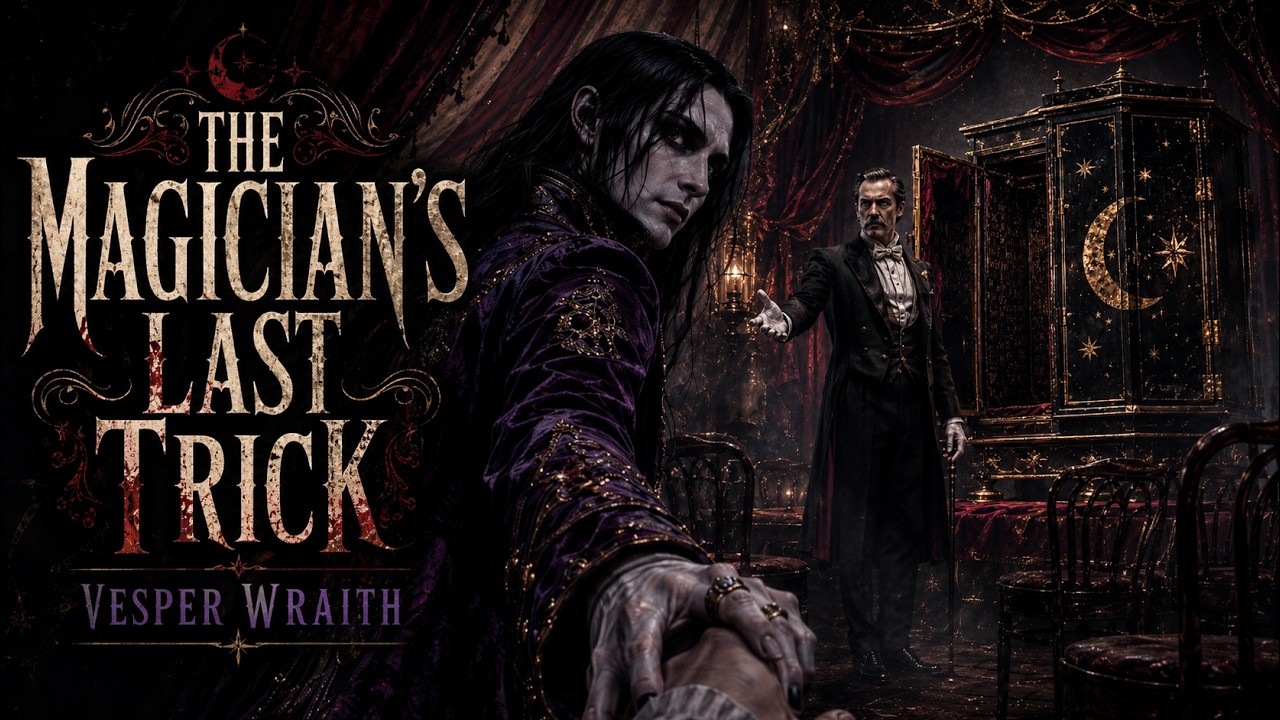
Vesper Mourdant’s polished carnival magician makes volunteers disappear, then lets the audience laugh at the condition that coming back costs extra.
WRITING THE SONG
The magician asks for volunteers.
They enter the cabinet.
They disappear.
The audience waits for the part where he brings them back.
Instead, he offers a joke:
“Coming back costs extra.”
At first, everyone laughs.
The Magician’s Last Trick lets that laughter become part of the danger. The performer tells the audience something important, and they mistake it for entertainment.
The published premise places the magician inside a candlelit carnival tent.
He is polished, theatrical and comfortable asking people to join his act.
That confidence matters.
A stage magician depends on an audience agreeing to follow his instructions and accept temporary uncertainty. A disappearance is expected. The return is what completes the performance.
The carnival’s magician uses that expectation.
People volunteer because they believe they understand the kind of event they are attending.
His presentation gives them little reason to question it immediately.
“Coming back costs extra.”
The line works because it resembles an ordinary piece of stage banter.
It sounds like an exaggerated complaint about prices, or a performer pretending to charge for the second half of a trick.
Within the original album concept, the audience laughs and nobody pays.
That makes the joke a trap built from interpretation.
The magician has announced a condition.
The audience has decided he cannot mean it.
The danger grows in the space between what he says and what they are willing to believe.
The published description measures the consequences through empty chairs.
That is a particularly effective detail because it keeps the horror in the audience’s own space.
The cabinet is onstage.
The missing people leave gaps among everyone watching.
Each empty seat is evidence that the performance has reached beyond its theatrical frame.
The crowd becomes smaller.
The joke becomes harder to enjoy.
The audience can continue watching the magician, but the room around them is changing.
The locked album blueprint adds another disturbing image: hundreds of initials scratched inside the cabinet.
Those marks suggest that the disappearances have a history.
The volunteers are entering something others have entered before them. The scratched letters give those earlier people a trace of identity without explaining where they went.
The cabinet becomes more than a prop.
Its surface holds evidence that someone had time—or reason—to leave a mark.
The attraction’s polished exterior conceals a different story.
The central invitation is:
“For my last trick, I’ll make you disappear…”
Initially, it belongs to the familiar language of a stage performance.
“Last trick” promises a finale.
It tells the audience that the act is approaching its most impressive moment.
The published premise changes the direction of that promise. By the time the magician delivers the line, he is looking at you.
The listener’s position shifts.
Watching the volunteers was one kind of participation.
Being selected is another.
That direct attention gives the track its final threat.
The listener has been able to observe the cabinet, the joke and the empty chairs from an apparent distance.
The magician removes that distance.
His announcement now includes the person who has been watching.
The phrase remains theatrical, but its meaning has changed through everything that came before it.
The audience knows what disappearance has meant for the volunteers.
Now the same offer is personal.
This is Track 9 of The Carnival After Midnight, following Carousel of Bones and preceding Don’t Follow the Ghost Train.
The album blueprint gives it a specific role: bring black humour and momentum back before the final descent.
The magician supplies both.
His act is entertaining enough to keep people engaged. Its rules become frightening as their consequences accumulate.
The published description places the track where realization begins moving toward panic.
The listener is no longer merely noticing that the carnival’s attractions are impossible.
They are beginning to understand the risk of remaining part of the show.
The published recording combines gothic horror music, dark cabaret, theatrical rock, dark electronic production and distorted carnival textures.
The locked musical concept called for piano, distorted guitar, brass and modern electronic drums.
Those ingredients were intended to support the performer’s stage presence and the attraction’s changing mood.
The theatrical character gives the magician room to entertain.
The darker musical setting supports the growing recognition that his words have consequences.
The humour and the threat belong to the same performance.
The structural blueprint proposed multiple false endings.
Each time the track seemed to finish, the magician would announce another trick and the arrangement would return.
That was a development choice designed to make the form echo the attraction.
The listener expects closure.
The performer keeps control of when the show ends.
Even the idea of a “last” trick becomes unreliable.
The act can offer a conclusion without releasing its audience.
The published description captures the larger idea:
“The carnival rarely lies.
It simply lets you believe what you wanted to hear.”
That is the mechanism underneath the magician’s joke.
The audience hears a condition and chooses the comforting interpretation. They expect a disappearance to be temporary because that is how a familiar performance should work.
The magician benefits from that expectation.
The Magician’s Last Trick turns stage banter into a warning: the audience laughs at the price of coming back, until the empty chairs make it clear that the joke was part of the contract.
SOURCES & REFERENCES
Source status applies to the referenced material, not to the original Rhialto song.
This is an original Rhialto concept developed for Vesper Mourdant’s The Carnival After Midnight.
The note draws on the locked album blueprint and the published video description.
The cabinet’s scratched initials and the proposed false endings come from the blueprint. The empty chairs, direct address and quoted stage lines appear in the published description. Musical and structural intentions are identified as development choices.
No specific literary work or historical magician is claimed as its source.
Source status: Reference Sources Only.