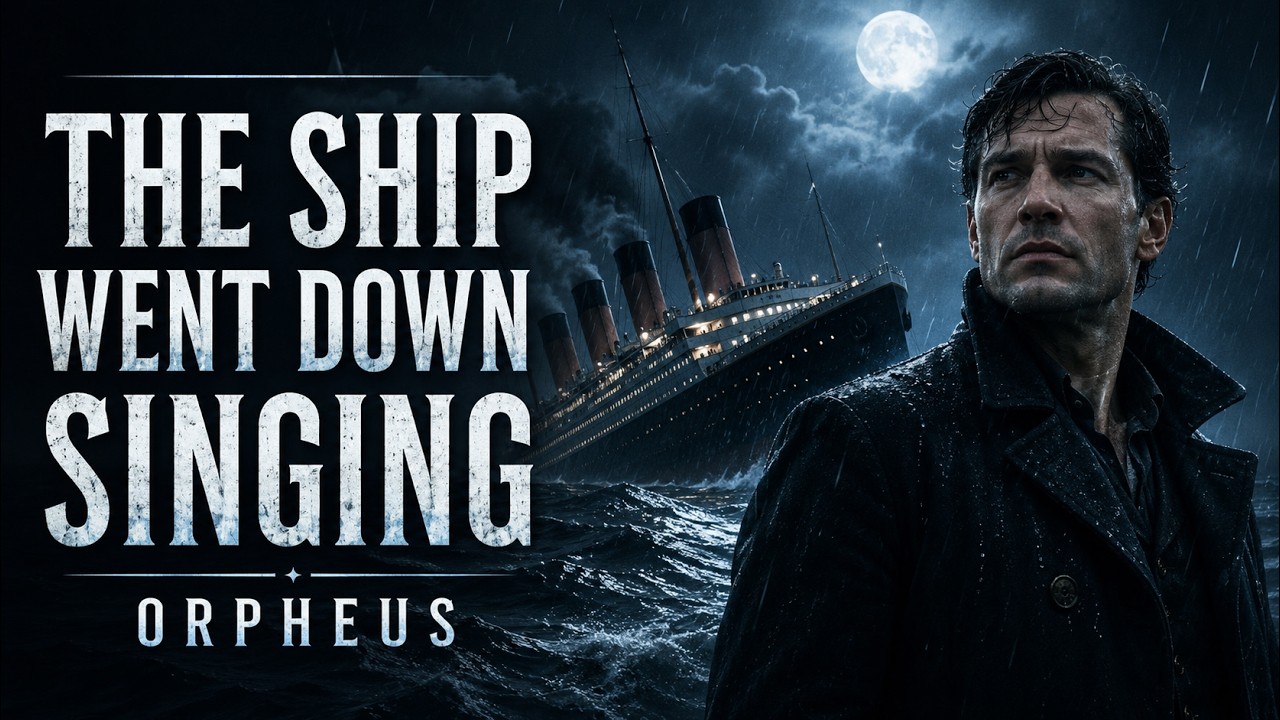
How an unnamed shipwreck became Orpheus Shade’s dark maritime ballad about black water, survivor guilt and a crew whose final act is to sing.
WRITING THE SONG
The ship is already dying.
The storm has stopped being weather and become fate.
The crew understands what is happening before anyone says it aloud.
Then something strange happens.
They sing.
Not because they believe music will save them.
Not because the shipwreck becomes beautiful.
They sing because almost everything else has been taken out of their hands.
The sea controls the ship.
The storm controls the night.
Death controls what happens next.
But the final sound they make still belongs to them.
That became the central image of The Ship Went Down Singing.
The song is not based on a specific named maritime disaster.
That was deliberate.
Orpheus Shade has other material connected more directly to historical wrecks, literature and maritime history. The Ship Went Down Singing works differently.
The vessel is unnamed.
The place is unnamed.
The date does not matter.
It is a composite maritime catastrophe built from familiar realities of shipwreck:
Black water.
A failing hull.
Heavy weather.
Bells.
Crewmen realizing the pumps will not be enough.
People praying.
People working.
People understanding.
That absence of a specific historical identity allows the song to become larger than one wreck.
It could be almost any ship whose final minutes vanished beneath dark water.
The early verses needed to establish that the ocean is not merely atmospheric.
It is physical.
One of the deliberately blunt images became:
“The wave hit the ship like a rock.”
There is nothing elegant about the comparison.
That is why it works.
Water is supposed to move around solid things.
Here the water has become the solid thing.
The ship is what breaks against it.
The line turns the sea from landscape into force.
By that point the storm is no longer something the crew is sailing through.
It is something striking them.
Another small image became important:
“The cook mumbled a silent prayer.”
I liked placing the prayer with the cook rather than the captain.
Shipwreck stories naturally pull attention toward command:
The bridge.
The wheel.
The officers.
The final order.
But disasters happen to entire crews.
A cook has no control over the storm.
He cannot change the ship's heading.
He cannot repair the hull by authority.
His response is smaller.
Human.
A prayer muttered in the middle of work.
That image keeps the song from becoming an abstract maritime legend.
There are ordinary people inside the wreck.
An early working title was:
Bells Below the Black Tide.
That phrase remained important even after the title changed.
The chorus carries the image:
“Only bells below the black tide.”
A ship's bell normally belongs above the water.
It marks time.
Watch changes.
Warnings.
Presence.
After the wreck, the same bell exists beneath the sea.
Its meaning has changed.
There is no crew left to answer it.
No harbour to hear it.
No watch to change.
The bell becomes a remnant of the ship's human order lying inside a place where that order no longer matters.
That is one of the core images in Orpheus's maritime world:
The sea does not need to destroy every object.
Sometimes it is enough to move the object somewhere it no longer belongs.
Bells Below the Black Tide was a strong image.
But it described the aftermath.
The Ship Went Down Singing describes the people.
That became more important.
The wreck itself is not the unusual part of the premise.
Ships have gone down in storms for as long as people have crossed oceans.
The unusual part is the final act.
They sing.
The title tells us what the song is really interested in before we hear a single verse.
Not:
How did the ship sink?
But:
What did the people aboard do when they knew it would?
The singing cannot be treated as cheerful defiance.
That would weaken the song.
This is not a sea shanty where the crew raises a chorus and somehow beats the storm.
Nobody sings the water away.
The ship still sinks.
That fact is essential.
The music becomes powerful precisely because it has no practical effect.
It does not rescue anyone.
It does not repair anything.
It does not change the ending.
The singing matters because the ending does not change.
When action can no longer alter the outcome, expression becomes one of the last remaining forms of choice.
This track became an important part of defining Orpheus Shade.
His strongest lane is not conventional folk nostalgia.
It is the doomed witness.
The survivor.
The man who tells you what happened without decorating it until the truth becomes comfortable.
That requires a particular voice.
Low.
Weathered.
Controlled.
The performance should sound like someone who has already accepted the ending before the listener has.
Orpheus does not need to scream that the situation is terrible.
He tells you what happened.
That restraint makes the story heavier.
The shipwreck also carries an implied problem beyond the sinking itself.
Someone has to tell the story.
That creates survivor guilt.
Why did one person come back when others did not?
What does survival require from the survivor?
Remember them?
Name them?
Tell the story accurately?
The song does not need to answer those questions directly.
The existence of the ballad answers part of them.
Someone remembers.
The ship disappeared.
The voices did not disappear completely because somebody carried them out.
That idea became increasingly important to Orpheus as a persona:
A grave can hold a body.
It cannot always hold the story.
The Ship Went Down Singing became one of the defining pieces of Orpheus Shade's Every Grave Holds a Song world.
The title of that project expresses the same idea on a larger scale.
Death ends a life.
It does not automatically end the story attached to it.
A shipwreck leaves wreckage.
A battlefield leaves names.
A town fire leaves photographs.
A grave leaves somebody who remembers.
Orpheus exists in that space between disappearance and memory.
The Ship Went Down Singing is almost a mission statement for him.
The bodies go under.
The story refuses to.
Musically, the obvious danger was turning the song into a traditional sea shanty.
That was specifically avoided.
No cheerful call-and-response.
No exaggerated pirate voice.
No jaunty Celtic rhythm.
No tavern atmosphere.
The story is maritime.
The production does not need to cosplay the nineteenth century.
The original musical direction leaned toward restrained dark maritime blues-metal, later settling naturally into Orpheus's broader dark cinematic folk-rock / gothic Americana lane.
The goal was weight rather than speed.
The vocal needed to be a weathered male baritone.
Human rather than theatrical.
Measured rather than operatic.
Orpheus works best when the singer sounds like someone who might actually have stood on that deck.
There can be power in the chorus.
But not metal growling.
Not exaggerated gravel.
Not a stage villain's voice.
The performance should feel like testimony.
That difference became part of the persona's identity.
The arrangement was designed around physical, low-register sounds:
Dark acoustic or resonator guitar.
Low distorted guitar used selectively.
Bowed bass.
Cello.
Deep floor toms.
Marching-drum weight.
Low sustained drones.
Occasional brass.
And maritime details such as ship creaks or a distant bell.
Those sounds make the arrangement feel constructed from timber, iron and weather.
The production can grow larger as the ship fails, but it should never become glossy.
The wreck needs mass.
Another deliberate decision was to avoid a spoken opening.
The song does not need Orpheus to announce:
This is the story of a doomed ship.
The first verse should already put us aboard.
Narrative momentum matters.
The listener should feel the story beginning before there is time to stand outside it.
The same rule applies to excessive theatrical effects.
A bell can be effective.
A hull creak can be effective.
A whole audio drama surrounding the song would pull attention away from the people.
Orpheus choruses work best when they sound less like emotional explanation and more like verdicts.
By the time the chorus arrives, the story has already provided the evidence.
The chorus tells us what it means.
The ship went down.
The people sang.
Only the bells remained below the black tide.
That structure became a benchmark for later Orpheus writing.
Concrete verses.
Inevitable chorus.
No unnecessary explanation.
The title contains a strange contradiction.
The ship loses.
The people also lose, in the most literal sense.
Yet the title does not belong to the storm.
It does not say:
The Storm Sank the Ship.
It says:
The Ship Went Down Singing.
The catastrophe gets the outcome.
The people get the final action.
That distinction is the entire song.
The sea can determine where the ship ends.
It cannot completely determine what the final human moment means.
By the end, the sea has won physically.
Timber.
Iron.
Bells.
Bodies.
Everything goes below.
But the song itself exists because something escaped.
Memory.
A story.
A voice.
That is why the ending should remain heavy rather than triumphant.
Nothing has been undone.
Nobody has been resurrected.
The wreck is still a wreck.
What survives is smaller.
But perhaps more durable than anyone aboard could have known.
Someone remembers that when the ship finally disappeared—
it went down singing.
SOURCES & REFERENCES
Source status applies to the referenced material, not to the original Rhialto song.
Original Rhialto maritime tragedy
The Ship Went Down Singing is an original composite shipwreck narrative rather than an adaptation of a specific historical disaster.
Its writing developed around the image of a doomed vessel whose crew continues singing after hope of rescue has effectively disappeared, with recurring images including violent waves, a crewman's prayer, ship bells and the “black tide.”
The piece helped establish the core Orpheus Shade approach: concrete narrative writing, a controlled weathered baritone, heavy organic low-register instrumentation and choruses that function as verdicts rather than explanations.
The source status is Reference Sources Only; no specific historical wreck or public-domain literary source is claimed.