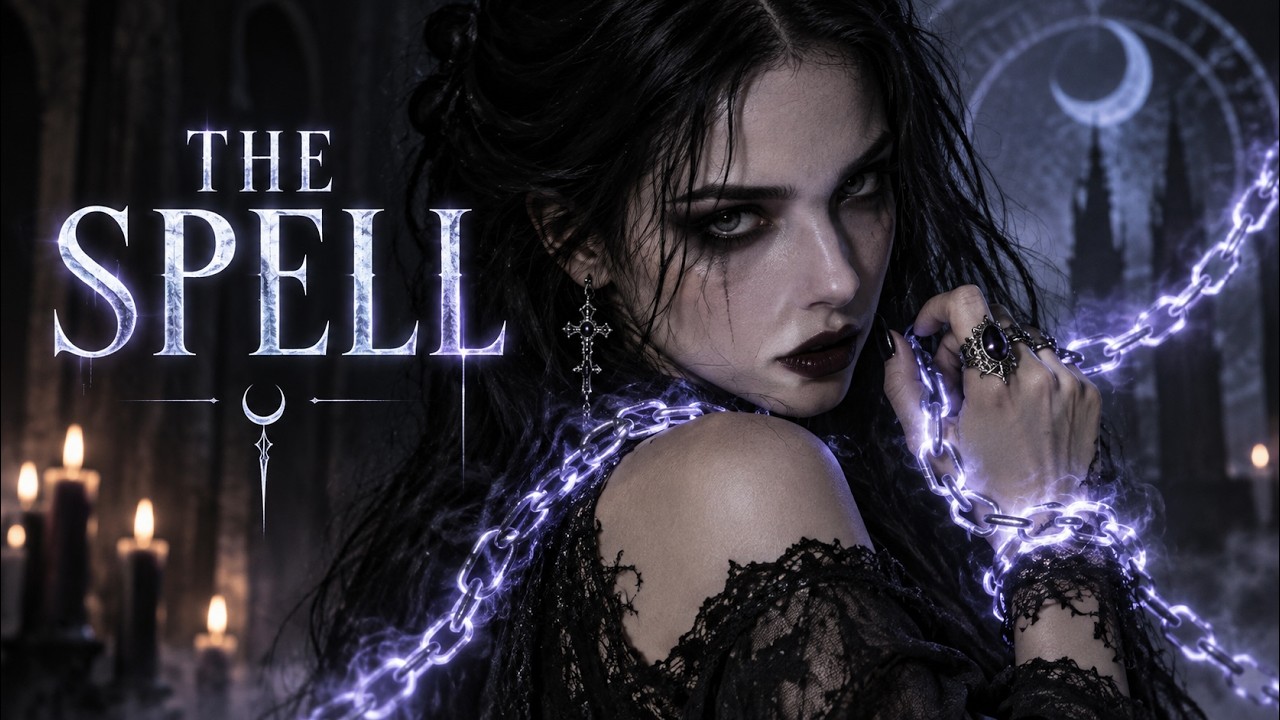
Vesper Mourdant explores the struggle between longing and escape in gothic darkwave music about a place, a memory or a love that refuses to release its hold.
WRITING THE SONG
Wanting to leave is not always the same as wanting to let go.
That tension sits at the centre of The Spell That Keeps Me Here.
Vesper is caught within something that still attracts her. The captivity has an emotional pull: whatever holds her also gives her a reason to remain.
The music moves from quiet confinement toward open rebellion. But the question survives that rebellion:
Has the spell truly been broken?
The original concept leaves the nature of the binding open.
It could be a place.
A memory.
A love.
Each possibility changes the story slightly. A place can hold the life someone once had. A memory can keep an absent person close. A love can remain powerful long after it becomes something someone needs to escape.
The common thread is attachment.
Vesper wants freedom while still feeling drawn toward the very thing that keeps her trapped. That makes escape more complicated than finding an unlocked door.
She has to confront what leaving would cost her.
The title gives that emotional hold a supernatural form.
A spell can suggest enchantment, fascination and pleasure. It can also suggest an influence operating beyond someone’s control.
Both meanings belong here.
The thing that keeps Vesper captive has enough beauty, familiarity or longing attached to it that resistance does not come easily.
Read psychologically, the spell gives shape to an attachment that has become difficult to explain. Read as gothic fantasy, it becomes a force she must challenge.
The music leaves room for both readings.
The visual world places Vesper among candlelit ruins.
Ruins carry evidence of something that once existed: a home, a sanctuary, a structure built to last. Their power comes partly from what remains and partly from what has disappeared.
That makes them a fitting setting for this struggle.
Vesper moves through a world that still has the outline of meaning. Its beauty survives its damage.
The candles add intimacy to that setting. They keep the darkness close, illuminating small areas while leaving the larger space uncertain.
The result is a captivity that can feel almost welcoming.
Fractured reflections bring the conflict closer to Vesper herself.
A reflection should offer recognition. When it breaks, recognition becomes harder.
As an image, it suits someone whose desires no longer agree. She can want to escape and still recognize the part of herself that wants to stay.
The broken reflection allows those feelings to occupy the same frame.
It also raises a quieter question: how much of her understanding of herself has been shaped by whatever holds her here?
The original visual direction combines ritual circles, black roses and supernatural chains.
Together, those images give the binding several different qualities.
The circle suggests enclosure and repetition. It can protect someone, contain them or mark a boundary they cannot cross.
The black roses preserve the form of a romantic gift while changing its emotional temperature. Beauty remains, but it carries unease.
The chains make the restraint visible.
That combination matters because the story contains both longing and resistance. The roses help explain the attraction. The chains expose its cost.
The emotional movement of the piece is clear even while the cause of the spell remains uncertain.
It begins in quiet captivity.
It builds toward rebellion.
That progression gives Vesper room to become more active within the story. The music moves beyond describing the hold and toward challenging it.
Yet rebellion does not automatically settle the emotional conflict.
Someone can resist a binding while still feeling its pull. An act of defiance can be real without providing complete freedom.
The unresolved ending keeps that distinction alive.
The original description identifies a blend of gothic rock, dark electronic music, cinematic atmosphere and poetic female vocals.
That combination places the emotional struggle within a larger, haunted environment.
The occult imagery gives the attachment a visible form. The cinematic atmosphere allows the setting to feel charged with memory and threat. The female vocal keeps Vesper’s experience at the centre of it.
The movement from confinement toward rebellion provides the dramatic shape.
The music’s central conflict remains intimate, even when its surroundings become supernatural.
The ending leaves the most important question unanswered.
Vesper’s rebellion changes the story, but it does not establish that the binding has disappeared.
That uncertainty is part of the piece’s appeal.
A spell might be broken in one sense and survive in another. A person can leave a place while carrying it with them. They can resist a memory without losing its power. They can end a relationship while still feeling its call.
The Spell That Keeps Me Here lives in that uneasy space between taking action and becoming free.
SOURCES & REFERENCES
Source status applies to the referenced material, not to the original Rhialto song.
This Song Note draws on the original Rhialto video description and the recovered July 2026 visual-development notes.
Those materials describe captivity to a place, memory or love; candlelit ruins; fractured reflections; ritual circles; black roses; supernatural chains; and a progression from quiet captivity to open rebellion.
No specific literary adaptation is attributed in the recovered material.