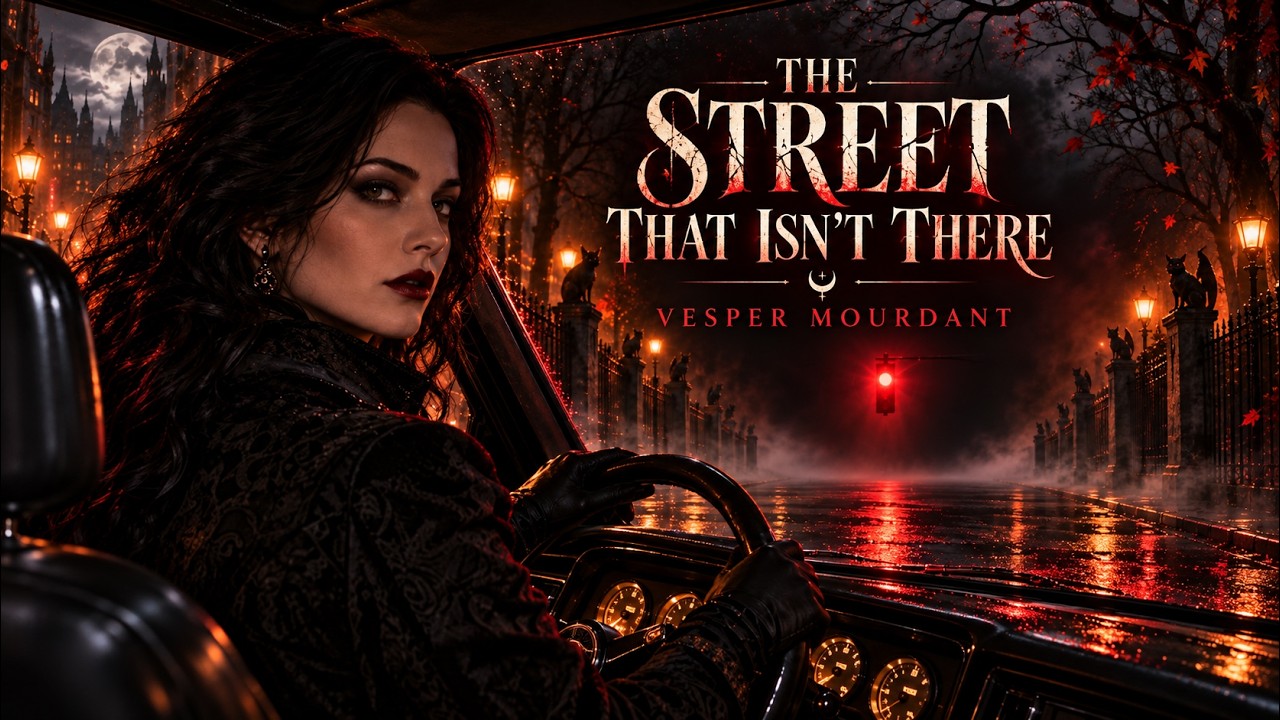
Vesper Mourdant follows a street missing from every map into a Halloween city mystery of old neon, mixed decades, repeating landmarks and a red light with no crossing road.
WRITING THE SONG
Every city has streets you have never taken.
Most of them would still be there if you looked them up.
On Halloween night, Vesper Mourdant finds one that is missing from every map.
Old neon flickers through the fog. Buildings from different decades stand beside each other. A telephone keeps ringing.
Then the landmarks begin appearing twice.
The Street That Isn’t There builds its mystery from ordinary things arranged in ways that gradually become impossible.
The published description offers a simple invitation:
“Turn where the map goes black.”
It places the threshold between the known city and somewhere its maps cannot explain.
A map should make a street less mysterious. It gives the route a name, a location and connections to other places.
Here, that reassurance is missing.
Vesper can see the street.
The city’s recorded version of itself has no place for it.
That disagreement supplies the first reason to hesitate—and the first reason to keep looking.
A 1920s cocktail bar stands beside a 1950s diner.
Each belongs to a recognizable world. Together, they suggest a street assembled from pieces of different eras.
The detail gives the mystery texture.
Vesper has not entered an empty supernatural corridor. There are places that seem to have histories, purposes and the possibility of people inside.
The old neon adds to that impression.
These are signs meant to attract customers and guide ordinary activity. In the fog, they become invitations whose destination is uncertain.
The street looks inhabited by the city’s past.
The telephone introduces a different kind of pressure.
A building can be studied from a distance.
A ringing telephone asks for a response.
Someone—or something—may be trying to reach whoever has entered the street. The repeated sound suggests that the call has not been abandoned.
The published premise leaves the caller unidentified.
That uncertainty gives the detail its strength. The listener can imagine several explanations without the story having to settle on one.
Answering might provide information.
It might also acknowledge that Vesper is there.
The same landmarks begin appearing twice.
That changes the problem from an unfamiliar location to an unreliable route.
Landmarks normally help a person measure progress. A distinctive building or sign tells you where you are and whether you have moved forward.
Repetition weakens that confidence.
Has Vesper returned to somewhere she already passed?
Are there two copies of the same place?
Is the street changing around her?
The premise allows those questions to remain open. What matters is that the familiar method of finding her bearings has stopped working.
The street can be observed.
It becomes harder to navigate.
At the end waits a red traffic light.
There is no road crossing it.
That is one of the clearest images in the concept because the object remains recognizable while its purpose becomes uncertain.
A traffic light ordinarily coordinates movement through an intersection. Red tells someone to stop because another movement must be allowed.
Here, the visible intersection is missing.
The instruction remains.
The image invites a question the published premise does not answer: what is the light waiting for?
Vesper has reached a signal she understands in a place that gives her no clear reason to obey it.
The published description suggests that this impossible part of the city may exist for only one night each year.
Halloween supplies the opportunity to encounter it.
That possibility adds urgency without establishing a complete set of supernatural rules. If the street is temporary, discovering it and finding a way out may be different problems.
The familiar city remains close enough to imagine.
Its maps and landmarks are no longer dependable guides.
The mystery grows from that uneasy proximity: Vesper seems to be somewhere urban and recognizable, yet the ordinary systems that explain a city have begun to fail.
The published musical description combines gothic synth-pop, darkwave and nocturnal electronic music.
That setting suits a story built around fog, neon and an uncertain journey through the city.
The electronic character gives the track a connection to nightlife, while the gothic atmosphere supports the suggestion of older histories beneath the visible streets.
The title also offers a compact phrase around which the mystery can gather.
The Street That Isn’t There names the contradiction without resolving it.
There is something to see.
There is nowhere to place it.
The concept does not need every object to be strange.
A cocktail bar, a diner, a telephone and a traffic light are all familiar.
The unease comes from how they relate to one another: different decades share an address, a call persists without a known caller, landmarks repeat, and a stopping signal waits at an absent intersection.
Each detail removes a little more confidence from the setting.
Vesper begins with a street the map cannot find.
By the end, even the street’s own directions are difficult to trust.
The Street That Isn’t There turns a walk through the city into a question about whether familiar signs can still guide you when the place around them no longer makes sense.
SOURCES & REFERENCES
Source status applies to the referenced material, not to the original Rhialto song.
This is an original Rhialto Halloween concept developed for Vesper Mourdant.
The note draws on the published video description and recovered promotional-development material.
The description supplies the impossible street, mixed-era buildings, ringing telephone, repeated landmarks, red traffic light and musical classification. The discussion of those details is an interpretation of the published premise.
No specific literary work or historical incident is claimed as its source.
Source status: Reference Sources Only.