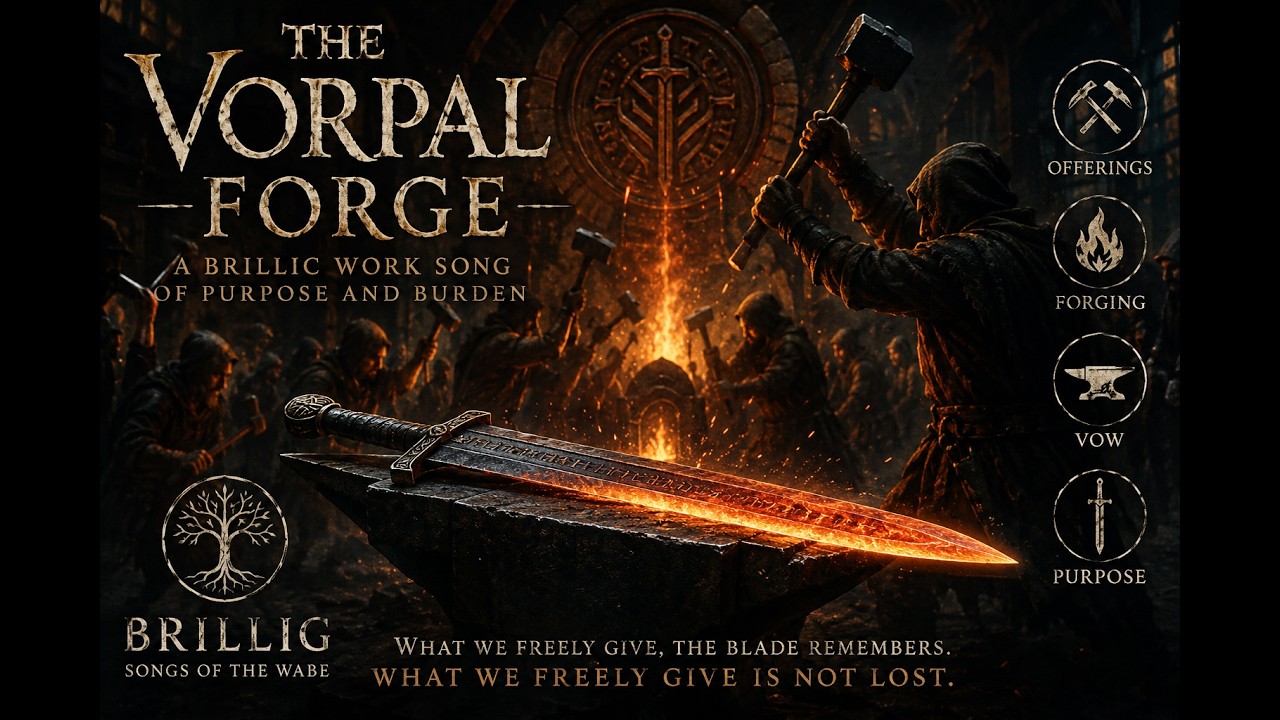
How Lewis Carroll’s unexplained “vorpal blade” became an entire Brillic cultural ritual: a weapon forged not by one legendary smith, but by a community combining labour, memory, sacrifice and a freely chosen purpose.
WRITING THE SONG
In “Jabberwocky,” Lewis Carroll gives us one of fantasy literature’s most famous weapons:
the vorpal blade.
But he never tells us where it came from.
That omission became the opening for The Vorpal Forge.
Rather than treating the sword as a convenient magical object waiting for the hero to pick it up, the Brillira world asks a different question:
What kind of culture would know how to make something called vorpal?
The answer became communal.
In the original Rhialto concept, a true vorpal blade cannot be made by one extraordinary blacksmith.
Miners bring metal.
Charcoal burners preserve the fire.
Smiths shape the blade.
Singers give it purpose.
Elders bring warnings.
Families contribute fragments of damaged tools.
Travellers return iron from distant places.
Children take part in the final cooling ritual.
And the future bearer must contribute something that cannot simply be hammered into shape:
intention.
The core principle was established very early:
No one person makes the blade. The blade contains everyone who refuses to surrender the wabe.
That changed the whole meaning of the weapon.
The blade is not powerful because somebody cast a spell on it.
It becomes powerful because many separate lives agree on what it is for.
That also meant the word vorpal needed an actual meaning inside Brillic culture.
It could not remain a fantasy adjective that simply means “very sharp.”
In the Brillira canon, vorpal became closer to:
precisely purposed.
A vorpal thing is shaped around a freely chosen intention so clearly that it can distinguish between what belongs to that purpose and what does not.
That is why the blade can be understood as more than a physical weapon.
It can separate:
the false from the true,
imitation from identity,
fear from action,
corruption from promise,
and confusion from the path home.
The concept deliberately limited that power. The blade cannot simply do anything its bearer wants. Its strength depends on the integrity of its making and on whether the bearer remains consistent with the purpose that created it.
That limitation was important.
Without it, the vorpal blade becomes just another magical super-weapon.
With it, the blade becomes a kind of moral instrument.
It can only be as coherent as the people who made it.
That gave the forging ritual emotional weight.
Every object placed into the furnace should have belonged to somebody.
Not anonymous fantasy metal.
Something used.
Something remembered.
A broken household tool.
Iron brought home from a journey.
An object belonging to someone who did not survive.
Something small offered by a child.
The metal therefore contains a history before it ever becomes a blade.
The physical labour matters too.
The forge is reopened because danger has returned.
The bellows have to be repaired.
Old coals are awakened.
People arrive one by one carrying what they are willing to give.
The hammer rhythm begins.
Then the community starts to sing.
The song moves deliberately from many people working together toward one person eventually having to carry the result.
The established narrative sequence ends with the bearer making a freely chosen promise, the blade receiving its vorpal purpose, one final hammer strike, and then silence.
There is no victory celebration.
The forge cools, and the bearer is left alone with what everyone else helped create.
That silence is important.
The blade has been made.
Nothing has been defeated.
Preparation is not victory.
That also explains where the song sits inside BRILLIG: Songs of the Wabe.
Earlier tracks such as Jubjub Sky and The Bandersnatch are about recognizing danger.
The Vorpal Forge marks the point where the Brillic people stop merely identifying threats and begin preparing to answer one.
But the actual confrontation still does not happen here.
The next important question is not:
Can the blade kill the Jabberwock?
It is:
Will somebody choose to carry it?
That is why the next track, Uffish, becomes necessary.
Once all the communal voices disappear and the forge goes dark, one person is left holding an object made from everybody else’s hope.
That person can still say no.
And in Brillic culture, that freedom matters.
A promise made only because everyone expects obedience would contradict the very idea that makes the blade vorpal.
So the weapon cannot be completed by force.
The final ingredient has to be a decision.
That is what makes The Vorpal Forge less a song about making a sword than a song about how communities prepare someone for responsibility without being allowed to make the final choice for them.
The forge provides the blade.
The community provides the purpose.
The bearer still has to decide what happens next.
SOURCES & REFERENCES
Source status applies to the referenced material, not to the original Rhialto song.
Public-domain literary source
Rhialto / Brillira reinterpretation
The communal forge, Brillic culture, expanded meaning of vorpal, ritual contributions, naming process, moral limitations of the blade and its connection to Uffish are original Rhialto worldbuilding.
BRILLIG: Songs of the Wabe treats “Jabberwocky” as evidence of a larger imagined culture rather than simply retelling the poem repeatedly.