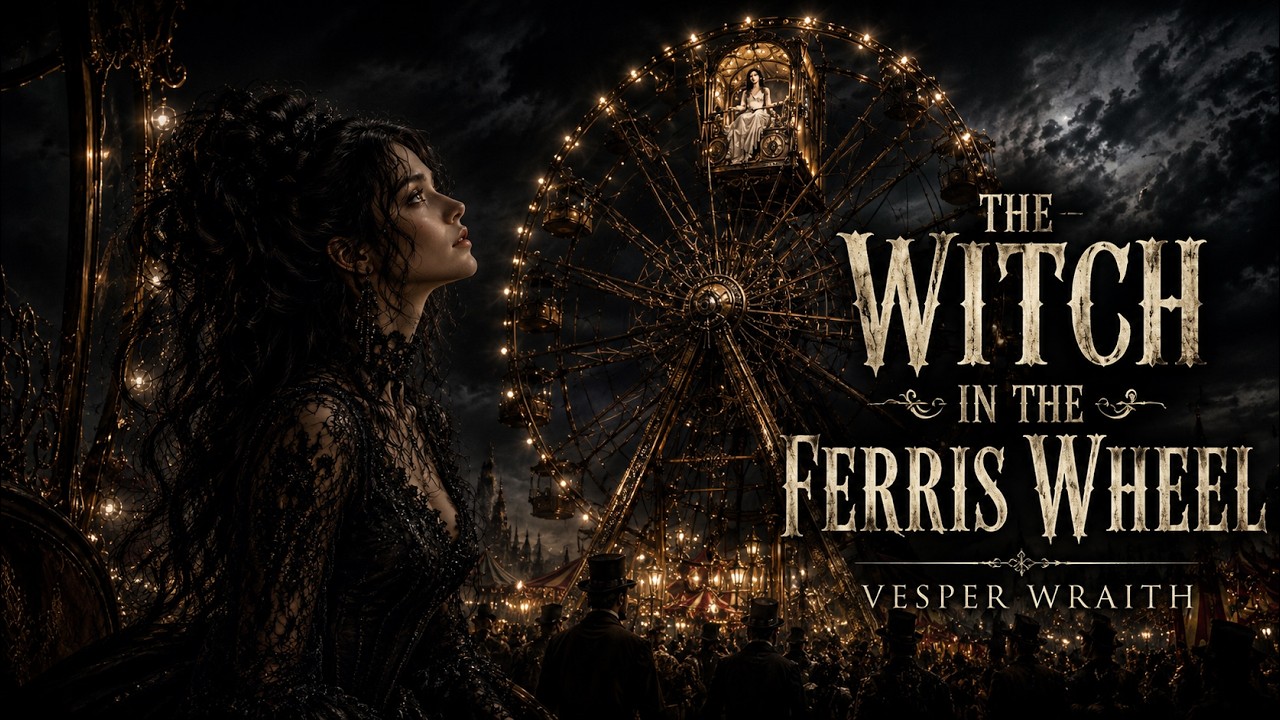
How a beautiful carnival witch became the centre of a time-exchange bargain: she grows younger with every Ferris-wheel revolution while somebody else comes down old.
WRITING THE SONG
The Witch in the Ferris Wheel was designed as the moment in The Carnival After Midnight when the carnival's beauty stops feeling entirely safe.
The important thing was that the witch should not look frightening.
No crooked hat.
No obvious monster makeup.
No stereotypical old crone waiting in the shadows.
She is beautiful.
Remote.
Elegant.
Almost ageless.
The kind of person you notice immediately without understanding why.
And she is always sitting in the same carriage.
That repetition becomes the first clue.
The Ferris wheel turns.
Carriages rise.
They disappear over the top.
They descend.
People step off.
New riders climb aboard.
But somehow she keeps returning in exactly the same place.
Same carriage.
Same posture.
Same quiet expression.
At first, that can be explained away.
Maybe she simply stayed on for another rotation.
Then the face changes.
Not dramatically.
She is simply a little younger.
One turn later, younger again.
That gave the story its central supernatural rule:
She goes up young.
Somebody comes down old.
The witch is not creating youth from nothing.
The wheel is moving time.
Every revolution is an exchange.
Somebody gains what somebody else loses.
The first signs appear around the midway.
A rider steps down with grey beginning at the temples.
Someone else's hands look thinner than they did minutes earlier.
A face that entered the ride smooth returns lined.
A parent suddenly looks too old beside their child.
Meanwhile, the woman in the high carriage becomes increasingly young.
That contrast needed to remain beautiful before it became frightening.
The Ferris wheel itself is one of the most visually elegant objects in the carnival.
A huge illuminated circle against the night.
Tarnished gold.
Violet sky.
Old bulbs moving slowly through darkness.
Carriages repeating around the same impossible geometry.
From below, it looks almost ceremonial.
That is why the attraction works.
Nobody is being dragged onto it.
The crowd can see something strange happening.
Eventually they can see exactly what is happening.
And still people wait in line.
That became the deeper idea behind the song.
The real horror is not simply that the Ferris wheel steals time.
It is that people knowingly accept the bargain.
Someone looks at the witch growing younger.
Looks at the previous rider aging.
Then looks back at the gate.
And thinks:
Maybe it won't take much from me.
Or:
Maybe I'll be the one who gets something.
Or simply:
One more turn.
That phrase became another important hook.
One more turn.
A Ferris wheel naturally invites repetition.
You reach the top.
You descend.
The ride should be over.
But the circle keeps suggesting another revolution.
That circular structure also shaped the music.
The track lives in gothic dream-pop / dark synthpop rather than the harsher industrial territory that appears later in the album.
This is still part of the carnival's seduction.
The pulse is hypnotic.
Arpeggios repeat.
The bass rotates.
Carnival-organ and music-box fragments appear inside a more modern electronic arrangement.
Everything should feel circular.
The listener should feel as though the song itself keeps returning to the same point.
But never quite unchanged.
That became important musically.
Earlier in the album, the carnival can still sound almost normal.
Here, the tuning begins to drift.
Only slightly.
A rotation returns a little sharp.
The next one feels slightly flat.
A harmony that sounded beautiful the first time becomes less stable when it comes back.
Nothing is obviously broken.
But the music itself is beginning to behave like the Ferris wheel.
Each revolution takes something.
That instability should become perceptible without becoming chaotic.
The carnival has not collapsed yet.
This is the beginning of unease.
That places The Witch in the Ferris Wheel at an important point in the album.
The earlier carnival is still seductive.
Lights.
Movement.
Midway glamour.
Midnight excitement.
The Ferris wheel keeps all of that beauty.
But the geometry becomes enclosing.
The circle is no longer simply a ride.
It is a mechanism.
And eventually the listener begins to understand that the carnival's repeated shapes matter.
Circles.
Loops.
Rotations.
Routes that return to where they began.
Nothing here travels in a straight line.
That visual motif becomes part of the larger Carnival After Midnight world.
The wheel fills the sky.
Carriages repeat.
The witch returns.
Time itself appears to be trapped inside the circle.
The witch should also remain ambiguous.
She is not necessarily the villain.
That mattered to me.
Her eyes are older than the face around them.
That detail suggests she may understand the bargain better than anyone else.
Perhaps she controls the wheel.
Perhaps the wheel controls her.
Perhaps she has been riding for decades.
Perhaps centuries.
Perhaps becoming younger is not a gift at all.
The song should never completely explain that.
The strongest horror often comes from understanding the rule while still not understanding the system that created it.
So the audience knows:
She becomes younger.
Someone else becomes older.
The wheel makes the exchange.
The riders know.
They still get on.
That is enough.
The narrator's relationship with the witch adds another layer.
Vesper does not encounter her as a stranger.
She recognizes her.
And the witch recognizes Vesper.
There is no dramatic reunion.
No exposition.
No explanation of how they know one another.
Just recognition.
That quiet acknowledgment tells us something important:
Vesper has been inside this carnival before.
She understands more than she has been saying.
That becomes part of the album's larger mystery.
At the top of the wheel, the music can become almost weightless.
The midway falls away below.
The lights become distant.
The circular motion briefly feels suspended.
The witch and Vesper occupy the highest point above the carnival.
For a few seconds, the attraction almost becomes peaceful.
That is exactly where the age/time implication should feel strongest.
From that height, the carnival looks beautiful.
Tiny lights.
Moving rides.
People below.
And perhaps that is why everyone keeps coming.
The horror is easier to accept when it arrives beautifully.
The visual palette follows that idea.
Deep violet sky.
Midnight blue.
Tarnished gold.
Old incandescent bulbs.
A subtle sickly green beginning to appear in the carnival lighting.
The enormous Ferris-wheel circle should dominate the composition.
The witch is important, but the wheel itself is larger.
That scale makes her look both powerful and trapped.
She occupies the same carriage inside a machine that never stops turning.
The final repetitions should preserve the central hook:
She goes up young.
Somebody comes down old.
But by the end, the listener understands that the line is not merely describing the witch.
It describes the entire attraction.
Youth and age are moving around the same circle.
Someone gains.
Someone pays.
And the line beneath the wheel continues growing.
That is what makes The Witch in the Ferris Wheel more than a supernatural character song.
It is a song about how attractive a terrible bargain can become when the cost belongs to somebody else.
And perhaps the darkest part is that by the time everyone understands the rule—
the next carriage is already waiting.
SOURCES & REFERENCES
Source status applies to the referenced material, not to the original Rhialto song.
Original Rhialto concept
The Witch in the Ferris Wheel is an original Rhialto / Vesper Mourdant supernatural dark-carnival story developed for The Carnival After Midnight.
The witch remaining in the same carriage, becoming younger with each revolution, the transfer of age to other riders, the crowd's willing participation despite understanding the bargain, Vesper's unexplained recognition of the witch, and the central hook “She goes up young / somebody comes down old” are original Rhialto creative elements.
The Ferris wheel, carnival midway, illuminated rides and travelling-carnival imagery are used as general setting and genre vocabulary. The story is not an adaptation of a specific witch legend, literary work, film or historical event.