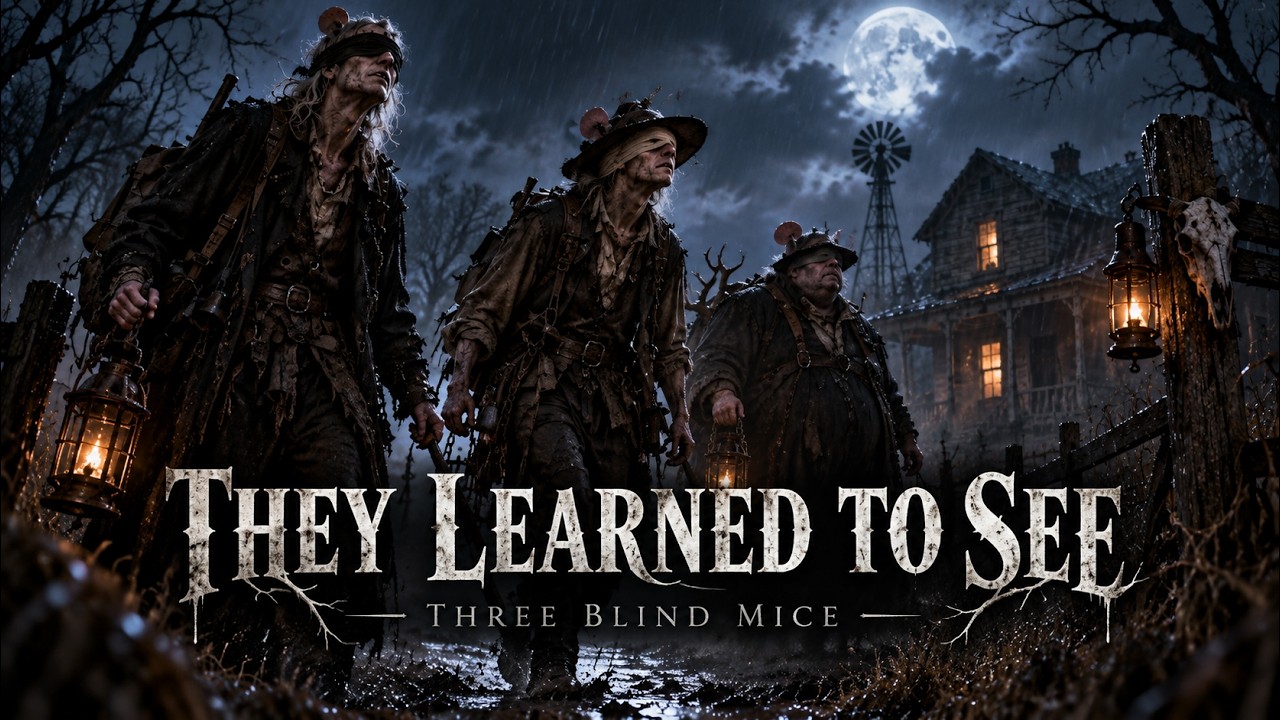
Rhialto transforms Three Blind Mice into a catchy Halloween horror chase: three blind figures return, and every sound their victims make gives them away.
WRITING THE SONG
Everyone assumes they will be easy to escape.
They cannot see.
They were hurt, driven away and left behind.
But they have spent the intervening years learning.
Footsteps tell them where someone is going. Breathing reveals someone trying to hide. A heartbeat gives away the person who has managed to stop moving.
They are still blind.
They have simply become much harder to fool.
That reversal became the centre of They Learned to See.
The familiar nursery rhyme already contains pursuit and violence. Its mice run after the farmer’s wife, who cuts off their tails.
Our version imagines what happens after the familiar rhyme ends.
The three figures return years later. The people who remember them expect weakness, confusion and helplessness.
Instead, they find hunters.
The transformation changes the meaning of running. What once sounded like a playful instruction becomes a warning.
Someone is running now because the three have found them.
The first hook keeps the nursery rhyme close enough to recognize:
“Three blind mice—
They know where you are.”
The response overturns the reassurance built into the first line.
Blindness offers their intended victims no protection. Darkness will not hide them. Standing behind a door will not make them disappear.
The hunters are listening.
That gives the music a threat the audience can understand immediately. Every ordinary action becomes a possible mistake.
A shoe against the floor.
A breath taken too quickly.
A frightened heart.
The three figures have distinct ways of finding their prey.
One listens for footsteps.
One listens for breathing.
One hears something deeper: a heartbeat.
That distinction gives each hunter a role while tightening the trap around the person hiding from them.
Stop walking, and there is still your breathing.
Hold your breath, and there is still your pulse.
Fear makes concealment harder. The more urgently someone tries to become silent, the more aware they become of the sounds their own body makes.
The horror comes from that shrinking space.
The central chorus explains the title:
“They learned to see
Without their eyes
Every sound you make
Tells them where you hide.”
“See” becomes a description of what they can discover rather than what their eyes can do.
They have learned to read their surroundings through sound. Their victims keep making the mistake of treating vision as the only form of awareness that matters.
The title turns that assumption against them.
It also gives the returning figures a history. They did not come back unchanged. Whatever happened during their absence has made them patient, attentive and dangerous.
The musical direction needed a complete rethink during development.
The accepted approach became Halloween electro-pop, with a target tempo of 126 BPM, an early chorus and a strong melodic payoff.
The call-and-response hook supplies the immediate recognition:
“THREE BLIND MICE”
“THEY KNOW WHERE YOU ARE.”
The production direction combines a twisted nursery-rhyme motif with music-box textures, organ stabs, bells and whispers.
Those details keep Halloween present inside the pop arrangement. The melody invites participation while the words make that participation unsettling.
The aim was music that could work as a party track while still carrying a clear horror story.
The breakdown brings the premise directly to the listener.
“Hold your breath.”
Then silence.
Then a creak.
That tiny sound carries the threat. Once the music has established how the hunters locate people, a floorboard can become more frightening than a scream.
The heartbeat and creak also connect the production to the narrative. Sound is the hunters’ method, so sound becomes the mechanism of the suspense.
The listener knows what the mistake means before the chase resumes.
The concept begins with figures who were mutilated and driven away, but the adaptation does not depend on graphic detail.
Its strongest horror is anticipation.
They have returned.
They can hear you.
You have already made a sound.
Keeping the gore restrained leaves more room for the hook, the pursuit and the realization that hiding may be impossible.
The nursery-rhyme familiarity does the rest. Something remembered from childhood becomes a warning that arrives too late.
The ending returns to the rhyme’s familiar language:
“Run.
And see—how they run.”
By this point, running has acquired a different meaning.
The three figures are no longer remembered only for what was done to them. They control the pursuit.
That is the final turn of They Learned to See: the people who assumed the hunters could not find them become the ones desperately looking for a way out.
SOURCES & REFERENCES
Source status applies to the referenced material, not to the original Rhialto song.
“Three Blind Mice” — traditional English nursery rhyme and round
The Morgan Library & Museum identifies Thomas Ravenscroft’s Deuteromelia, published in 1609, as containing the first printing of “Three Blind Mice.”
The familiar running, farmer’s-wife and tail-cutting text appears in nineteenth-century nursery-rhyme collections, including James Orchard Halliwell’s The Nursery Rhymes of England.
They Learned to See uses that historical rhyme as its starting point. The returning hunters, their distinct listening abilities and the Halloween chase are Rhialto’s fictional transformation.
Source status: Public Domain Sources