How Shakespeare’s Weird Sisters became a ritual gothic darkwave meditation on prophecy, ambition and the human tendency to hear destiny in the words we already want to believe.
WRITING THE SONG
Three Voices in the Rain began with the opening atmosphere of Shakespeare's Macbeth.
Three figures in a storm.
Rain.
Mud.
An exhausted soldier returning from violence.
And voices that seem to know something about his future before he does.
But I did not want to retell Macbeth.
The more interesting idea was the relationship between prophecy and desire.
People often remember the witches as the characters who send Macbeth toward murder.
But they never actually tell him:
Kill Duncan.
They give him information.
They give him titles.
They introduce the possibility of a crown.
Then Macbeth supplies the rest.
That became the core of the track.
The three voices are not puppet masters.
They are witnesses.
They recognize something already present.
And they know exactly which words will make it visible.
The central dramatic sequence became:
Soldier.
Thane.
King.
Three identities.
The first belongs to the present.
The second suddenly becomes real.
And once that happens, the impossible third word becomes harder to dismiss.
King.
That is where I wanted the music to hesitate.
Not because the witches have said something frightening.
Because Macbeth has heard something he wants.
The dangerous moment is therefore not the prophecy itself.
It is:
the silence after “king.”
That silence leaves space for ambition to answer.
The witches do not need to continue.
His imagination does the work for them.
That became one of the track's most important ideas.
You never told me what to do.
You only named the thing I wanted.
That is the trap.
Nothing has technically been demanded.
No command has been issued.
The listener can still tell themselves that every decision is their own.
And perhaps it is.
The track therefore treats prophecy less like magic and more like a mirror.
The voices show Macbeth an image of himself that he was not yet willing to say aloud.
Once he sees it, he cannot completely unsee it.
That connects to another central line:
We name the voice we want to hear
and call the echo fate.
That is really what the track is about.
How easily desire can disguise itself as destiny.
If someone tells us something we desperately want to believe, it becomes tempting to treat the statement as revelation rather than temptation.
That is why the witches remain relatively restrained.
They do not need giant theatrical vocals.
They do not need exaggerated evil laughter.
They are more unsettling if they sound certain.
Calm.
Almost indifferent.
They have seen this before.
They recognize ambition.
They know how little encouragement it requires.
The lead vocal was designed as the human centre of the track.
One low, intimate female lead carries the narrative.
The three voices appear around her as distant whispers and fragments.
Not a traditional three-part vocal performance.
More like thoughts arriving from different positions in the darkness.
One voice close.
One farther away.
One difficult to place.
Sometimes they overlap.
Sometimes they finish one another.
Sometimes they reduce entire futures to a single word.
Soldier.
Thane.
King.
That vocal architecture became part of the psychological idea.
The voices may be supernatural.
But eventually it becomes difficult to tell where they end and Macbeth's own thoughts begin.
That ambiguity was important.
The witches should never completely own the responsibility for what follows.
If they do, Macbeth becomes less interesting.
The stronger interpretation is that they expose a possibility and then step aside.
He chooses what that possibility means.
That is why another whispered sequence became useful:
Clean hands.
No hands.
Whose hands?
By this point, the language is moving away from prophecy and toward consequence.
Blood has entered the story.
But again, the voices do not need to describe the murder.
The listener already knows where ambition has gone.
The production was built to support that gradual descent.
The foundation is ritual gothic darkwave / cinematic art-rock.
A slow-to-midtempo irregular marching pulse.
Rain striking metal.
Deep sub-bass.
Low piano.
Abrasive bowed strings.
Sparse distorted synth.
Nothing should sound smooth enough to become comfortable.
The rhythm suggests marching, but it never settles into a perfectly reassuring pattern.
That connects back to Macbeth as a soldier.
He comes from battle.
The martial pulse belongs to him before the witches appear.
They do not introduce violence into his world.
Violence is already there.
They simply redirect its possibility.
Rain became one of the most important production elements.
Not decorative rain sitting behind the track.
Rain as percussion.
Drops against metal.
Wet impact.
Irregular surfaces.
Water becoming part of the rhythm.
That tied the production directly to the title and to the opening storm without requiring literal theatrical sound design.
The bowed cello and abrasive string textures add another kind of pressure.
Long notes that feel slightly unstable.
Scrapes rather than elegant orchestral swells.
The arrangement should sound as though something is tightening around the listener without ever fully closing.
The choruses widen, but they do not become triumphant.
That was important.
A traditional rock chorus could accidentally make the prophecy feel heroic.
This story should never celebrate the crown.
Instead, every expansion in the music carries additional weight.
The future sounds larger.
But also more dangerous.
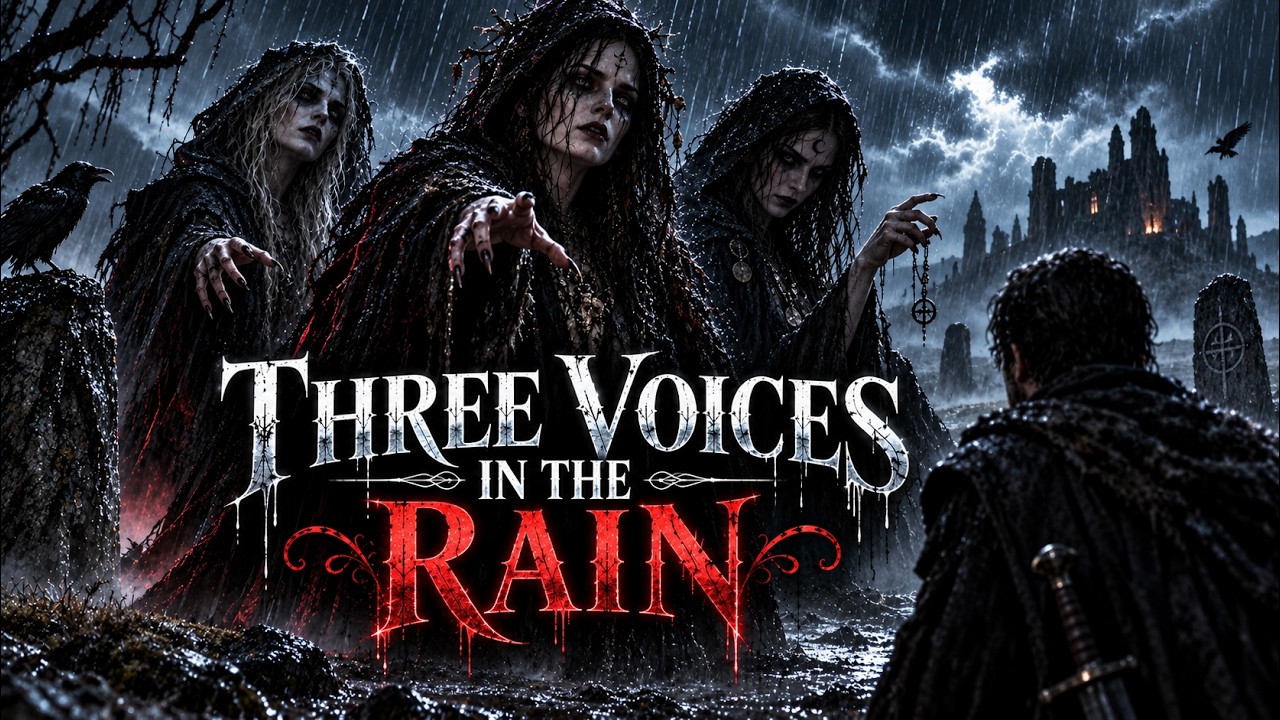
Visually, the world follows the same restraint.
Rain.
Wet roads.
Mud.
Three distant figures.
A dark skyline.
Black-blue atmosphere.
Small teal and amber reflections in the water.
Occasional red that can initially look like reflected light and later begin to suggest blood.
The witches should not immediately resemble theatrical witches.
At first they can almost be mistaken for ordinary women standing too still in the rain.
Their strangeness comes from repetition.
Three silhouettes.
Three positions.
Three voices.
One possibility being repeated until it becomes impossible to ignore.
A recurring visual idea was the crown appearing indirectly.
Not an actual crown floating dramatically in the darkness.
A crown-like shape in water.
A reflection in glass.
Light forming points above a head for half a second.
Something the audience notices at approximately the same moment the character does.
The track becomes increasingly internal as it progresses.
The external storm matters less.
The voices matter less.
Eventually the central conflict is happening inside the person who heard them.
That leads to the final reversal.
The witches vanish.
The rain remains.
And the narrator is left alone.
At that point there is nobody left to blame.
The voices have said what they came to say.
The future still has not technically happened.
Every choice remains available.
And yet the final realization arrives:
The blood supplied the rest.
The prophecy did not commit the crime.
The storm did not commit the crime.
The witches did not place the weapon in anyone's hand.
They named a possibility.
Ambition recognized itself.
And human action completed the sentence.
That is why Three Voices in the Rain is less a story about witchcraft than a story about temptation.
The supernatural voices matter.
But the most frightening voice may be the one that answers them.
SOURCES & REFERENCES
Source status applies to the referenced material, not to the original Rhialto song.
William Shakespeare — Macbeth
The primary literary source is Shakespeare's Macbeth, particularly Act 1, Scenes 1 and 3.
The play opens with three witches meeting during thunder and lightning and planning to meet Macbeth on the heath. When they later encounter Macbeth and Banquo, they greet Macbeth with a sequence of titles culminating in the prophecy that he will become king.
Three Voices in the Rain does not retell the play scene by scene and does not reproduce a modern adaptation.
Instead, it uses Shakespeare's public-domain characters, situation and themes as the starting point for an original interpretation focused on temptation, selective hearing, ambition and the boundary between prophecy and choice.
The track's modern narrative framing, hooks, vocal architecture, production, imagery and psychological interpretation are original Rhialto creative elements.