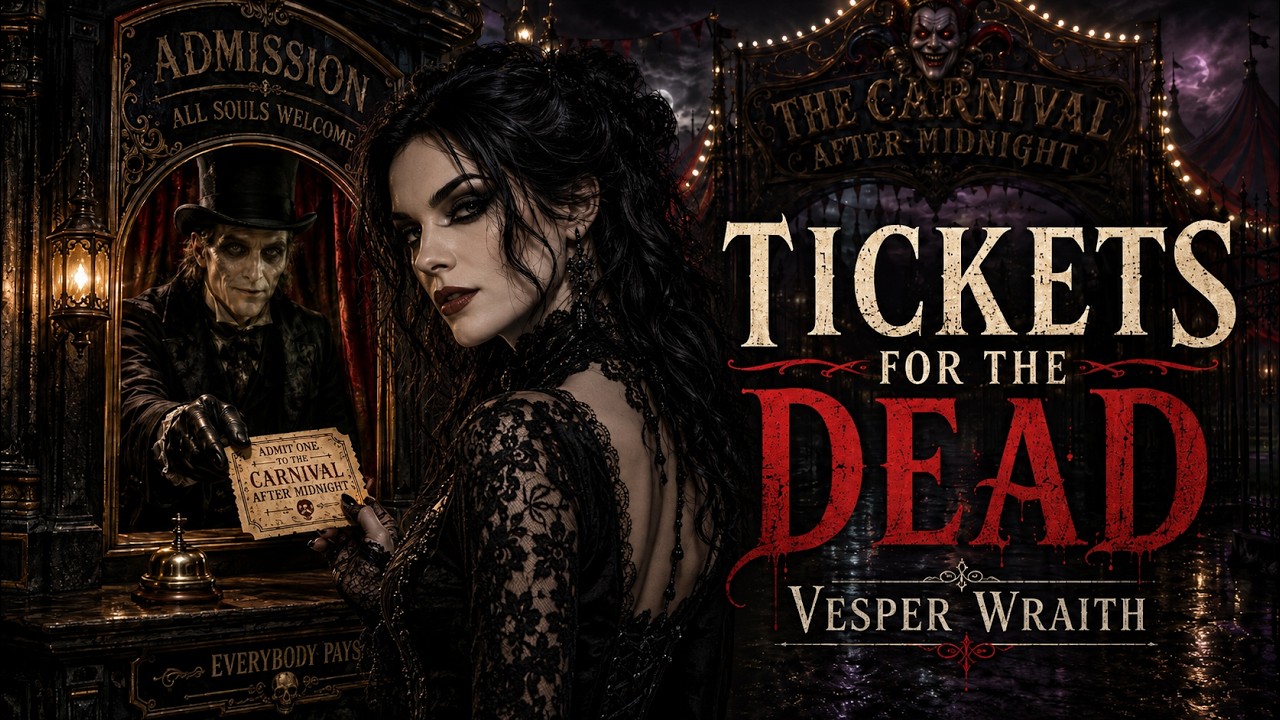
Vesper Mourdant’s cheerful carnival ticket seller accepts cash, cards, memories and years—and lets visitors laugh at the true price of admission.
WRITING THE SONG
The carnival has appeared.
The gates are open.
Before entering, everyone must stop at the ticket booth.
The seller is cheerful. His questions sound almost ordinary.
“Are you living, dead, or undecided?”
Everyone assumes he is joking.
Tickets for the Dead begins with that misunderstanding and turns the simple act of buying admission into the first transaction the visitors should have questioned.
This is Track 2 of The Carnival After Midnight, following The Carnival Comes at Sundown and leading into Midnight on the Midway.
The opening track has brought the listener toward the lights.
Now there is a counter between wanting to enter and being allowed inside.
That makes the ticket booth an important threshold. The visitor must participate in a transaction before the attractions become available.
The seller makes it seem easy.
His manner is familiar enough to encourage people to keep moving through the process, even as the questions become strange.
The first question treats an impossible distinction as routine administration.
Living or dead should not require much discussion.
Adding “undecided” turns the exchange into a joke—and quietly suggests that the carnival handles categories the visitors do not understand.
The seller behaves as though every answer is manageable.
That confidence gives the scene its peculiar charm. The visitor is encountering something extraordinary through the language of ordinary customer service.
It is easy to laugh and continue.
The published description offers another question:
“Cash, card, memory… or years?”
The list begins with familiar ways to pay.
Then it changes the scale of the transaction.
Memory and years are parts of a life. Treating them as payment suggests that admission may cost something the visitor cannot replace simply by earning more money.
The casual delivery is essential.
The seller presents these possibilities as options at a counter. The visitor supplies the reassuring assumption that they cannot be real.
The carnival does not have to conceal every condition.
It can let people dismiss what they hear.
The offer of a receipt brings the exchange back to something mundane.
That small detail makes the stranger questions more effective.
A receipt belongs to a world of purchases, records and completed business. Its presence makes the booth feel organized and legitimate, even when the accepted payment might be a portion of someone’s life.
The scene gains humour from that mismatch.
The seller appears ready to document a transaction the buyer has barely understood.
The locked album blueprint extends the ticket seller’s questions to the length of the visit, whether anyone will notice a visitor’s absence, and whether a return ticket is wanted.
Those details introduce consequences without stopping the carnival’s invitation.
“One night or forever” can sound like an exaggerated sales pitch.
A return ticket sounds reassuring because it suggests a way back.
Yet each question also asks the visitor to consider something more serious than an evening’s entertainment.
How long are they staying?
Who expects them home?
What, exactly, have they purchased?
The concept lets those questions remain funny long enough for people to answer them.
The central refrain joins two groups:
“Tickets for the living.
Tickets for the dead.”
The published description follows it with:
“Everybody pays.”
That last statement gives the booth a rule.
The carnival welcomes a wide range of customers, but admission always carries a cost.
The uncertainty lies in what payment means for each person.
The refrain is simple enough to sound like a seller’s chant. As the surrounding questions accumulate, it becomes harder to hear as harmless advertising.
The seller’s friendliness is part of the attraction.
He does not need to threaten visitors or chase them through the gates.
They already want to enter.
His job is to make the transaction feel like the next natural step. A joke, a question and a ticket are enough to keep the queue moving.
That makes him a useful early figure in the album.
He introduces the carnival’s black humour while showing how danger can be offered politely.
The visitor’s desire does much of the work.
The published recording blends gothic music, dark cabaret, electro-swing, dark synthpop and cinematic Halloween atmosphere.
The album blueprint called for piano, stomp percussion, brass accents and electronic bass, with ticket-counter bell sounds punctuating the exchanges.
These were arrangement directions intended to give the booth a lively theatrical identity.
The musical invitation matters as much as the seller’s smile.
At this stage of the album, the carnival still needs to feel worth entering. The track has to carry the pleasure of the encounter alongside its increasingly uncomfortable implications.
The listener should understand why the visitors keep going.
The later attractions will make the carnival’s danger harder to ignore.
Here, the warning signs arrive inside a transaction that seems small.
A person wants a ticket.
A seller asks a few questions.
Payment changes hands.
That ordinary sequence gives the supernatural premise its foundation. The visitor has taken an active step into the carnival before fully considering what the seller’s words might mean.
Tickets for the Dead turns admission into the first unsettling bargain of the night: everyone wants to get inside, and the cheerful man at the counter is perfectly willing to tell them what it costs.
SOURCES & REFERENCES
Source status applies to the referenced material, not to the original Rhialto song.
This is an original Rhialto concept developed for Vesper Mourdant’s The Carnival After Midnight.
The note draws on the locked album blueprint and the published video description.
The published description supplies the seller’s questions about living or dead customers, forms of payment and receipts. The questions about visit length, absence and return tickets come from the album blueprint. Musical intentions are identified as development choices.
No specific literary work or historical carnival is claimed as its source.
Source status: Reference Sources Only.