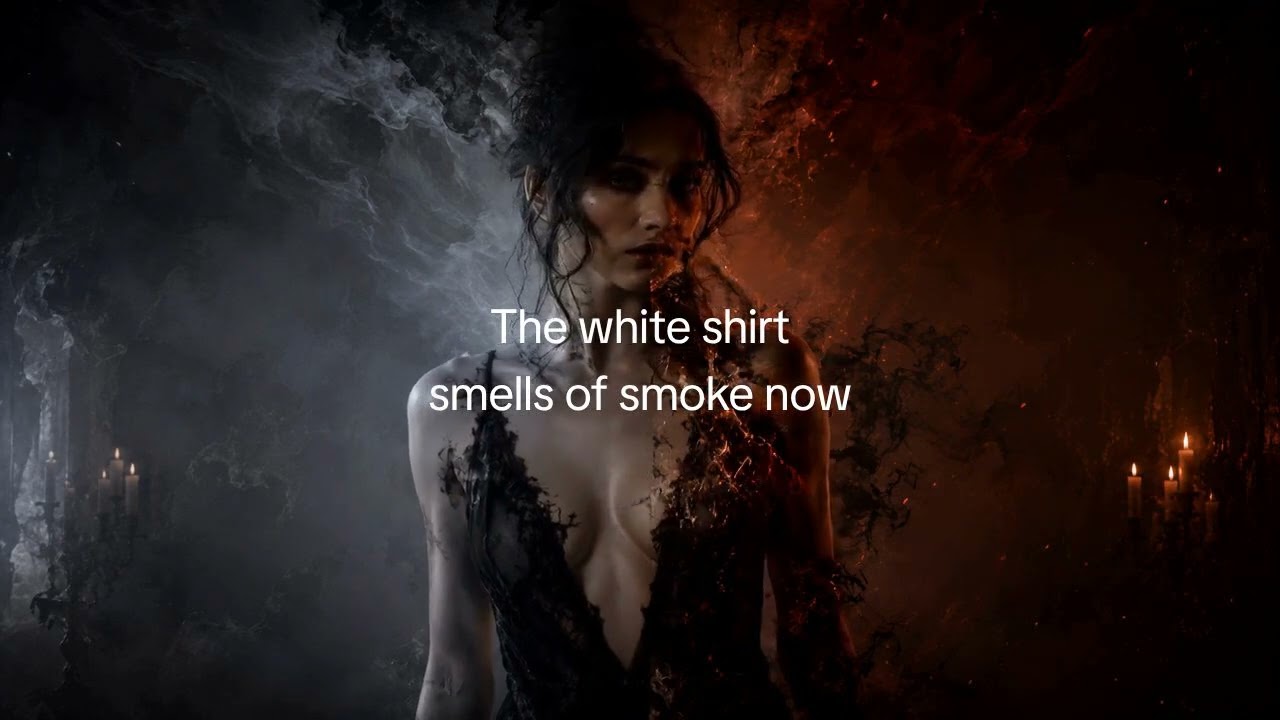
How Shakespeare’s Sonnet 144 became Vesper Mourdant’s gothic same-sex love triangle, where two very different women begin sharing impossible connections.
WRITING THE SONG
Two women.
Two kinds of danger.
One feels calm enough to trust. The other makes danger feel honest.
At first, Vesper believes the difference between them is obvious. One woman is controlled, measured, almost reassuring. The other is more direct—sensual, dangerous, and impossible to misunderstand.
Both attract her.
Then the details begin to overlap.
The same ring appears on both women.
They seem to know the same private things.
They use similar words.
They touch Vesper as though each already knows exactly where the other has been.
And gradually the question changes.
It is no longer simply which woman does Vesper want?
It becomes:
Are they actually at war—or am I the territory?
Two Loves at War draws from William Shakespeare’s Sonnet 144, one of the darker and more psychologically complicated poems in the sonnet sequence.
Shakespeare begins with two competing loves, associated with comfort and despair. The poem presents them through the language of opposing spirits—one apparently virtuous, the other dangerous—and then immediately destabilizes that distinction through jealousy, temptation and uncertainty.
Vesper Mourdant’s version keeps the central idea of being pulled between two powerful attractions but changes the geometry of the story.
Here, the two loves are two women.
They are not symbols standing at Vesper’s shoulders. They are not two fragments of Vesper given physical form. They are two distinct people who enter her life differently and affect her differently.
That distinction matters because the mystery of the song depends upon it.
Vesper knows there are two women.
What she does not know is why the two women seem to know so much about each other—and about her.
At first, the triangle appears simple.
One woman seems safer.
She is quieter, more restrained, more emotionally controlled. Being around her feels like something Vesper might actually survive.
The second woman makes no such promise.
Her attraction is immediate and physical. She does not disguise the danger surrounding her, and that honesty becomes part of her appeal.
But Two Loves at War deliberately refuses to turn them into a simple choice between a “good” woman and a “bad” woman.
The supposedly safer woman may simply be better at concealing what she wants.
The supposedly dangerous woman may be the only one honest enough to admit it.
Vesper cannot determine whether caution means goodness or whether danger means deception.
That uncertainty is what keeps both attractions alive.
The central hook places the conflict exactly where it belongs:
“Two loves at war beneath my skin.”
The women may be external, but the battle is happening inside Vesper.
Each awakens something different in her.
One offers the possibility of surrender without chaos.
The other makes chaos itself seductive.
Vesper responds to both.
“Both find my pulse in the same place.”
“My mouth moves when either calls.”
Those lines remove any easy escape from the triangle. Vesper cannot pretend that one attraction is genuine and the other merely curiosity.
Her body has already answered that question.
Then the song begins introducing evidence that something stranger is happening.
The same ring appears on both women.
Private knowledge seems to pass between them.
Certain phrases recur.
Moments that should belong exclusively to one relationship appear somehow to echo inside the other.
The most unsettling possibility is not that the women are secretly the same person.
They are not.
The disturbing possibility is that they may know each other.
Perhaps they are comparing notes.
Perhaps one is telling the other things Vesper believes are private.
Perhaps neither woman is actually competing at all.
Or perhaps there is another connection Vesper has not yet understood.
The song never answers that question.
Instead, every new coincidence makes the triangle feel less accidental.
One of the darkest ideas in the song is also one of its most intimate:
“Both turn the key from inside.”
By this point, the women no longer feel like outsiders trying to gain access to Vesper.
Somehow, both already seem to be inside the locked rooms.
That is where the gothic element of the story moves beyond romance.
The threat is not simply that Vesper may choose badly.
The threat is that choices may already have been made around her without her knowledge.
The two women appear to understand parts of Vesper that she has carefully kept hidden.
And Vesper is increasingly uncertain whether she is witnessing a rivalry or participating in something whose rules everyone understands except her.
The psychological layer of Two Loves at War does not require turning either woman into a metaphor.
Both women can be real while still revealing divided parts of Vesper.
One draws out her desire for safety, intimacy and control.
The other draws out her appetite for danger, surrender and transgression.
Neither desire cancels the other.
That is the deeper conflict inherited from Shakespeare.
The battle between the two loves is also a battle over what Vesper wants herself to become.
The women do not need to represent parts of her personality.
They simply need to expose them.
The visual story makes the same-sex tension impossible to mistake.
Vesper is physically and emotionally positioned between two women whose attraction operates in very different ways.
The calmer woman draws Vesper inward.
The more dangerous woman comes directly toward her.
Vesper responds to both.
But as the video continues, visual details undermine the assumption that these are two completely separate relationships.
The repeated ring becomes particularly important.
It is small enough to dismiss once.
When it appears again, it becomes evidence.
The women remain visually distinct, yet their knowledge of Vesper increasingly seems shared.
That tension allows the video to preserve the triangle while introducing another possibility:
What if the two women understand the situation better than Vesper does?
Musically, Two Loves at War sits in Vesper Mourdant’s gothic art-pop, darkwave and dark electronic world.
That atmosphere fits a story built less around open confrontation than controlled tension.
The sensuality matters.
This is not a distant philosophical debate about two abstract kinds of love. Vesper wants these women. Their proximity, touch and attention are part of what prevents her from simply walking away when the inconsistencies begin accumulating.
The darker the mystery becomes, the harder it becomes to separate suspicion from desire.
That is also why the arrangement does not need a conventional villain.
The danger comes from uncertainty.
Who is telling the truth?
Who knows what?
Who told whom?
And why does Vesper continue moving closer?
Eventually the coincidences become impossible to explain away.
Then comes the detail Vesper cannot rationalize:
“Both voices use the name
I only speak inside my head.”
It is not a nickname she gave both women.
It is not something one of them should reasonably have learned.
It belongs to a private interior space Vesper believed was inaccessible.
Yet both women know it.
The song ends without explaining how.
That is deliberate.
Maybe the two women know each other.
Maybe they have always known each other.
Maybe the rivalry Vesper thinks she is watching is something else entirely.
The question left hanging after Two Loves at War is no longer which woman will win.
It is whether there was ever really a competition.
And if there was not—
what exactly were they doing with Vesper?
SOURCES & REFERENCES
Source status applies to the referenced material, not to the original Rhialto song.
William Shakespeare — Sonnet 144
The principal literary source for Two Loves at War is Shakespeare’s Sonnet 144, which presents the speaker caught between two loves associated with comfort and despair, then complicates the apparent opposition through temptation, jealousy and uncertainty.
Original Rhialto adaptation
Rhialto’s version changes the original triangle into a same-sex gothic love triangle around Vesper Mourdant. The two women are distinct real characters; the adaptation adds the recurring ring, shared private knowledge, the possibility that the women know each other or are coordinating, and the unresolved question of whether Vesper is the territory rather than the prize.
The public-domain designation applies to Shakespeare’s original poem—not to modern recordings, arrangements, performances or editorial commentary.
Reference editions