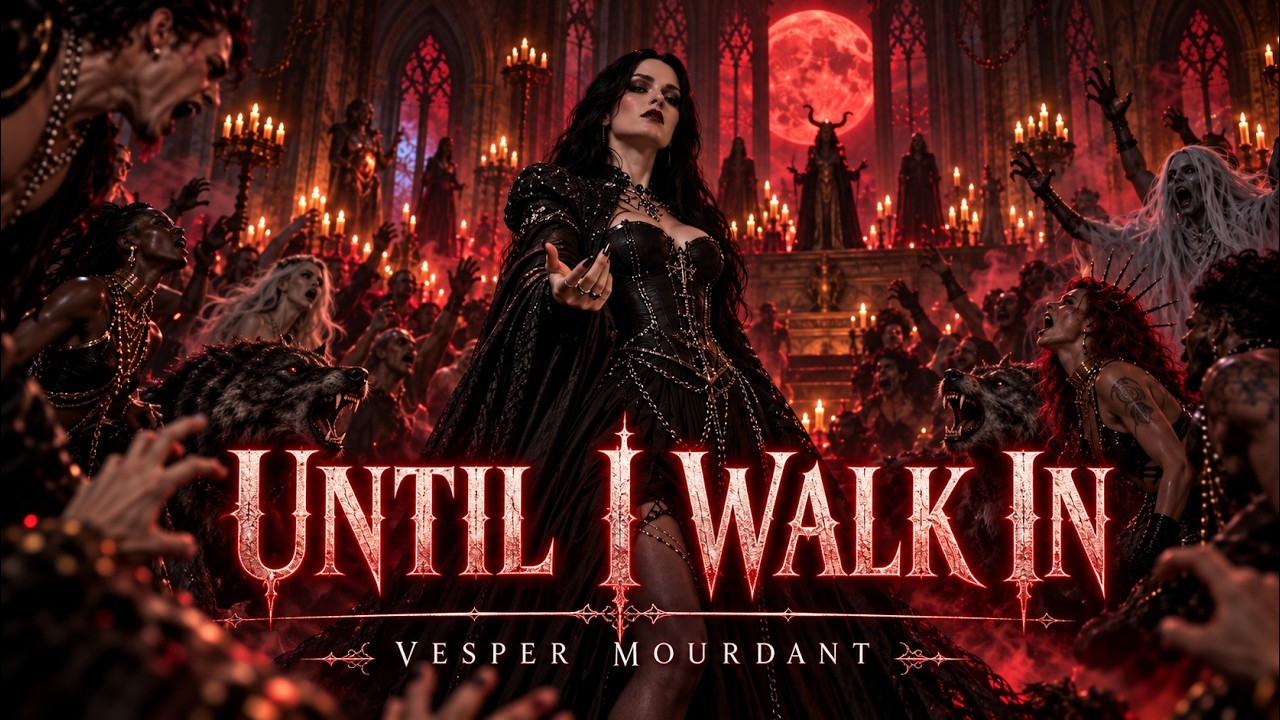
Vesper Mourdant turns a room full of monsters into an audience in a gothic Afro-house and hip-hop song about reputation, dark humour and commanding presence.
WRITING THE SONG
Everyone in the room has a reputation.
Then Vesper arrives.
Until I Walk In builds its gothic swagger around a simple reversal: the creatures accustomed to frightening everyone else suddenly have something to fear.
The recovered lyric draft states the premise immediately:
“Everybody’s a monster
until I walk in.”
Her entrance changes the room before she needs to explain herself.
The hook gives everyone else a moment of authority, then places a limit on it.
“Everybody’s a monster” establishes the setting. The second line overturns its hierarchy.
That makes the title useful as both a promise and a punchline. Each return can remind the listener that whatever confidence existed before Vesper arrived was temporary.
The song’s drama comes from anticipation: what happens when someone walks into a frightening place and feels entirely at home?
Another line from the development draft pushes the idea further:
“I make graves nervous
when I walk in.”
The image gives fear to something normally associated with its finality.
A grave should have nothing left to worry about. Making it nervous turns Vesper’s reputation into an absurdly powerful force.
That exaggeration supplies dark humour as well as menace. The listener is invited to enjoy the boast—to hear the confidence in a character whose arrival unsettles even the scenery.
The line needs little explanation because the impossible image does the work.
The draft also gives Vesper a compact claim to notoriety:
“Hell knows me.
Ask around.”
The casual phrasing is central to its effect.
She treats an infernal reputation as something other people could verify. There is no long account of how she earned it, and that missing history leaves room for the listener’s imagination.
“Ask around” makes the boast conversational. Vesper sounds comfortable enough with the supernatural world to regard its inhabitants as acquaintances who already know her name.
The character emerges through her manner of speaking.
A further sequence reduces the threat to clipped phrases:
“Wrong night.
Wrong room.
Wrong thing.”
Each phrase removes another possibility that the encounter will go well for whoever has challenged her.
Their brevity suits rhythmic delivery. They can land individually, with space between them for the implication to register.
The sequence also keeps the writing economical. Vesper does not need to describe a punishment in detail. Her certainty lets the listener imagine the consequences.
That restraint gives the swagger room to breathe.
The development direction explicitly retained Afro-house and hip-hop within an overall gothic atmosphere.
That combination matters to the concept.
The song needs a groove that makes an entrance feel physical: someone moving through a room with confidence, aware of the attention following them.
The musical brief proposed a pace around 112–116 BPM, deep log drums, hand percussion, dark sub-bass and sparse industrial synths. Bells and cathedral atmosphere were intended to extend the gothic setting.
These were arrangement intentions. They describe the musical framework developed for the song, rather than a measured account of every sound in the released recording.
The percussion supplies movement. The darker textures give that movement a setting.
The vocal brief emphasized low delivery and sharp rhythmic phrasing.
Those choices support a character who expects to be heard.
A line such as “Ask around” gains force when it sounds almost effortless. The listener can hear the implication that Vesper has nothing to prove through a lengthy explanation.
The short hooks also allow changes in emphasis without requiring more words. A pause, a stressed syllable or a quieter delivery can make the same claim feel amused, dismissive or threatening.
Her confidence is part of the storytelling.
The concept gives Vesper a theatrical space in which to enjoy her own reputation.
Its monsters, graves and infernal references create a world where exaggerated bravado belongs. The humour keeps that world lively, while the groove gives the listener a way to inhabit the character’s confidence.
The central pleasure is the reversal.
A room full of frightening figures becomes an audience watching the door.
Until I Walk In turns a gothic entrance into a statement of presence: everyone else may be a monster, but Vesper is the reason they look up.
SOURCES & REFERENCES
Source status applies to the referenced material, not to the original Rhialto song.
Based on the recovered lyric-development draft and musical brief. Quotations are identified as development material; tempo, instrumentation and delivery are described as creative intentions. No specific literary source is claimed.
This is an original Rhialto concept developed for Vesper Mourdant.
Source status: Reference Sources Only.