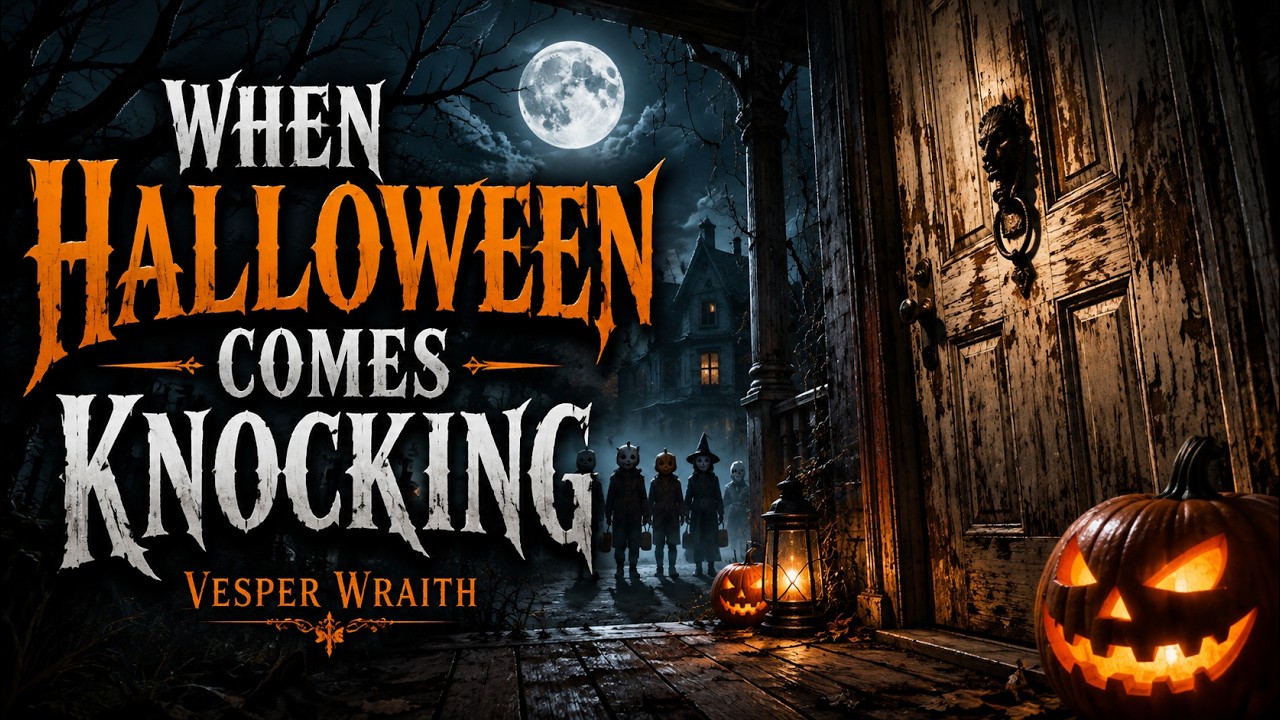
How an ordinary Halloween night became a Vesper Mourdant horror story where seven children cast eight shadows, the decorations stop behaving like decorations, and the final trick-or-treater is already inside the house.
WRITING THE SONG
When Halloween Comes Knocking started with a familiar Halloween image: someone knocking at the front door.
On October 31, a knock is supposed to be harmless.
Children.
Costumes.
Candy.
Someone saying: Trick or treat.
That familiarity made it useful for horror.
The central question became: What if the knock is not a trick-or-treater?
But I did not want the music to begin with something obviously supernatural standing on the porch.
The stronger version was to let Halloween look completely normal at first.
Pumpkins.
Masks.
Decorations.
Children walking through the neighbourhood.
Everything where it belongs.
Then introduce one detail that does not fit.
Seven children. Eight shadows.
That became one of the key images in the piece.
Nothing has attacked anyone.
There is no monster to point at.
But the arithmetic is wrong.
And once the listener notices that, every familiar Halloween image becomes less trustworthy.
The pumpkins are no longer simply decorations.
They seem to be watching.
Figures that should be props appear slightly different the next time you look at them.
Masks hide faces long enough that you start wondering whether there is still a person underneath.
Halloween depends on pretending that frightening things are real.
The song reverses that relationship.
What happens when the frightening things stop pretending?
That is the real premise underneath When Halloween Comes Knocking.
The decorations and traditions gradually begin crossing the boundary between performance and reality.
At first, nobody is certain.
A shape moves.
A shadow does not belong to anyone.
Something seems to follow the group.
You can still explain each event individually.
Then comes the knock.
That sound is important because it creates a boundary.
Outside.
Inside.
Safe.
Unsafe.
The door is the line between them.
And the obvious horror rule becomes: Do not open it.
That idea gives the song a very different kind of tension from a chase.
The danger is not moving quickly.
It is waiting.
Something on the other side knows you are there.
It does not have to break the door down.
It can simply knock again.
That turns the ordinary rhythm of trick-or-treating into something threatening.
A Halloween knock normally means: open the door.
Here, every instinct says the opposite.
The sound design was built to make that distance steadily collapse.
It begins outside.
Wind.
Distant movement.
Footsteps approaching.
Then the knock comes close.
Then something scratches against the glass.
Then there is breathing.
Eventually the sound no longer seems to be coming from outside at all.
That progression was essential.
If the threat simply smashed through the door, the story would become a conventional home-invasion sequence.
Instead, the horror comes from gradually realizing that the boundary may already have failed.
That leads to the ending.
After spending the song worrying about what might be waiting outside, the final voice comes from somewhere it should not.
Inside the house.
A child's voice whispers: Trick or treat.
That line is frightening precisely because it is the most ordinary Halloween phrase possible.
Nothing threatening needs to be added to it.
The location changes its meaning.
At the beginning of the evening, hearing those words outside your door is expected.
Hearing them from inside a supposedly empty room means something else entirely.
That reversal became the destination of the story.
The title therefore works in two ways.
At first, Halloween comes knocking means October 31 has arrived.
The costumes are out.
The pumpkins are lit.
The neighbourhood is celebrating.
By the end, Halloween comes knocking means something much more literal.
Halloween itself has arrived at the door.
And perhaps opening the door was never necessary.
The repeated chorus helps reinforce that transformation.
Each return can use essentially the same warning while the situation around it becomes worse.
The first repetition feels like spooky seasonal fun.
The next carries genuine uncertainty.
By the final return, the warning has become completely literal.
That is one reason I wanted the track to remain more intimate than some of Vesper Mourdant's larger gothic-metal pieces.
This is close-range horror.
You should hear footsteps.
A hand near the door.
Something against the window.
Breathing where breathing should not be.
The production therefore leans on atmosphere rather than spectacle:
a low organ drone,
sparse piano,
bowed strings,
wind,
knocking,
scratching glass,
and increasingly close horror effects.
There is no need for carnival music here.
The setting is not The Carnival After Midnight.
It is an ordinary house on an ordinary Halloween night.
That normality is what makes the piece work.
The listener already understands the ritual.
Decorate the house.
Light the pumpkins.
Wait for the children.
Hear the knock.
Open the door.
Give them candy.
Close the door.
Repeat.
When Halloween Comes Knocking asks what happens when that familiar ritual continues one step too far.
When the shadows stop matching the children.
When the decorations stop behaving like decorations.
When the thing outside stops needing permission to come in.
And when the final “Trick or treat” is whispered from somewhere behind you.
SOURCES & REFERENCES
Source status applies to the referenced material, not to the original Rhialto song.
Original Rhialto concept
When Halloween Comes Knocking is an original Rhialto / Vesper Mourdant Halloween-horror narrative.
The extra shadow, increasingly animate Halloween decorations, unseen presence at the door, progression from exterior sounds to a presence inside the house, and final reversal are original creative elements rather than an adaptation of a specific legend, story, film or historical event.
The piece uses familiar Halloween traditions — trick-or-treating, costumes, jack-o'-lanterns, decorated houses and children knocking on doors — as seasonal genre vocabulary.