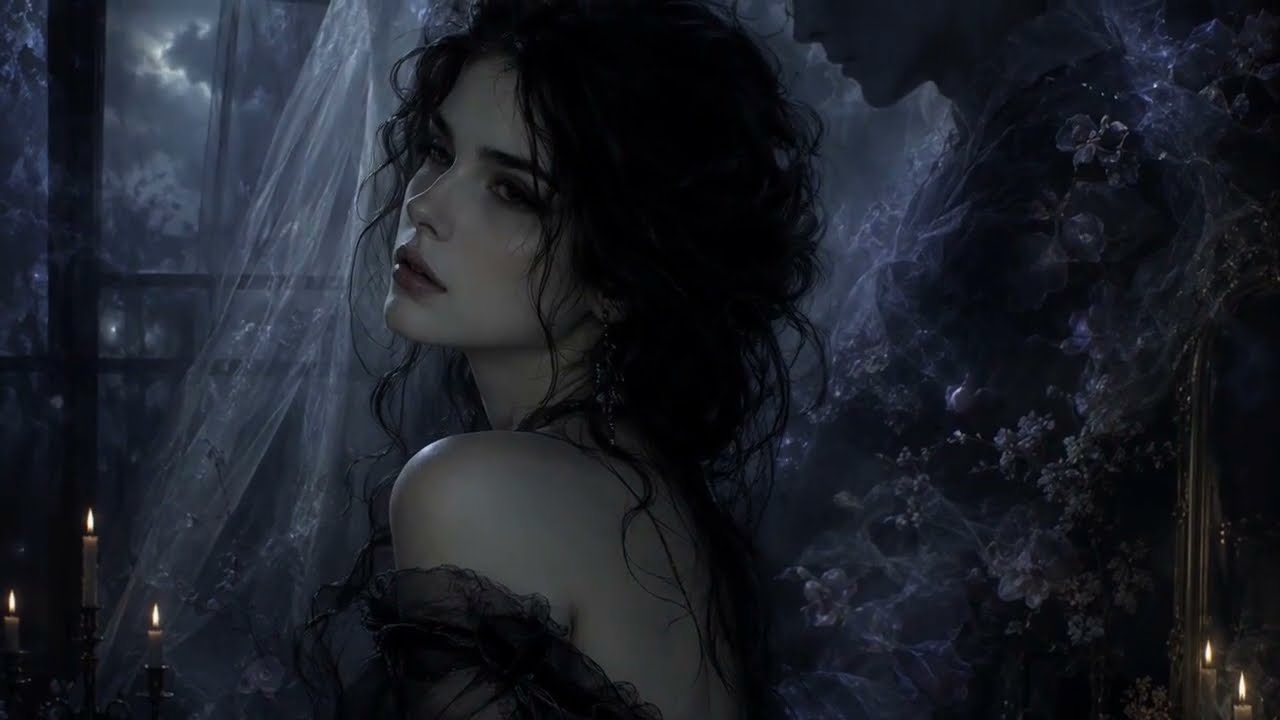
How Shakespeare’s Sonnet 43 became Vesper Mourdant’s urgent gothic darkwave dream where an absent lover feels more real with her eyes closed than in daylight.
WRITING THE SONG
Daylight is where Vesper loses them.
Night is where they come back.
There is a wet coat hanging in the hall.
A stopped watch beside the lamp.
A glass ring fading near the bed.
They are ordinary objects, but they feel slightly impossible—as though pieces of the dream have followed Vesper into the waking room.
She knows what morning will do.
The light will arrive.
The room will become ordinary again.
And the person she wants will disappear.
So Vesper makes a choice:
“I lose you in the light.
I find you when I close my eyes.”
When I Close My Eyes draws from William Shakespeare’s Sonnet 43.
The poem begins with a paradox: when the speaker closes his eyes, he sees better.
During the day, the physical world is visible but emotionally empty because the beloved is absent. In sleep, darkness becomes bright because dreams restore the person daylight cannot provide.
Shakespeare calls this strange dream vision “darkly bright.”
That contradiction is the doorway into Vesper Mourdant’s version.
The song keeps Shakespeare’s central idea—the absent beloved becoming vividly present during sleep—but pushes it somewhere darker.
Shakespeare’s speaker still longs to see the real person in daylight.
Vesper begins to wonder whether she wants daylight at all.
That change is crucial.
At first, sleep is consolation.
Vesper closes her eyes because dreams temporarily return someone she misses.
But repetition changes the relationship.
Night begins to feel less like an imitation of reality and more like the place where the relationship actually exists.
Daylight becomes the interruption.
Morning becomes the thing that takes the beloved away.
The song gradually moves from longing into preference.
Vesper is no longer simply waiting for sleep.
She is choosing it.
That transformation is captured in the closing idea:
“I choose the dark.
I choose you.”
The line turns Sonnet 43’s paradox into a decision.
Much of the song’s emotional world is built from small domestic images rather than grand supernatural ones.
“Your wet coat hangs in the hall.”
A coat should be evidence that someone has arrived.
But the person is absent.
The object becomes more convincing than reality.
Then there is the stopped watch.
“Stopped watch lying by the lamp.”
Time itself seems to have failed inside this room.
If the watch does not move, perhaps morning does not have to arrive.
Perhaps the dream can continue.
And near the bed:
“Your glass ring fading by the bed.”
The ring feels tangible enough to see but too fragile to trust.
Glass can catch light, distort it and disappear into it.
As morning approaches, the object becomes another boundary between what Vesper remembers, what she dreams and what may actually have been there.
The song never needs to explain these details literally.
Their uncertainty is the point.
The secondary hook reduces Vesper’s desire to almost ritual instructions:
“Keep the room dark.
Keep the door closed.”
The language is deliberately simple.
Darkness protects the dream.
The closed door protects the room from the waking world outside it.
Together they create the private conditions under which the absent beloved can continue to exist.
That also gives the song a subtle gothic tension.
Vesper is not trapped in the dark.
She is defending it.
The room is becoming a sanctuary built around absence.
Songs from Shakespeare’s Shadows places When I Close My Eyes at the beginning of Act II: The Price of Desire.
That position fits the song particularly well.
The desire itself is understandable.
Vesper wants someone who is not there.
The price emerges when she begins reorganizing reality around that absence.
She darkens the room.
She closes the door.
She values the dream over the morning.
The song asks a quiet question beneath the romance:
What happens when the version of someone inside your head becomes easier to love than the world without them?
There is no suggestion that Vesper does not understand the difference.
That would make the story simpler.
She understands it.
She chooses the dream anyway.
Musically, When I Close My Eyes avoids the obvious treatment.
A story about sleep, dreams and absence could easily become a slow piano ballad.
Instead, the production moves with an urgent nocturnal pulse.
The original direction was fast darkwave synth-pop: electronic drums, sub-bass, driving synth arpeggios, muted piano and fragmented electronic textures beneath a low female vocal.
That speed changes the emotional meaning.
Vesper is not peacefully drifting toward sleep.
She is rushing toward it.
The beat feels like someone trying to reach the night before the night can disappear.
That creates a useful contradiction between subject and sound.
The lyrics want the clock to stop.
The music refuses to stop moving.
The main hook contains the entire architecture of the song:
“I lose you in the light.
I find you when I close my eyes.”
Light would normally represent clarity.
Darkness would normally represent uncertainty.
Here those meanings reverse.
Daylight proves the beloved is gone.
Darkness restores them.
The more clearly Vesper sees reality, the less of what she wants remains.
Closing her eyes becomes its own kind of sight.
That reversal comes directly from the imaginative engine of Sonnet 43 while allowing the song to become something recognizably Vesper.
The visual language follows the same division between waking emptiness and nocturnal presence.
Daylight should feel exposed rather than comforting.
The room is recognizable, but something essential is missing from it.
Night changes the same space.
Objects carry more meaning.
Memory becomes physical.
An absent touch can feel recent.
A coat, a ring or a stopped watch can hold more emotional weight than an empty room supposedly telling the truth.
The gothic quality comes not from a monster entering the house but from uncertainty over which version of the room Vesper now considers real.
The stranger the dream becomes, the less interested she is in escaping it.
By the end, morning is no longer neutral.
It is an antagonist without being a villain.
Morning does exactly what morning is supposed to do.
It brings light.
It reveals the room.
It ends the dream.
That is precisely why Vesper resists it.
The final emotional movement is not toward acceptance.
It is toward deliberate surrender:
Room dark.
Door closed.
Then the choice:
“I choose the dark.
I choose you.”
Shakespeare’s speaker dreams because the beloved is absent.
Vesper goes one step further.
If daylight is the world where she cannot have the person she wants, she is prepared to stop treating daylight as the better world.
SOURCES & REFERENCES
Source status applies to the referenced material, not to the original Rhialto song.
William Shakespeare — Sonnet 43
The principal literary source for When I Close My Eyes is Shakespeare’s public-domain Sonnet 43, built around the paradox that the absent beloved becomes more vividly visible in dreams than in waking daylight.
Original Rhialto adaptation
Rhialto’s version turns that dream paradox into a darker choice: Vesper increasingly prefers the nocturnal dream-world to the waking room that proves the beloved is absent. The wet coat, stopped watch, glass ring, closed door and final decision to choose darkness are original Rhialto elements.
The public-domain designation applies to Shakespeare’s original poem—not to modern recordings, arrangements, performances or editorial commentary.
Reference editions